AI Predictive Analytics for Smarter Marketing Decisions

AI Predictive Analytics for Smarter Marketing Decisions

Artificial intelligence is transforming the way businesses understand and connect with their audiences. Instead of reacting to customer actions after they happen, companies can now predict future behavior and deliver more personalized experiences. 

A well-planned AI Marketing Strategy helps organizations analyze customer data, identify buying patterns, and create campaigns that reach the right audience at the right time. By combining predictive analytics with digital marketing, businesses can improve customer satisfaction, strengthen brand loyalty, and increase conversions.

As online competition continues to grow, using AI is becoming essential for building smarter marketing campaigns and making informed business decisions.

Understanding an AI Marketing Strategy

An AI Marketing Strategy is the process of using artificial intelligence to improve marketing efforts through automation, predictive analytics, and data-driven decision-making. AI can quickly process large amounts of information from websites, customer relationship management (CRM) systems, email campaigns, and social media platforms to uncover valuable insights.

Rather than relying on assumptions, marketers can use AI to understand customer behavior and identify trends that help guide future campaigns. Businesses that begin with a strong content marketing strategy create a foundation for AI to deliver even better results by providing useful, relevant content that addresses customer needs.

Predictive Analytics Helps Businesses Stay Ahead

One of the biggest advantages of AI is its predictive analytics capabilities. This technology examines historical and real-time data to forecast future customer actions. Instead of waiting for customers to make decisions, businesses can anticipate what they are likely to need next.

Predictive analytics can help organizations:

  • Identify customers who are likely to make another purchase.
  • Detect visitors who may leave a website without converting.
  • Recommend products based on previous buying habits.
  • Recognize seasonal trends before demand increases.
  • Improve audience targeting for future campaigns.

These insights enable businesses to make proactive marketing decisions rather than react after opportunities have passed.

Improving SEO with Artificial Intelligence

Search engine optimization is no longer just about adding keywords to a webpage. Modern SEO focuses on providing valuable content that satisfies user intent, and AI can help marketers better understand what their audiences are searching for.

Artificial intelligence can identify content gaps, analyze competitors, discover trending topics, and recommend new keyword opportunities. It also helps marketers organize content into topic clusters that improve website structure and user experience.

An effective SEO content strategy supported by AI enables businesses to create content that answers customer questions while improving visibility in search engine results.

Creating Personalized Customer Experiences

Consumers are more likely to engage with brands that provide relevant and personalized experiences. AI makes personalization possible by analyzing customer behavior across multiple channels.

Some of the information AI evaluates includes:

  • Purchase history
  • Website browsing activity
  • Search behavior
  • Geographic location
  • Device preferences
  • Customer interests
  • Previous interactions with the business

Using these insights, companies can recommend products, personalize website content, customize email campaigns, and display targeted advertisements that are more likely to generate results.

Personalized marketing not only improves engagement but also strengthens trust between businesses and their customers.

Smarter Marketing Automation

Marketing automation has become increasingly powerful with the addition of artificial intelligence. Instead of following fixed schedules, AI-powered automation responds to customer actions in real time.

Businesses can automate processes such as:

  • Welcome email sequences
  • Product recommendations
  • Abandoned cart reminders
  • Follow-up messages after purchases
  • Customer re-engagement campaigns
  • Educational email series

These automated workflows save time while ensuring customers receive relevant information throughout their buying journey. Marketing teams can then spend more time developing creative strategies while AI manages repetitive tasks behind the scenes.

Bringing SEO and Social Media Together

Successful digital marketing involves more than optimizing a website. Customers interact with businesses through search engines, social media platforms, online reviews, and other digital channels.

Artificial intelligence helps marketers understand how users move between these channels and which interactions influence purchasing decisions. These insights allow businesses to create more consistent messaging across their entire marketing strategy.

Companies looking to strengthen their online presence can learn more about the ways social media and SEO strategy work together. Combining AI with SEO and social media creates a more connected customer experience while improving visibility across multiple platforms.

Best Practices for Building an AI Marketing Strategy

Businesses should approach AI with a clear plan rather than adopting new technology without defined goals. A successful AI Marketing Strategy starts with quality data and measurable objectives.

Some best practices include:

  • Define clear marketing goals.
  • Collect accurate customer data.
  • Regularly monitor campaign performance.
  • Test and optimize marketing content.
  • Continue updating SEO content.
  • Combine AI insights with human creativity.

Artificial intelligence is most effective when it supports experienced marketers instead of replacing them. Human expertise remains essential for understanding customer emotions, developing creative campaigns, and building lasting relationships.

Looking Ahead

Artificial intelligence will continue to shape the future of digital marketing as technology advances. Businesses that invest in an AI Marketing Strategy today will be better prepared to adapt to changing customer expectations, evolving search algorithms, and new marketing opportunities.

By using predictive analytics to understand customer behavior, improving SEO through valuable content, and creating personalized experiences across multiple channels, organizations can build stronger relationships while increasing long-term business growth. Companies that embrace AI now will be well positioned to remain competitive and deliver exceptional customer experiences for years to come.

Openai context hints

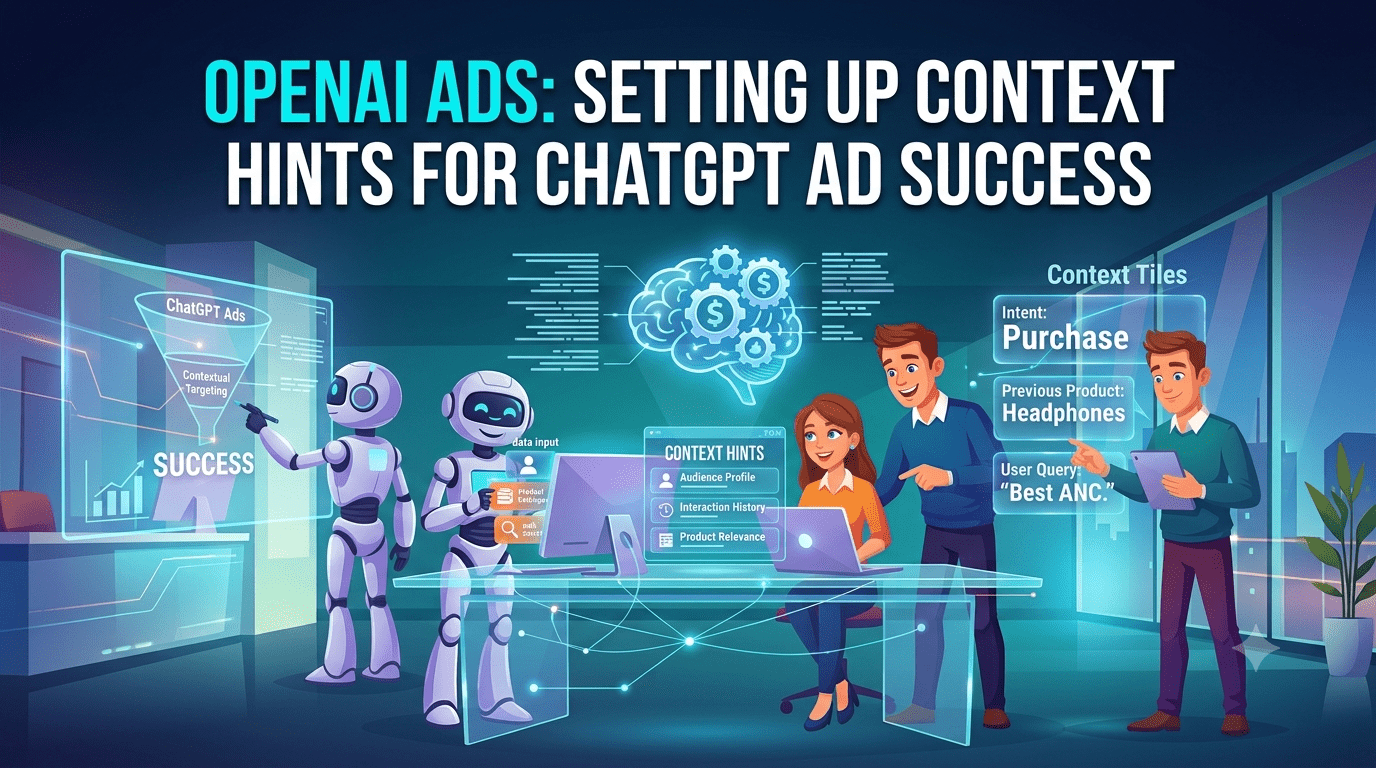
OpenAI Ads: Setting Up Context Hints for ChatGPT Ad Success

OpenAI Ads: Setting Up Context Hints for ChatGPT Ad Success

Are you a business owner grappling with underperforming marketing campaigns and struggling to connect with your target audience effectively? The rapidly evolving digital landscape demands innovative solutions, and understanding how to leverage new channels like ChatGPT for advertising can be a game-changer. This article will guide you through the intricacies of OpenAI Ads, focusing specifically on setting up context hints to drive unparalleled success in your ChatGPT advertising efforts. By mastering this new frontier, you can unlock significant growth and achieve your marketing objectives with greater precision.

Key Takeaways:

  • Context hints are crucial for guiding the AI in ChatGPT ads, ensuring your message aligns perfectly with the user’s conversational context and intent.
  • Effective implementation of context hints within the OpenAI Ads Manager allows advertisers to target audiences with unprecedented precision, leading to higher engagement and conversion rates.
  • Utilizing context hints can significantly improve the performance of your ChatGPT ad campaigns by reducing irrelevant impressions and increasing the likelihood of meaningful user interactions.
  • Partnering with an expert like The AD Leaf Marketing Firm can help businesses navigate the complexities of OpenAI Ads and implement sophisticated context hint strategies for optimal results and scalable growth.

What are Context Hints in ChatGPT Ads?

Context hints are a pivotal element within the OpenAI Ads system, designed to provide the AI with crucial information about an advertiser’s product or service. These hints help guide the conversational AI to surface relevant advertisements during user interactions within ChatGPT. Essentially, they function as explicit directives, ensuring that:

  • The ad copy aligns seamlessly with the ongoing chat.
  • Targeting aligns seamlessly with the ongoing chat.

Thereby enhancing the user experience and the efficacy of the ad.

Understanding Context Hints and Their Importance

Understanding context hints is fundamental for any marketer looking to advertise on ChatGPT. These hints allow the AI to grasp the nuanced conversational context of a user’s chat, enabling it to present the most appropriate and timely ad. Their importance cannot be overstated, as they directly impact the relevance of the ad impression, influencing click-through rates and overall conversion. Without well-crafted context hints, advertisers risk showing irrelevant ads, leading to wasted spend and a diminished user experience inside ChatGPT.

How Context Hints Work in OpenAI Ads

Context hints work by providing the OpenAI Ads system with descriptive phrases and keywords that characterize your product or service and the types of conversations where your ad should appear. When a user engages in a chat that aligns with these provided hints, the AI is more likely to trigger your ad. This mechanism moves beyond traditional keyword matching, leveraging the AI’s understanding of natural language to identify relevant opportunities for your ChatGPT ad to be shown, making the ads system highly intelligent.

Benefits of Utilizing Context Hints

The benefits of utilizing context hints for ChatGPT ad success are manifold. They significantly enhance ad relevance, leading to higher engagement and better performance metrics. By precisely guiding the AI, context hints minimize irrelevant impressions, ensuring your ad spend is directed towards users genuinely interested in your offering. This targeted approach offers several key advantages:

  • Higher engagement and better performance metrics like average CPC and average CPM.
  • Minimized irrelevant impressions, ensuring ad spend is directed towards genuinely interested users.
  • Boosted conversions.
  • Improved brand safety and overall brand perception within this new digital advertising channel.

How to Set Up Context Hints for Success in OpenAI Ads Manager

Setting up context hints effectively in the OpenAI Ads Manager is a strategic process that demands attention to detail. This involves navigating the Ads Manager Beta, creating specific ad groups, and meticulously crafting your context hints to describe the conversations where your ad should appear. A well-structured setup ensures that your ChatGPT advertising campaigns leverage the full potential of AI-driven targeting, maximizing your return on investment and achieving your marketing goals.

Step-by-Step Guide to Accessing Ads Manager Beta

To begin setting up context hints, you first need to access the OpenAI Ads Manager Beta. As this is a new channel, access may be granted through an invitation or specific registration process. Once you have access, familiarize yourself with the interface, as this is where you will manage all your OpenAI Ads campaigns. The platform is designed to be intuitive, guiding advertisers through the process of creating and optimizing their ad groups for ChatGPT advertising.

Creating Effective Ad Groups with Context Hints

Creating effective ad groups is paramount, and context hints are assigned at the ad group level. Within each ad group, you will specify the product or service you are promoting and then write context hints that precisely describe the conversations your target audience might have. Think about user intent and the types of queries that would lead to a natural integration of your ad inside ChatGPT. This granular approach allows for highly targeted campaigns.

Best Practices for Implementing Context Hints

When implementing context hints, several best practices can significantly boost your ChatGPT ad performance. These include:

  • Focusing on specificity and providing detailed, yet concise, descriptions.
  • Utilizing a mix of broad and exact-match keywords within your hints to capture a wider range of relevant conversational contexts.
  • Regularly reviewing your ad group analytics and adjusting your context hints based on performance data to continuously optimize your campaigns for better conversion and lower average CPC.

How to Optimize Your ChatGPT Ads with Keywords

Optimizing your ChatGPT ads with keywords is a critical step in ensuring your campaigns reach the right audience at the right time. While context hints provide a broader understanding of the conversational context, specific keywords within your ad copy and landing page help the AI further refine targeting and improve relevance. This dual approach maximizes the chances of your ad appearing in highly pertinent conversations, driving better engagement and conversion rates for your product or service.

Selecting the Right Keywords for Your Ads

Selecting the right keywords for your ChatGPT ads involves a comprehensive understanding of your target audience’s search intent and conversational patterns. Research relevant terms that people might use when discussing topics related to your product or service within a chat. Consider both broad and exact-match keywords to capture a wide range of relevant impressions. The goal is to identify keywords that not only describe your offering but also align with the natural language used in conversations inside ChatGPT.

Incorporating Keywords into Context Hints

Incorporating keywords directly into your context hints strengthens their effectiveness in guiding the AI. While context hints describe the conversations, integrating specific keywords ensures that the AI understands precisely what your ad is about. For example, if you’re advertising a “digital marketing course,” your context hints might include phrases like “learning digital marketing,” “online marketing education,” or “improving SEO skills,” all containing relevant keywords. This granular approach helps the OpenAI Ads system deliver more accurate and relevant ads.

Measuring the Success of Your Keyword Strategy

Measuring the success of your keyword strategy is essential for continuous optimization. Monitor key performance indicators (KPIs) such as average CPC, average CPM, click-through rates, and conversion rates within the OpenAI Ads Manager. Analyze which keywords are driving the most relevant traffic from ChatGPT ads and contributing to conversions. Use these insights to refine your keyword lists, remove underperforming terms, and allocate budget more effectively to achieve your advertising goals.

What to Consider for Brand Safety in ChatGPT Advertising?

Brand safety in ChatGPT advertising is a paramount concern for any advertiser looking to protect their brand’s reputation and ensure their ads appear in appropriate conversational contexts. Given the AI-driven nature of ChatGPT, understanding and implementing robust safety measures is crucial to prevent your ads from being associated with undesirable or irrelevant content. Proactive strategies are necessary to maintain a positive brand image and ensure your ad campaigns align with your brand values inside ChatGPT.

Understanding Brand Safety in the Context of OpenAI Ads

Understanding brand safety in the context of OpenAI Ads means recognizing the unique challenges and opportunities presented by AI-powered conversational platforms. Unlike traditional display ads or search ads, where content placement can be more rigidly controlled, ads in ChatGPT are dynamically generated based on the conversational context. This requires a nuanced approach to ensure your product or service is not associated with sensitive, inappropriate, or off-topic discussions, which could harm your brand’s reputation and dilute your message.

Implementing Safety Measures in Your Advertising Strategy

Implementing effective safety measures in your advertising strategy for ChatGPT ads involves careful keyword exclusion lists and finely tuned context hints. Work closely with the OpenAI Ads Manager to define what constitutes an “unsafe” conversation for your brand. Utilize negative keywords to prevent your ads from appearing in chats discussing specific topics. Additionally, ensure your context hints are precise enough to guide the AI towards brand-safe conversations, aligning with your desired brand image and avoiding unintended impressions.

Monitoring Brand Safety: Tools and Techniques

Monitoring brand safety in your ChatGPT advertising campaigns requires a combination of vigilance and the right tools. Regularly review ad placements and performance data within the OpenAI Ads Manager to identify any instances where your ads appeared in undesirable conversational contexts. While specific tools for OpenAI Ads are still evolving, leveraging existing analytics tools and potentially third-party brand safety platforms can help track and flag problematic impressions. This continuous monitoring allows for prompt adjustments to your ad groups and context hints, safeguarding your brand’s integrity.

How to Set Up Tracking for Your OpenAI Ads

Setting up robust tracking for your OpenAI Ads is fundamental to understanding the performance of your ChatGPT advertising campaigns and making data-driven decisions. Without proper tracking, it’s impossible to accurately measure return on investment, optimize your ad spend, or understand how users interact with your ads after an impression or click. Effective tracking provides the insights necessary to refine your strategies, improve conversion rates, and ultimately achieve greater success with your product or service promotion.

Why Tracking is Essential for Ad Success

Tracking is essential for ad success because it provides tangible data on how your ChatGPT ads are performing. It allows marketers to see which context hints are most effective, which ad copy resonates best, and critically, how many users are converting on your landing page. Understanding traffic from ChatGPT ads, from the initial impression to the final conversion, helps you identify successful strategies and areas for improvement, ensuring your budget is spent efficiently on this new channel.

Setting Up Tracking Mechanisms in Ads Manager

Setting up tracking mechanisms in the OpenAI Ads Manager typically involves implementing conversion measurement and utilizing UTM parameters. For conversion tracking, you’ll need to configure events that signify valuable actions on your landing page, such as a purchase or lead form submission. Additionally, attach UTM parameters to your landing page URLs for each ad group. These parameters allow you to track the source of traffic more accurately within your existing analytics tools, distinguishing traffic from ChatGPT ads from other digital advertising channels.

Interpreting Tracking Data for Better Performance

Interpreting tracking data effectively is key to improving your ChatGPT ad performance. Analyze metrics like average CPC, CPM, click-through rate, and conversion rate for each ad group and context hint. Look for patterns: which types of conversations lead to the highest conversions? Are there specific ad copies that drive more clicks? Use this data to refine your context hints, adjust your ad copy, and optimize your budget allocation. This iterative process of analysis and adjustment will continuously enhance the effectiveness of your ads in ChatGPT.

Key Takeaways

Summary of Effective Context Hint Strategies

Effective context hints are the cornerstone of successful ChatGPT advertising, acting as critical signals that guide the AI in presenting your product or service to the most relevant users. By meticulously crafting these hints within the OpenAI Ads Manager, advertisers can ensure their ads in ChatGPT align perfectly with the user’s conversational context, significantly boosting engagement and conversion rates. It’s about leveraging AI’s understanding of natural language to create a seamless and pertinent ad experience.

Importance of Keywords in ChatGPT Ads

Keywords play a pivotal role in refining the precision of your ChatGPT ad campaigns. While context hints define the broader conversational landscape, strategic keyword integration within your ad copy and context hints themselves further hones targeting. This synergy ensures that your ad reaches users with explicit intent, improving metrics like average CPC and driving higher quality traffic from ChatGPT ads to your landing page, ultimately leading to better conversions.

Brand Safety Best Practices

Brand safety is non-negotiable in the dynamic environment of ChatGPT advertising. Implementing best practices involves careful selection of negative keywords and precise context hints to prevent your ads from appearing in inappropriate or sensitive conversational contexts. Proactive monitoring within the OpenAI Ads Manager, coupled with a vigilant approach to ad group performance, helps safeguard your brand’s reputation and ensures your ads consistently reflect your desired brand image inside ChatGPT.

Tracking for Continuous Improvement

Robust tracking mechanisms are essential for the ongoing optimization of your OpenAI Ads. By utilizing conversion measurement and UTM parameters, marketers can gain invaluable insights into the performance of their ChatGPT ads, from initial impression to final conversion. Analyzing data such as average CPM, click-through rates, and conversions allows for continuous refinement of ad groups, context hints, and ad copy, driving sustained improvement and maximizing ROI on this new channel of digital advertising.

Frequently Asked Questions | The AD Leaf Marketing Firm

How do I start advertising on ChatGPT?

To start advertising on ChatGPT, you typically begin by gaining access to the OpenAI Ads Manager Beta. Once access is secured, you’ll create ad groups, define your target audience, and most importantly, set up precise context hints that describe the conversations where your product or service should appear. This process guides the AI, ensuring your ChatGPT ad campaigns are relevant and effective, ultimately driving valuable traffic to your landing page.

What are the benefits of using OpenAI Ads Manager Beta?

The OpenAI Ads Manager Beta offers numerous benefits for advertisers, primarily its ability to leverage advanced AI for highly contextual and relevant ad placement within ChatGPT. It allows for granular control over ad groups and context hints, leading to improved ad performance, higher click-through rates, and better conversion potential. This new channel provides a unique opportunity to engage users directly within their conversational context, making your advertising efforts more impactful.

Can I use context hints for different ad formats?

Yes, context hints are a foundational element designed to guide the AI across various potential ad formats that may be introduced within ChatGPT. Regardless of the specific ad format, the core principle remains the same: providing the AI with clear information to describe the conversations where your ad is most relevant. This ensures consistent brand safety and ad effectiveness, no matter how the ad is presented inside ChatGPT to the user.

What should I do if my ads are not performing well?

If your ads are not performing well, the first step is to review your context hints and ad copy within the OpenAI Ads Manager. Analyze your analytics to identify underperforming ad groups or hints. Consider refining your keywords, adjusting your target audience settings, or enhancing your landing page experience. Continuously testing and iterating based on data, focusing on average CPC and conversion rates, is crucial for optimizing your ChatGPT advertising efforts.

How do I ensure my ads are compliant with brand safety guidelines?

Ensuring brand safety for your ChatGPT ads involves implementing negative keywords and carefully crafting your context hints to avoid inappropriate conversational contexts. Regularly monitor your ad placements and performance data in the OpenAI Ads Manager to proactively identify and address any issues. Adhering to the platform’s guidelines and continuously refining your targeting helps prevent your product or service from being associated with undesirable content, maintaining your brand’s integrity.

What support does The AD Leaf Marketing Firm provide for OpenAI Ads?

The AD Leaf Marketing Firm specializes in assisting businesses with navigating and optimizing complex digital advertising platforms, including OpenAI Ads. We provide expert guidance on setting up effective context hints, crafting compelling ad copy, selecting precise keywords, and implementing robust tracking mechanisms. Our team ensures your ChatGPT ad campaigns maximize ROI, achieve superior conversion rates, and maintain brand safety, positioning your product or service for unparalleled success in this innovative new channel.

Best AI Agents Development Companies for Customer Service, ai customer service agent development agency

Best AI Agents Development Companies for Customer Service

Best AI Agents Development Companies for Customer Service

Are you a business owner grappling with escalating customer service demands, a stretched support team, and the persistent challenge of maintaining high customer satisfaction? In today’s fast-paced digital landscape, traditional customer support models often struggle to keep up, leading to missed opportunities and a potentially declining customer experience. This article delves into how AI agents can revolutionize your customer service operations, offering scalable and efficient solutions that free up your human agents to focus on more complex tasks and ultimately drive better business outcomes. Discover how working with the right AI agent development comapny for customer service can transform your customer interactions and position your company for success in an increasingly AI-driven market.

Key Takeaways

  1. Prioritize clear business goals and measurable outcomes.Top AI customer service agent development companies focus first on defining use cases, KPIs (CSAT, FRT, containment rate, cost per contact) and data requirements. Before shortlisting vendors, map the customer journeys you want to automate, estimate expected savings and experience improvements, and ensure the provider can align technical choices (NLP models, orchestration, analytics) to those outcomes.
  2. Evaluate technical capabilities and integration readiness.Best vendors combine advanced conversational AI (robust intent recognition, entity extraction, contextual memory) with flexible integration layers for CRMs, ticketing systems, telephony and analytics. Vet vendors on model customization, multilingual support, data privacy practices, latency and uptime SLAs, ability to deploy on-prem/cloud/hybrid, and whether they provide ongoing model retraining and monitoring tooling.
  3. Look for strong human+AI orchestration and governance.Leading companies design hybrid workflows that let AI handle routine queries while routing complex or sensitive issues to human agents seamlessly. Assess fallback strategies, escalation rules, explainability features, audit logs, and compliance controls. Also confirm vendor training programs, change management support, and phased rollout plans to minimize disruption and sustain adoption.
  4. Compare value beyond technology — support, ROI transparency and partnership fit matter.Choose vendors that provide clear implementation roadmaps, measurable pilot programs, transparent pricing, and post-launch optimization services. References, case studies in your industry, and a collaborative approach to continuous improvement are often the difference between pilots that stall and deployments that scale.

For help with vendor selection, messaging, and go-to-market support around AI customer service agents, consider The AD Leaf as a marketing partner. They can assist with vendor shortlists, positioning, content and campaign execution to accelerate adoption and maximize return on your AI customer service investments.

What is an AI Agent for Customer Service?

Definition and Functionality

An AI agent for customer service is a sophisticated software application designed to interact with customers, understand their queries, and provide relevant solutions, often mimicking human conversation. Utilizing advanced conversational AI, these agents can process natural language, interpret intent, and access vast knowledge bases to address a wide range of customer requests. They function as a crucial first line of defense in customer support, capable of handling routine inquiries, guiding customers through processes, and even resolving common issues without the need for a human agent. The core functionality of an AI agent is to automate customer interactions, ensuring consistent and immediate responses around the clock.

How AI Agents Enhance Customer Support

AI agents significantly enhance customer support by providing instant, 24/7 assistance, which dramatically improves the customer experience. By automating responses to frequently asked questions and handling repetitive tasks, an AI agent allows human agents to focus on more complex, high-value customer interactions that require empathy and nuanced problem-solving. This shift not only boosts the efficiency of the support team but also elevates overall customer satisfaction by reducing wait times and offering immediate resolutions. The implementation of a robust AI agent platform leads to a more streamlined and effective support operation, directly contributing to positive customer relationships.

Key Features of Effective AI Agents

Effective AI agents possess several key features that enable them to deliver superior customer service. They must also have seamless integration with existing customer service platforms, such as Zendesk, to access customer history and relevant information. Furthermore, the best AI agents for customer service offer continuous learning, meaning they improve over time with more data and interactions. Enterprise-grade AI agents also provide scalability, allowing businesses to handle a growing volume of customer requests without a proportional increase in human resources, ensuring consistent and high-quality support at all times.

Feature Description
Robust Conversational AI Allows for natural and intuitive interactions that mirror human conversation.
Continuous Learning Improves over time with more data and interactions.

Top AI Agent Development Companies for AI Customer Service Agents

Overview of Leading Providers

When seeking to implement the best AI agents for customer service, businesses often look to leading development companies that offer robust conversational AI platforms. These top-tier providers specialize in creating sophisticated AI agent solutions capable of transforming customer interactions and enhancing the overall customer experience. They deploy AI agents designed to automate customer requests, providing immediate and accurate responses, thereby significantly boosting customer satisfaction. Understanding the landscape of these leading providers is crucial for any business aiming to leverage enterprise AI for superior customer support.

The AD Leaf Marketing Firm

The AD Leaf Marketing Firm is a premier partner for developing and deploying AI agents at scale, offering tailored solutions that integrate seamlessly with your existing customer service platform. Our expertise in conversational AI ensures a highly natural and effective customer experience. We focus on creating enterprise-grade AI agents that empower your human agent team by automating routine tasks, allowing them to focus on complex customer support issues and ultimately drive higher customer satisfaction. Partner with us to revolutionize your customer service operations.

Feature Benefit
Tailored AI agent solutions Seamless integration with existing customer service platforms
Conversational AI expertise Highly natural and effective customer experience
Enterprise-grade AI agents Automates routine tasks, empowering human agents to focus on complex issues and driving higher customer satisfaction

Zendesk AI: A Case Study

Zendesk AI offers a compelling case study in how a powerful AI agent platform can transform customer support. By integrating advanced AI tools directly into their widely used customer service platform, Zendesk AI agents enhance the capabilities of support teams, enabling them to automate customer interactions with remarkable efficiency. This allows the human agent to focus on more complex tasks, while the AI agent handles routine inquiries, improving response times and overall customer satisfaction. The seamless functionality of Zendesk AI demonstrates the benefits of a well-integrated AI customer service solution.

Fin.ai

Fin.ai is another prominent player in the AI agent development space, specializing in creating intelligent AI agent solutions for the financial sector. Their AI agents are meticulously designed to handle intricate customer requests with precision and security, ensuring a superior customer experience. By leveraging sophisticated conversational AI, Fin.ai helps businesses deploy AI agents that can automate customer interactions while maintaining regulatory compliance. This focus on specialized, enterprise-grade AI ensures that their AI customer service solutions deliver exceptional value and efficiency for financial institutions looking to enhance their customer support.

Agentic AI: Innovations in Customer Service

Agentic AI represents a cutting-edge approach to customer service, focusing on autonomous AI agents that can proactively resolve issues and anticipate customer needs. These innovative AI agent solutions go beyond reactive responses, using advanced AI capabilities to learn from customer interactions and provide highly personalized support. By implementing agentic AI, businesses can elevate their customer experience, reduce the workload on their human agent support team, and achieve unprecedented levels of customer satisfaction. This forward-thinking approach is set to redefine the future of customer support.

How to Choose the Best AI Agent Company for Customer Support | The AD Leaf Marketing Firm

Evaluating AI Agent Platforms

When selecting an AI agent platform for customer support, it is critical to thoroughly evaluate its capabilities and alignment with your business needs. Focus on platforms that offer robust conversational AI, ensuring natural and effective customer interactions. Assess how easily the AI agent can integrate with your existing customer service platform, such as Zendesk, to provide a seamless customer experience. A comprehensive evaluation should also consider the platform’s ability to automate customer requests, providing immediate and accurate responses, which significantly enhances the overall support operation and customer satisfaction.

Comparing Customer Service AI Solutions

Comparing various customer service AI solutions involves a deep dive into their feature sets, scalability, and performance metrics. Look for solutions that specialize in enterprise-grade AI, designed to handle large volumes of customer interactions efficiently. Consider platforms that offer advanced AI tools, including sophisticated natural language processing and machine learning capabilities, to ensure the AI agent can effectively understand and resolve complex queries. The goal is to find an AI customer service agent that not only automates responses but also learns and improves over time, continually enhancing the customer experience.

Factors to Consider in Development Companies

Choosing the right development company for your AI agent solution is paramount for long-term success. Key factors include their expertise in conversational AI and their track record of deploying AI agents at scale for various businesses. Ensure the company understands your specific customer support challenges and can tailor an AI agent for customer service that integrates seamlessly with your existing infrastructure.

Key Consideration Example/Benefit
Integration with existing infrastructure Platforms like Zendesk
Specialized AI solutions The AD Leaf Marketing Firm crafts bespoke AI solutions that deliver measurable results, improving customer interactions and satisfaction.

Benefits of Using AI in Customer Service

Cost Efficiency and Scalability

One of the primary benefits of using AI in customer service is the significant cost efficiency and scalability it offers. By deploying AI agents, businesses can automate customer interactions, reducing the need for an ever-expanding human agent team for routine inquiries. This automation allows companies to handle a much higher volume of customer requests without a proportional increase in operational costs. Furthermore, an AI agent platform can easily scale AI agents up or down based on demand, ensuring consistent support operation during peak times and fostering greater customer satisfaction.

Improved Response Times and Customer Satisfaction

AI agents dramatically improve response times, which is a critical factor in enhancing customer satisfaction. With an AI customer service agent available 24/7, customers receive immediate answers to their queries, eliminating frustrating wait times. This instant gratification significantly boosts the customer experience, making interactions more efficient and positive. The ability of the AI agent for customer support to quickly resolve common issues also frees up human agents to focus on more complex cases, leading to a more streamlined and effective support team and overall improved customer satisfaction.

Data Insights and Personalization

Utilizing AI in customer service provides invaluable data insights and opportunities for personalization that were previously unattainable. An AI agent can analyze vast amounts of customer interactions, identifying trends, pain points, and preferences. This data allows businesses to better understand their customer base and proactively address issues. Furthermore, enterprise AI enables personalized customer interactions, tailoring responses and recommendations based on individual customer history and behavior, leading to a more relevant and engaging customer experience and fostering deeper customer satisfaction.

Customer Service: The Role of AI Agents

Predicted Trends and Innovations

The role of AI agents in customer service is continuously evolving, with predicted trends pointing towards even more sophisticated conversational AI and personalized customer interactions. We anticipate further advancements in natural language understanding, allowing AI agents to comprehend nuanced human emotions and context more effectively. The integration of generative AI will enable AI agents to create more dynamic and tailored responses, further enhancing the customer experience. These innovations will allow businesses to deploy AI agents that are more intuitive, efficient, and capable of addressing a broader range of customer requests, setting new benchmarks for customer satisfaction.

Preparing Your Business for the Future

To prepare your business for the future of customer service, embracing AI agent technology is not just an option, but a necessity. Begin by evaluating your current customer support operation and identifying areas where an AI agent for customer service can automate routine customer requests. Invest in scalable AI agent platforms that can grow with your business and seamlessly integrate with existing systems like Zendesk. Training your human agent support team to collaborate effectively with AI agents will be crucial, ensuring a hybrid approach that maximizes efficiency and improves customer satisfaction. The AD Leaf Marketing Firm can guide you through this transformative journey.

How to Stay Competitive with AI Tools

Staying competitive in today’s market demands a strategic adoption of AI tools, particularly within customer service operations. Businesses must leverage conversational AI to automate customer interactions, reduce response times, and provide 24/7 support. Implementing a robust AI agent for customer service not only frees up your human agent support team to focus on complex issues but also gathers invaluable data insights to personalize the customer experience. By continuously updating your AI capabilities and partnering with experts like The AD Leaf Marketing Firm, you can deploy AI agents that keep your business at the forefront of customer satisfaction.

Frequently Asked Questions (FAQs) About AI Agents for Customer Service | The AD Leaf Marketing Firm

What are the Best Customer Service AI Platforms?

Identifying the best customer service AI platforms depends heavily on a business’s specific needs, but leading solutions often excel in conversational AI and seamless integration. Platforms like Zendesk AI offer comprehensive features that allow businesses to automate customer interactions effectively, providing an exceptional customer experience. The best AI agent platforms are those that provide robust AI tools for an AI agent for customer service to handle a wide range of customer requests, thereby enhancing the overall support operation and boosting customer satisfaction. Enterprise-grade AI capabilities are also crucial for managing large volumes of inquiries.

How Do AI Agents Improve Customer Experience?

AI agents significantly improve customer experience by offering immediate, 24/7 support, which drastically reduces wait times and provides instant resolutions to customer requests. An AI agent for customer service can personalize interactions by accessing customer history and preferences, making each engagement more relevant and efficient. This not only leads to higher customer satisfaction but also frees up human agent support teams to focus on complex issues, ultimately creating a more streamlined and responsive customer service operation. The consistent and accurate responses from an AI agent ensure a reliable and positive customer journey.

What Should Businesses Look for in AI Tools?

When businesses look for AI tools for customer service, several critical features should be prioritized to ensure optimal performance. Key considerations include the strength of the conversational AI for natural customer interactions, the ability to seamlessly integrate with existing customer service platforms like Zendesk, and robust AI capabilities that allow the AI agent to learn and adapt. Furthermore, businesses should seek AI agent platforms that offer scalability, enterprise-grade AI for handling high volumes, and comprehensive analytics to gain insights into customer interactions, all contributing to improved customer satisfaction and an efficient support team.

Can AI Agents Fully Replace Human Customer Service?

While AI agents are incredibly powerful and can automate customer interactions for a significant portion of customer requests, they cannot fully replace human customer service. AI agents excel at handling routine inquiries, providing quick answers, and offering 24/7 support, greatly enhancing the customer experience. However, complex, emotionally charged, or highly nuanced issues still require the empathy, critical thinking, and problem-solving skills of a human agent. The most effective approach is a hybrid model where an AI agent works in conjunction with a human agent support team, ensuring comprehensive coverage and optimal customer satisfaction.

How are AI Agents Integrated into Existing Systems?

Integrating AI agents into existing systems is a crucial step for businesses looking to enhance their customer support operations. Typically, an AI agent for customer service is integrated through APIs and pre-built connectors that link it to various customer service platforms, CRM systems, and knowledge bases. For instance, an AI agent can be seamlessly connected with Zendesk to access customer data and communication history, enabling a more personalized customer experience. This allows the AI agent platform to automate customer requests while ensuring a smooth handover to a human agent when necessary, optimizing the support operation and boosting customer satisfaction.

What is the Future of Customer Support in 2026?

The future of customer support in 2026 is poised for significant transformation, with AI agents playing an even more central role. We anticipate advanced conversational AI that provides highly intuitive and personalized customer interactions, far beyond current capabilities. The integration of generative AI will enable AI agents to offer proactive and predictive support, anticipating customer needs before they arise. This evolution will lead to a hybrid support model where AI agents and human agents collaborate seamlessly, ensuring unparalleled customer satisfaction and efficiency in every customer service operation. The AD Leaf Marketing Firm is at the forefront of these innovations.

Voice Search And AI Optimization For Local Business

Think about how many times a day you find yourself reaching for your phone to look up something. Whether it be directions, restaurant recommendations, or fact-checking something you saw on Instagram, you probably use your phone for search more than you realize. As of 2026, over half of all internet traffic comes from mobile devices, according to Consumer Affairs. 

This is great news for businesses because they can connect with consumers wherever they go and whatever they are doing. No longer do you need a place with wifi to sit down with your computer if you want to look something up online. Features like data and voice search make it easy for users to search while on the go. 

Half of mobile users in the U.S. use voice search daily, and much of this traffic comes from AI assistants like Siri. 

Optimizing for voice search is becoming increasingly important for getting your business in front of users, especially as search becomes increasingly reliant on AI.


Voice Search SEO Can Connect Local Businesses With High-Intent Consumers

Imagine two users searching for restaurants in their area: one is searching on their laptop at home, and the other is using voice search while driving around town. Which one do you think is likely to commit to going to a restaurant first? Probably the one on the road.

Users often use voice search when they want an immediate, highly relevant answer. These users are high-intent and ready to convert, making them an incredibly valuable group to target.

The same factors that make these users ready to convert are also why a strong voice search SEO strategy is so important. Busy, multitasking users are likely to choose the first relevant answer they receive from their AI assistant. If you are not among the first few suggestions, you are not being considered.

But if you can get in those first few suggestions, you can unlock an audience of consumers ready to convert. 


Voice Search is Changing eCommerce

Voice search is impacting more than businesses with physical stores or local service providers; it is also changing how consumers shop online. 

In 2024, 22% of consumers were using voice search to make direct purchases through their AI assistants. That number has likely increased as AI has increasingly embedded itself in the consumer decision-making process. 

Consumers are using AI assistants to guide their purchasing decisions, largely interacting with them via voice search. Appearing in these search results will become increasingly critical for e-commerce businesses to connect with and attract consumers.


How to Optimize for Voice Search and AI Assistants

In many ways, the old rules of SEO still apply, especially as AI often scrapes top search results for information. Authority, relevance, and trustworthiness are important for appearing in both traditional search results and voice search results. 

For example, if someone does a voice search for a particular service and your business has an average rating of 3 stars out of 5, there is a good chance it will not appear on the first page. 

The main difference between traditional search and voice search lies in how users phrase their queries. Voice search queries tend to be more conversational and more clearly phrased as questions. This aligns with the trend we are seeing in AI searches, where queries are longer, more specific, and more natural-sounding than traditional searches. 

Adapting your SEO strategy for these longer, more conversational queries is critical for keeping up with changing search behavior. 

Working with a marketing company like the Ad Leaf that specializes in AI-friendly SEO strategies can help bring your website out of 2015 and into this new era of AI search. 


It Can Help With A Local Business Website Structure & Content Marketing

When a business has a website and is looking to build a content marketing strategy for voice search SEO, it should imagine being in the customer’s position. What questions might they ask?

When marketing, it is important to consider the consumer journey. At which point in the journey does the consumer see your marketing, and how can we move them further along that journey?

You want your content to guide the consumer toward a purchase decision. If they are using voice search SEO, you need to be the business that can answer all their questions and objections about why they need your products and services.

High-quality, relevant content optimized for voice search can help you, as a local business, be found on the first page of Google.


Appear in Voice Searches With The AD Leaf

The AD Leaf’s SEO and Content Marketing teams stay on top of evolving SEO trends and user search behavior, so that even in a shifting search landscape, your website reaches consumers.


Start ranking in voice searches with The AD Leaf

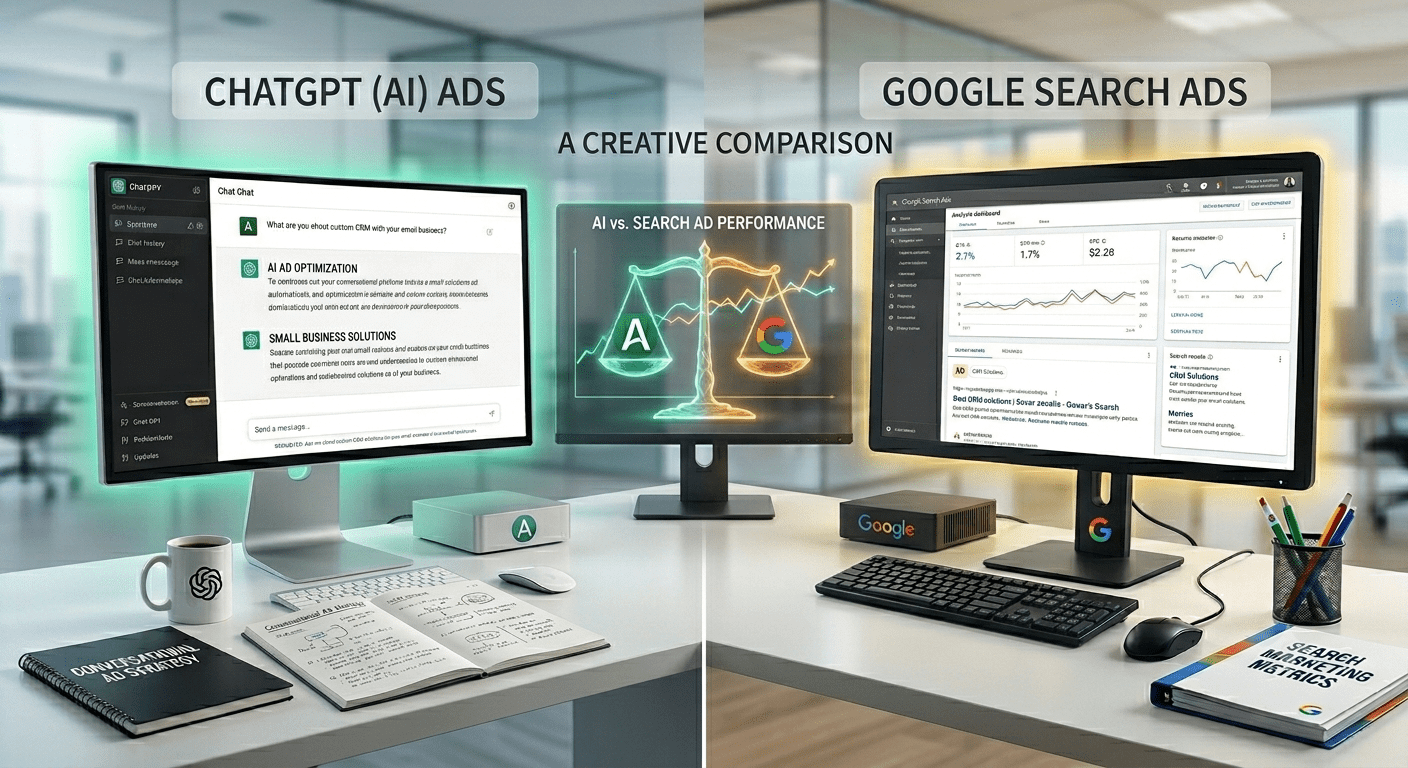
ChatGPT Ads vs. Google Search Ads

ChatGPT Ads vs. Google Search Ads: Key Differences and Which Is Right For Your Business

In the rapidly evolving landscape of digital advertising, businesses often find themselves at a crossroads when deciding on the most effective platforms to reach their target audience and drive conversions. If you’re a business owner grappling with underperforming marketing efforts or struggling to achieve scalable growth, understanding the nuanced differences between emerging AI-driven solutions and established giants is crucial. This article will provide a comprehensive comparison between ChatGPT Ads and Google Search Ads, helping you determine which platform, or combination thereof, is the right strategic fit for your unique business objectives. The AD Leaf Marketing Firm is ready to partner with you to implement the ideal strategy.

What Are ChatGPT Ads and Google Search Ads?

Understanding ChatGPT Ads

ChatGPT Ads represent a new frontier in AI-driven advertising, where ad formats are deeply integrated within conversational AI interfaces. While specific implementation details are still emerging from OpenAI, the core concept involves advertisers leveraging the conversational nature of ChatGPT to present highly relevant product or service information in response to user queries. This platform offers a unique opportunity for businesses to engage with users during their research and discovery phases, potentially leading to more informed and higher-intent conversions as users interact directly with AI responses. The ability to tailor responses based on the ongoing conversation provides a dynamic and personalized ad experience that traditional search ads cannot replicate.

Overview of Google Search Ads

Google Search Ads, a cornerstone of paid search for decades, allows businesses to display text ads directly within Google’s search results in response to specific user queries. Advertisers bid on keywords relevant to their offerings, and when a user searches for those terms, their ad may appear at the top or bottom of the search engine results page. This platform excels at capturing high-intent users who are actively searching for solutions, products, or services, making it a powerful tool for driving immediate traffic to a landing page. Google Ads campaigns are built around robust keyword research, bidding strategies, and conversion tracking to ensure optimal performance and a strong return on investment.

Key Features of Each Platform

When comparing ChatGPT Ads with Google Ads, each platform offers distinct features. Google Ads is known for its extensive reach, detailed keyword targeting, and a mature ecosystem of tools for optimization, conversion tracking, and analytics. It primarily serves text ads, though it integrates with other Google advertising products.

Here’s a breakdown of their key characteristics:

Platform Key Features
Google Ads Extensive reach, detailed keyword targeting, mature ecosystem of tools for optimization, conversion tracking, and analytics. Primarily serves text ads.
ChatGPT Ads Conversational format, dynamic and interactive user engagement, ads integrated within AI responses for a more native and less intrusive experience.

How Do ChatGPT Ads Actually Differ from Google Search Ads?

Ad Formats Comparison

The primary distinction in ad formats when comparing ChatGPT Ads vs. Google Ads lies in their presentation. The table below outlines key differences:

Ad Platform Ad Format Characteristics
Google Search Ads Predominantly text ads; concise, static snippets appearing above or below organic search results. Designed for quick scanning and direct clicks.
ChatGPT Ads (Envisioned) More conversational and integrated; potentially appearing as part of the AI’s response or woven into the chat flow. Allows for a richer, more interactive and dynamic experience based on ongoing conversation.

Targeting and Audience Reach

Targeting and audience reach also show significant differences between ChatGPT Ads and Google Search Ads. This allows for incredibly precise targeting of high-intent users actively searching for specific solutions. While ChatGPT Ads might represent a different type of intent (more focused on research and discovery rather than immediate purchase), it offers a unique opportunity to reach users engaging with AI for information, potentially before they even initiate a traditional Google Search, broadening the scope of an advertiser’s reach.

Ad Platform Targeting Criteria
Google Search Ads Keyword queries, geographic location, demographics, past browsing behavior
ChatGPT Ads Context of conversational queries within the ChatGPT platform

Cost Structures of ChatGPT Ads vs. Google Ads

The cost structures of ChatGPT Ads vs. Google Ads are also likely to diverge. Google Ads operates on a bid-based system, predominantly cost-per-click (CPC), where advertisers pay each time a user clicks on their ad. Factors like keyword competition, ad quality, and bidding strategy heavily influence the Google Ads cost. While specifics for ChatGPT Ads are speculative, they might involve a different model, perhaps based on engagement metrics, conversational interactions, or a unique AI-driven pricing model. As an advertiser, understanding these potential differences in CPCs and overall campaign costs will be crucial for budget allocation and measuring the ROI of both platforms when considering adding ChatGPT Ads to your marketing mix or when you test ChatGPT Ads.

When Should You Use ChatGPT Ads?

Best Use Cases for ChatGPT Advertising

ChatGPT Advertising is particularly well-suited for businesses focused on early-stage customer engagement, research and discovery, and complex product or service explanations. This platform excels when users are asking ChatGPT to help them understand options or compare solutions, as the conversational format allows for detailed AI responses. Companies offering intricate services, high-value products requiring extensive consideration, or those in emerging markets where user education is key, can significantly benefit. Utilizing ChatGPT Ads helps in nurturing high-intent leads by providing comprehensive answers within the chat itself, making it an ideal choice for a nuanced approach to an AI ad strategy.

Advantages of Using ChatGPT Ads

The primary advantages of using ChatGPT Ads lie in their interactive and personalized nature, offering a unique opportunity for advertisers to engage deeply with potential customers. Unlike traditional text ads, ChatGPT Ads can adapt to user queries in real-time, providing tailored information that directly addresses their needs. This conversational approach fosters greater trust and understanding, potentially leading to higher conversion rates as users feel more informed and valued. Furthermore, the integration within AI platforms like ChatGPT means businesses can capture users during their initial research, influencing decisions before they even hit a traditional search engine, thus enhancing early-stage customer acquisition.

Conversion Tracking with ChatGPT Ads

Effective conversion tracking with ChatGPT Ads will be paramount for understanding campaign performance and optimizing future efforts. While the exact mechanics are still evolving, advertisers will need robust systems to monitor user interactions, click-throughs to landing pages, and subsequent conversions originating from conversational engagements. This might involve unique tracking pixels, API integrations with CRM systems, or sophisticated analytics that measure the impact of AI responses on the customer journey. Gathering comprehensive conversion data will enable businesses to refine their ChatGPT Ad strategies, ensuring that their investment in this innovative platform yields a measurable return and contributes positively to overall campaign optimization.

When Is It Appropriate to Use Google Search Ads?

Benefits of Google Search Ads

Google Search Ads remain an indispensable tool for businesses seeking to capture high-intent users actively searching for products or services. The immediate visibility provided by Google Ads campaigns directly addresses specific user needs, often leading to rapid conversions. Its extensive reach across the Google Search network ensures businesses can target a vast audience with precise keyword targeting, maximizing the relevance of each ad impression. Furthermore, Google’s mature optimization tools and detailed conversion tracking capabilities allow for continuous refinement, ensuring advertisers achieve optimal performance and a strong return on investment from their paid search efforts.

Verticals That Excel with Google Ads

Numerous verticals consistently excel with Google Ads due to the platform’s ability to connect immediate user intent with relevant solutions. Industries such as e-commerce, local services (plumbers, electricians, lawyers), software-as-a-service (SaaS), finance, and real estate often see significant success. These businesses benefit from users actively searching for specific products, local providers, or solutions to urgent problems. Google Ads isn’t just about broad reach; it’s about connecting with individuals at the moment they are most likely to convert, making it a critical component for businesses whose customer journey begins with a clear search query on Google Search.

Setting Up a Successful Google Ads Campaign

Setting up a successful Google Ads campaign requires a strategic approach that encompasses thorough keyword research, compelling ad copy, and robust conversion tracking. Advertisers should focus on selecting high-intent keywords, crafting clear and persuasive text ads that resonate with their target audience, and designing a user-friendly landing page that facilitates conversion. Continuous monitoring of Google Ads cost, per click performance, and optimization data is essential for refining bids, adjusting targeting, and improving overall campaign efficiency. The AD Leaf Marketing Firm specializes in orchestrating these elements to ensure your Google Search campaigns achieve maximum impact and deliver measurable results.

How to Decide Between ChatGPT Ads and Google Ads

Factors to Consider in Your Decision

Deciding between ChatGPT Ads and Google Ads requires a careful consideration of various factors, including your business objectives, target audience behavior, and budget. For businesses aiming for early-stage customer engagement and education, especially for complex offerings, ChatGPT Advertising might be more suitable due to its conversational nature. Conversely, if your primary goal is to capture high-intent users actively searching for specific solutions and drive immediate conversions, Google Ads campaigns are generally more effective. Understanding where your target customers are in their buying journey and what type of interaction they prefer is crucial for an informed decision when comparing ChatGPT Ads vs. Google Ads.

Comparing ROI: ChatGPT vs. Google Ads

Comparing the return on investment (ROI) for ChatGPT Ads vs. Google Ads involves evaluating different metrics due to their distinct ad formats and engagement models. Google Ads, with its mature conversion tracking and established CPC models, allows for straightforward ROI calculations based on clicks, conversions, and acquisition costs. For ChatGPT Ads, while specific ROI models are still evolving, the value might be measured through deeper user engagement, lead nurturing, and influencing decisions during the research and discovery phase, which may lead to a longer sales cycle but potentially higher-quality leads. Advertisers will need to carefully monitor conversion data and attribute value from both platforms to truly compare their effectiveness and optimize their overall paid search strategy.

Utilizing Both Platforms for Maximum Impact

For many businesses, the most impactful strategy will involve utilizing both platforms, creating a comprehensive digital advertising ecosystem. Google Ads can capture immediate, high-intent demand, while ChatGPT Advertising can engage users earlier in their journey, providing detailed information and building brand affinity through conversational interactions. This integrated approach ensures that businesses are present across various touchpoints, from initial AI-driven queries to direct search results, maximizing reach and conversion opportunities. The AD Leaf Marketing Firm recommends a diversified strategy, carefully balancing investment in both Google Search campaigns and emerging AI ad platforms like ChatGPT to achieve holistic growth and sustained success.

Key Takeaways

Summary of ChatGPT Ads vs. Google Search Ads

The core distinction between ChatGPT Ads and Google Search Ads lies in their approach to user engagement and ad formats. Google Ads excel at targeting high-intent users with specific search queries, delivering concise text ads directly on search results, driving immediate clicks and conversions. ChatGPT Ads, on the other hand, offer a conversational, integrated ad experience within AI platforms like ChatGPT, ideal for early-stage research and discovery, allowing for more detailed, interactive AI responses. While Google Ads is a proven powerhouse for direct response, ChatGPT offers a unique avenue for deeper engagement and education, particularly for complex products or services, utilizing AI to enhance the user experience.

Recommendations for Businesses

For businesses seeking to maximize their digital advertising efforts, The AD Leaf Marketing Firm recommends a strategic integration of both ChatGPT Ads and Google Ads. Use Google Ads campaigns to capture immediate demand and drive conversions from users actively searching for solutions. Simultaneously, consider adding ChatGPT Ads to your marketing mix for engaging users during their research and discovery phase, leveraging the conversational format to provide in-depth information and build brand awareness. This dual-platform approach ensures comprehensive market coverage, addresses varying stages of the customer journey, and capitalizes on the strengths of both established paid search and innovative AI-driven advertising.

Next Steps for Implementation

To implement an effective strategy leveraging both ChatGPT Ads and Google Ads, businesses should first conduct a thorough audit of their current marketing objectives and target audience behavior. Begin by optimizing your existing Google Ads campaigns for maximum efficiency and conversion tracking. Simultaneously, explore opportunities to test ChatGPT Ads, focusing on crafting compelling conversational content that resonates with users asking ChatGPT to help with their queries. The AD Leaf Marketing Firm can provide expert guidance in developing a cohesive strategy, setting up robust conversion tracking for both platforms, and continuously optimizing your campaigns to ensure measurable ROI and sustained business growth in the evolving digital landscape.

Frequently Asked Questions | The AD Leaf Marketing Firm

What are the main differences in targeting with ChatGPT Ads and Google Search Ads?

The main differences in targeting between ChatGPT Ads and Google Search Ads stem from their underlying platforms and user intent. Google Ads campaigns primarily target users based on explicit keyword queries, demographics, geographic location, and remarketing lists, capturing high-intent individuals actively searching for specific products or services. In contrast, ChatGPT Ads would likely target users based on the context of their conversational queries within the ChatGPT environment, focusing on their research and discovery phase. This means Google Ads excels at direct response from clear intent, while ChatGPT Advertising targets users earlier in their decision-making process through more nuanced, conversational engagement.

How do I track conversions for ChatGPT Ads?

Tracking conversions for ChatGPT Ads will involve adapting traditional conversion tracking methods to the conversational format. While specific tools from OpenAI are still evolving, advertisers can anticipate using unique tracking pixels on landing pages linked from ChatGPT responses, API integrations with CRM systems to monitor leads generated through AI interactions, and sophisticated analytics to attribute value to conversational engagements. The goal is to measure user actions post-interaction with a ChatGPT ad, such as website visits, form submissions, or purchases, to ensure accurate conversion data. This allows for comprehensive optimization and understanding of the ROI for your ChatGPT ad spend.

What is the average cost of Google Ads compared to ChatGPT Ads?

The average cost of Google Ads varies widely depending on industry, keyword competition, and bidding strategy, typically operating on a cost-per-click (CPC) model. Highly competitive keywords can result in higher CPCs, impacting the overall Google Ads cost. For ChatGPT Ads, while specific pricing models are yet to be fully established by OpenAI, they may involve different metrics beyond simple clicks, possibly based on engagement, conversational length, or unique AI-driven pricing. As advertisers begin to test ChatGPT Ads, it will be crucial to compare these cost structures and per click performance to effectively manage budgets and project ROI for both platforms.

Can I use both ChatGPT Ads and Google Ads for my marketing strategy?

Absolutely, using both ChatGPT Ads and Google Ads in a combined marketing strategy can provide comprehensive coverage and maximize impact. Google Ads campaigns excel at capturing immediate, high-intent demand from users actively searching for solutions, driving quick conversions. ChatGPT Advertising can engage users earlier in their customer journey during the research and discovery phase, offering detailed conversational responses and building brand awareness. This integrated approach ensures your business is visible across various touchpoints, from initial AI queries to direct search results, effectively nurturing leads through different stages of the sales funnel and leveraging the unique strengths of each platform.

What industries benefit most from ChatGPT Advertising?

Industries that benefit most from ChatGPT Advertising are typically those with complex products or services, requiring extensive research, explanation, or comparison. This includes sectors like technology (SaaS, AI tools), education, finance, healthcare, and high-value B2B services. Businesses whose target audience often asks ChatGPT to help them understand options or needs detailed information will find the conversational format highly effective. ChatGPT Ads are ideal for fostering deeper engagement, educating potential customers during their research and discovery phase, and influencing purchasing decisions long before they enter the high-intent search phase that Google Ads excels at.

How can The AD Leaf Marketing Firm help with my ad campaigns?

The AD Leaf Marketing Firm specializes in developing and executing comprehensive digital advertising strategies, including both Google Ads campaigns and emerging AI ad opportunities like ChatGPT Advertising. Our expertise covers everything from meticulous keyword research and compelling ad formats to robust conversion tracking and continuous optimization. We help businesses navigate the complexities of paid search, ensuring optimal Google Ads cost and per click performance, while also strategically exploring how to use ChatGPT and test ChatGPT Ads to leverage AI for early-stage customer engagement. Partner with us to build a diversified, results-driven ad strategy that maximizes your ROI across all relevant platforms.
Creating an Intelligent Marketing Ecosystem: Integrating AI Virtual Assistants for Seamless User Experience

Creating an Intelligent Marketing Ecosystem: Integrating AI Virtual Assistants for Seamless User Experience

In the modern digital landscape, the “funnel” is no longer a linear path; it is an atmosphere. At The AD Leaf Marketing Firm, we describe the pinnacle of modern strategy as an intelligent marketing ecosystem. This is a self-sustaining environment where every digital touchpoint, from social media to your website, works in tandem to nurture a lead. At the heart of this evolution is the strategic integration of AI virtual assistants in marketing.

Gone are the days when a chatbot was a simple, “if-then” script that frustrated users more than it helped. Today, AI virtual assistants in marketing represent a sophisticated layer of artificial intelligence capable of natural language processing (NLP) and predictive behavior. For businesses looking to scale, these assistants are not just “add-ons”; they are the connective tissue that ensures a seamless customer interaction at any hour of the day.


The Shift Toward an Intelligent Marketing Ecosystem

An intelligent marketing ecosystem is defined by its ability to learn and adapt. Traditional marketing is reactive: you run an ad and wait for a click. In contrast, an AI-powered marketing ecosystem is proactive. When a user lands on your site after reading about the benefits of hiring an agency for your marketing, the AI assistant already understands the context of their visit.

By using marketing automation tools, we can map the user’s journey in real time. If the user stops on a service page for more than thirty seconds, the AI assistant can offer a case study or a consultation link. This isn’t just automation; it’s an enhancement of user experience that feels personal rather than programmed.


Enhancing User Experience Through AI

User experience (UX) is the ultimate currency of the web. Google’s latest algorithm updates place heavy emphasis on how users interact with your content. AI virtual assistants in marketing play a pivotal role here by providing immediate gratification.

Consider this: According to a study by Juniper Research, AI-powered chatbots and virtual assistants are projected to drive over $112 billion in retail sales by 2023. This staggering figure highlights that consumers aren’t just “okay” with AI; they are actively using it to make purchasing decisions. When you integrate AI virtual assistants into marketing, you remove the friction that often leads to cart abandonment or bounced sessions.


Seamless Customer Interaction and Voice Search

The rise of AI is intrinsically linked to how we search. As we have noted in our deep dive into voice search SEO for local businesses, more users are “talking” to the internet than ever before. AI virtual assistants in marketing bridge the gap between voice queries and website conversions.

When a user asks their phone, “Who is the best digital agency in Melbourne?” and lands on our site, our internal AI virtual marketing assistants can maintain that conversational tone. This creates a seamless customer interaction that mirrors a human conversation, which is critical for building trust in the high-stakes world of B2B and high-ticket B2C services.


Marketing Automation Tools: The Engine Room

To build a truly intelligent marketing ecosystem, you must look beyond the front-end chat bubble. The real power of AI virtual assistants in marketing lies in their integration with your CRM and marketing automation tools.

Every interaction a user has with an AI assistant provides data. This data should automatically flow into your content strategy. If your assistant reports that 40% of users are asking about “SEO pricing,” you know exactly how to enhance your content marketing strategy to address those specific pain points.


Why The AD Leaf?

At The AD Leaf Marketing Firm, we don’t just implement tools; we engineer results. Creating an intelligent marketing ecosystem requires a deep understanding of how AI virtual assistants in marketing interact with human psychology and search engine algorithms. Our team specializes in moving the needle for our clients by ensuring that every seamless customer interaction is backed by data-driven logic and creative excellence. We provide the “Human Element” that directs the AI, ensuring your brand remains authentic while becoming hyper-efficient.

How to Make Your Photos Pop for Social Media Marketing

Strong visuals drive modern digital success, yet many businesses still struggle with weak content and messaging that fails to connect with their audience. In today’s competitive digital space, brands must prioritize content writing, graphic design, marketing, and social media working together to build clarity and impact. At The AD Leaf Marketing Firm, we help businesses transform inconsistent visuals into powerful storytelling tools that improve targeting and performance.

Why Weak Visual Content Hurts Your Brand

Many businesses rely on inconsistent imagery that does not support their message. This leads to low social media engagement, unclear branding, and missed opportunities. Strong social media photography ensures your audience immediately understands your value, while strategic content writing strengthens that message across platforms. Without alignment, even high-effort campaigns fall flat.

Research from HubSpot shows that content with relevant images gets 94% more views than content without visuals, highlighting how essential strong visuals are for marketing success. This is where intentional visual marketing strategies make a measurable difference.

If your brand is struggling with inconsistent branding or underperforming posts, it’s time to rethink your approach. Strengthening your visual identity starts with improving your social media photography and applying structured photo enhancement tips that align with your audience.

Take the next step in refining your brand presence and improving your digital performance by exploring how integrated strategy improves results:

FRAMING AND COMPOSITION

Social Media MarketingThe “rule of thirds” is a rule of thumb in the composition of visual images such as photography, graphic designs and painting.  It can be applied to any subject to improve the composition and balance of your images to make your design more engaging. The rule of thirds involves mentally dividing up your image using 2 horizontal lines and 2 vertical lines. You then position the important elements in your scene along those lines, or at the points where they intersect.  You want to use the rule of thirds, both horizontally and vertically by placing  your subject in the right or left third of the photo–this stimulates the viewer to spend more time looking at your photo.  The idea is that an off-center composition is more pleasing to the eye and looks more natural than one where the subject is placed right in the middle of the frame. It also encourages you to make creative use of negative space, the empty areas around your subject.

If your photo is of a landscape, avoid putting the horizon line in the middle of the photo because this tends to make the photo feel like it’s split in two.  Instead, place the horizon line along one of the horizontal lines of thirds. Make sure any focal point of the picture is placed at one of the points where the horizontal and vertical lines meet to serve as an “anchor” for the image.

If your picture is of a person, remember that the eyes are where we are naturally drawn to, so put the eyes level with one of the horizontal lines of thirds or at one of the points where the horizontal and vertical lines intersect to make a much more interesting photo and not a “mug shot” (where the subject is centered in the middle of the frame).


Building Stronger Audience Targeting Through Visual Strategy

Effective marketing is not about posting more content; it is about posting the right content to the right audience. Weak content and messaging often come from not understanding audience behavior. When businesses invest in visual marketing strategies, they gain clarity on what resonates and what does not.

Social media photography plays a key role in this process. High-quality images tailored to your target demographic increase recognition and trust. Combined with strong content writing, brands can deliver messaging that feels intentional and consistent. This alignment improves social media engagement and ensures your audience stays connected.

We often see businesses overlook simple photo enhancement tips that dramatically improve results. Adjusting lighting, color balance, framing, and composition can elevate average content into eye-catching images that stop the scroll. When paired with strategic content writing, these visuals become powerful communication tools that drive social media engagement.

At The AD Leaf Marketing Firm, we encourage brands to treat every post as a strategic opportunity. Strong visual marketing strategies ensure your audience understands your value immediately, without confusion or distraction.

Creating High-Quality, Consistent Content That Converts

Consistency is the foundation of strong digital performance. Businesses that prioritize high-quality, consistent content outperform those that post sporadically or without strategy. Consistency builds trust, improves recognition, and strengthens social media engagement over time.

Social media photography should follow a unified style guide that reflects your brand identity. This includes tone, color palette, composition, and message alignment. When combined with content writing, your brand voice becomes recognizable across all platforms.

Using structured photo enhancement tips helps maintain quality standards across all posts. Even small adjustments can turn average visuals into eye-catching images that improve engagement rates. Strong visual marketing strategies ensure that every piece of content serves a purpose, whether it is awareness, engagement, or conversion.

Businesses that integrate these practices also see improved performance in cross-channel efforts. Learn how social media and SEO work together to strengthen visibility:
Social Media and SEO Strategy

To improve results further, brands must focus on social media engagement as a performance indicator, not just a vanity metric. Engagement reflects how well your content resonates with your audience and how effectively your messaging communicates value.

Turning Visuals Into Engagement-Driven Marketing Assets

Every piece of content you publish should support your broader marketing goals. Social media photography is not just about aesthetics; it is about communication. When paired with strong content writing, your visuals can guide users through a clear journey that supports conversion.

Businesses that use intentional visual marketing strategies consistently outperform those that do not. These strategies ensure that eye-catching images are not random but purposeful. Each post should support brand awareness, trust-building, or direct engagement.

Photo enhancement tips also play a critical role in maximizing performance. Simple improvements like sharpening details, adjusting contrast, or optimizing composition can significantly increase social media engagement. Over time, these improvements compound and build a stronger digital presence.

We also recommend evaluating performance regularly to understand what drives engagement. Patterns in social media photography can reveal what your audience prefers, helping you refine future content writing and visual marketing strategies.

Strengthening Messaging With Better Content and Design Alignment

Weak content and messaging often stem from misalignment between design and communication. When graphic design, content writing, and marketing operate separately, the result is confusion for the audience. Strong visual marketing strategies solve this by aligning all creative elements under one direction.

Eye-catching images alone are not enough. They must be supported by messaging that reinforces your brand’s value. This combination increases social media engagement and builds trust with your audience over time.

Applying structured photo enhancement tips ensures that every image supports your message. Meanwhile, consistent social media photography builds recognition across platforms. Together, these elements create a cohesive experience that strengthens your brand identity.

Why The AD Leaf

At The AD Leaf Marketing Firm, we help businesses transform weak content and messaging into powerful, results-driven campaigns. Our approach combines content writing, graphic design, marketing, and social media into one unified strategy that prioritizes clarity, consistency, and performance.

We focus on developing high-quality, consistent content supported by strong visual marketing strategies that elevate your brand presence. Through expert social media photography, advanced photo enhancement tips, and data-driven planning, we create eye-catching images that improve social media engagement and strengthen audience targeting.

If your business is ready to improve its digital presence, now is the time to act.

AI Video Production company, ai video generattion, ai video advertising

AI Video Generation Services for Social Media Content

AI Video Generation Services for Social Media Content: Best AI Video Generators

Businesses often grapple with the challenge of consistently producing high-quality social media content that truly captivates their audience and drives engagement. If you’re struggling to keep up with the demands of various social media platforms, or finding traditional video production methods too time-consuming and expensive, then leveraging AI video generation might be the innovative solution you’ve been searching for. This article will delve into how artificial intelligence is revolutionizing video creation, offering a scalable and efficient way to enhance your social media presence and connect with your target market more effectively.

What is AI Video Generation and How Does It Work?

AI video generation represents a groundbreaking technological advancement that allows users to create compelling video content with minimal human input. It harnesses the power of artificial intelligence to automate various stages of video production, from script generation to final video editing, making high-quality video creation accessible to a broader audience. Understanding this innovative process is crucial for businesses looking to streamline their content creation workflows and maintain a competitive edge in digital marketing.

Understanding AI Video Generation Technology and Generative AI

AI video generation technology fundamentally relies on advanced machine learning algorithms and deep neural networks to interpret and translate user inputs into visual narratives. This sophisticated AI tool can analyze text prompts, integrate various media elements, and even simulate human-like presenters or AI avatars. The core of this technology lies in its ability to understand context and generate coherent, engaging video content that aligns with the user’s initial vision, significantly reducing the time and effort traditionally associated with video production.

How AI Video Generators Create Content

AI video generators typically initiate the content creation process by taking a text prompt or a pre-written video script as their primary input. These powerful AI tools then leverage their extensive databases of visuals, audio, and AI voiceovers to synthesize a complete video clip. They can intelligently select appropriate background music, add text overlays, and even incorporate dynamic transitions, effectively turning text into a visually rich and engaging video in minutes, thereby streamlining the entire video creation workflow for marketers.

Key Features of AI Video Generators

Modern AI video generators boast a diverse array of features designed to enhance the video creation experience and produce high-quality output. Many platforms also offer caption generators, sophisticated background music options, and seamless integration for generating videos for social media platforms like TikTok, YouTube Shorts, and LinkedIn, making them invaluable for content creators and marketers alike.

Category Features
Core Functionalities Text-to-video capabilities, vast library of templates, customizable AI avatars, robust video editing tools
Additional Offerings Caption generators, sophisticated background music options, social media integration

Why Use an AI Video Generator for Social Media?

The imperative to consistently produce engaging social media content often places immense pressure on marketers and content creators. An AI video generator provides a strategic advantage by significantly accelerating the video creation process, allowing for greater volume and variety of content without compromising quality or draining resources. This efficiency is critical for maintaining an active and influential presence across diverse social media platforms, ultimately driving better engagement and marketing results.

Benefits of AI-Generated Videos for Social Media Marketing

Utilizing AI-generated videos for social media marketing offers numerous benefits, primarily centered around efficiency and scalability. Businesses can quickly generate video ads, reels, and other social media video content, drastically reducing the time and cost associated with traditional video production. This allows marketers to publish more frequently, experiment with different styles, and personalize content for various social media platforms, leading to improved audience engagement and stronger marketing campaigns across the board.

Comparing AI Video Generators with Traditional Video Production

The contrast between AI video generators and traditional video production methods is stark, particularly concerning speed, cost, and accessibility. Traditional video creation demands significant investment in equipment, personnel, and time for filming, editing, and post-production. In contrast, an AI video maker can generate video in minutes from a simple text prompt, requiring no camera crew or extensive video editing expertise, making high-quality video creation accessible to even small businesses and individual content creators.

Best Practices for Using AI Video on Social Media Platforms

To maximize the impact of AI video on social media platforms, it is essential to adhere to best practices that enhance engagement and deliver clear messages. Focus on creating concise, high-quality video content tailored to each platform’s unique audience and format, whether it’s a short TikTok or a professional LinkedIn video. Incorporate compelling text overlays, relevant background music, and clear calls to action, while ensuring your AI-generated videos maintain a consistent brand voice and visual identity to resonate effectively with your target audience.

How to Choose the Best AI Video Generation Services for Your Business Needs

Criteria for Selecting an AI Video Maker

When selecting an AI video maker, several critical criteria should guide your decision to ensure you choose the best AI video generator that aligns with your specific business needs. Consider the following aspects:

Feature Category Key Considerations
Core Generation Capabilities Text-to-video capabilities, diversity and quality of AI avatars, ease of generating social media video content.
Editing & Customization Range of video editing tools, customizable templates, support for various video formats (e.g., TikTok, YouTube Shorts).
Audio Elements High-quality AI voiceovers, background music options.

Top AI Video Generators for Social Media Content

For businesses focused on creating engaging social media content, several AI video generators stand out. These AI tools allow marketers to generate video content rapidly from a simple text prompt, making it easy to produce reels, video ads, and other short-form videos for social media marketing across various channels.

Among the best AI video generators frequently cited are:

Platform Key Features
HeyGen User-friendly interface, extensive template library, advanced features for dynamic social media videos
InVideo AI User-friendly interface, extensive template library, advanced features for dynamic social media videos

Evaluating Video Editing Tools and Features

Beyond basic video generation, the strength of an AI video generator often lies in its comprehensive video editing tools and features. Look for platforms that offer precise control over text overlays, seamless transitions, and the ability to fine-tune AI-generated video clips. A robust AI video editor should also include a caption generator, options for customizing AI avatars, and the flexibility to adjust background music and pacing to ensure your social media video content is polished and professional, ready for prime time on any social media platform.

Why You Should Work with an AI Video Production Agency like The AD Leaf Marketing Firm?

AI Video Generation Services by The AD Leaf

While AI video tools offer incredible capabilities, partnering with an expert AI video production agency like The AD Leaf Marketing Firm can elevate your AI video generation strategy. The AD Leaf specializes in leveraging the best AI video generators to create engaging social media video content that aligns perfectly with your brand’s objectives. Our AI-powered services ensure high-quality video production, from developing compelling video scripts and text prompts to refining AI-generated videos for maximum impact across all social media platforms, including LinkedIn and TikTok.

AI Video Generation Best Practices

To truly harness the power of AI video generation, it’s crucial to implement best practices that optimize your video content for engagement. This includes crafting concise and compelling text prompts, selecting appropriate AI avatars and templates, and utilizing the full suite of video editing tools to add professional touches. Ensuring your AI-generated videos feature clear calls to action, relevant text overlays, and suitable background music will significantly enhance their effectiveness and help you achieve your social media marketing goals, creating truly captivating reels and video ads.

Step-by-Step Guide to Generating Videos with AI Tools

How to Create Engaging Videos Using AI Video Generators

Creating engaging videos with AI video generators begins with a clear vision and a well-crafted text prompt. Start by defining your target audience and the message you want to convey, then input your video script or prompt into the AI tool. Experiment with different templates and AI avatars to find the best fit for your brand’s aesthetic. The goal is to generate video content that is not only visually appealing but also effectively communicates your message, making it ideal for social media platforms and driving user interaction.

Editing Your AI-Generated Videos for Maximum Impact

After generating your initial video clip, the next crucial step is editing your AI-generated videos for maximum impact. Utilize the platform’s video editing tools to refine transitions, adjust text overlays, and synchronize background music. Pay close attention to pacing and ensure the captions are accurate and engaging. A well-edited AI video will captivate your audience on social media platforms like YouTube Shorts and LinkedIn, turning text into a polished and professional piece of content that resonates with viewers and enhances your brand’s presence.

Using Templates and Prompts Effectively

Effectively using templates and prompts is key to maximizing the efficiency and quality of your AI video generation efforts. Start by exploring the range of templates available in your chosen AI video generator, selecting one that aligns with your video content goals. Then, craft clear, descriptive text prompts that guide the AI in generating the desired visuals and narrative. Don’t be afraid to iterate and refine your prompts, as small adjustments can lead to significant improvements in the output, helping you create engaging and high-quality social media video content.

Key Takeaways on AI Video Generation Services

Summarizing the Benefits of AI Video for Social Media

AI video generation offers unparalleled benefits for social media, primarily through its ability to quickly and cost-effectively produce high-quality video content. This technology enables marketers and content creators to generate videos for social media platforms such as TikTok, YouTube Shorts, and LinkedIn with remarkable efficiency. By leveraging AI tools, businesses can create engaging video ads, reels, and other social media video content at scale, significantly enhancing their online presence and driving better audience interaction without the traditional burdens of video production.

Importance of Choosing the Right AI Video Generator

Selecting the best AI video generator is crucial for maximizing your social media marketing efforts. The right AI video maker should offer a comprehensive suite of features, including advanced text-to-video capabilities, a diverse range of AI avatars, and robust video editing tools. Evaluating factors like customizable templates, high-quality AI voiceovers, and the ease of generating videos for social media will ensure you choose an AI tool that seamlessly integrates into your content creation workflow and delivers engaging, professional-grade video content.

Next Steps for Implementing AI Video Services

To effectively implement AI video services, begin by identifying your specific content needs and target audience for social media. Explore various AI video generators like HeyGen and InVideo AI to find the best fit for your brand’s aesthetic and budget. Experiment with different text prompts and templates to generate video content, then utilize the available video editing tools to refine and optimize your AI-generated videos. For comprehensive support, consider partnering with an expert agency like The AD Leaf Marketing Firm to streamline your AI video generation strategy.

Frequently Asked Questions | The AD Leaf Marketing Firm

What is the best AI video generator currently available?

While the “best” AI video generator can vary based on specific needs, HeyGen and InVideo AI are consistently recognized as top contenders for creating social media video content. These AI tools offer powerful text-to-video capabilities, a wide array of customizable AI avatars, and intuitive video editing tools that allow users to generate high-quality video in minutes from a simple text prompt. Their features make them ideal for marketers and content creators looking to produce engaging reels, video ads, and other videos for social media platforms efficiently.

Can AI video generators produce high-quality videos?

Yes, modern AI video generators are highly capable of producing high-quality videos that are suitable for professional social media marketing. With advancements in artificial intelligence and machine learning, these AI tools can generate video content with impressive visual fidelity, realistic AI voiceovers, and seamless transitions. Many platforms offer extensive libraries of templates, customizable AI avatars, and robust video editing features that allow content creators to fine-tune their AI-generated videos, ensuring a polished and engaging output that competes with traditionally produced video content.

How do I integrate AI-generated videos into my marketing strategy?

Integrating AI-generated videos into your marketing strategy involves several key steps. First, identify where video content can enhance your existing campaigns, whether for product launches, educational content, or engaging social media posts. Utilize an AI video generator to create short, captivating video clips tailored for platforms like TikTok, YouTube Shorts, and LinkedIn. Focus on compelling text prompts and then use the video editing tools to add branded elements, text overlays, and clear calls to action, ensuring your AI-powered videos align with your overall marketing objectives.

Are there any limitations to using AI video tools?

While AI video tools offer remarkable advantages in video creation, they do have some limitations. Currently, the level of nuanced emotional expression and complex storytelling may still require human artistic direction, although AI avatars are becoming increasingly sophisticated. Customization options, while extensive, might not always match the limitless possibilities of traditional video production. Furthermore, while AI can generate video quickly, the initial learning curve to effectively use advanced video editing tools and craft the perfect text prompt can take some time for content creators to master for optimal social media video content.

How can I optimize my videos for different social media platforms?

Optimizing your AI-generated videos for different social media platforms involves tailoring content to each platform’s unique audience and technical specifications. For TikTok and YouTube Shorts, focus on short, dynamic, vertical video clips with trending background music and engaging text overlays. For LinkedIn, aim for more professional, informative video content, possibly featuring an AI avatar presenting key insights. Always ensure your videos for social media have clear captions for accessibility and utilize the platform’s native features to maximize reach and engagement, thereby enhancing your social media marketing efforts.

What support does The AD Leaf Marketing Firm offer for AI video generation?

The AD Leaf Marketing Firm provides comprehensive support for AI video generation, helping businesses leverage the best AI video generators to create compelling social media video content. Our services include strategic guidance on selecting the right AI tool, assistance in crafting effective text prompts and video scripts, and expert use of video editing tools to refine AI-generated videos. We specialize in producing high-quality video ads, reels, and other social media video content that aligns with your brand’s goals, ensuring your AI-powered video marketing drives measurable results across all social media platforms.

losing traffic to ai search

Why Your Business Is Losing Traffic to AI Search

Why Your Business Is Losing Traffic to AI Search?

Are you a business owner noticing a significant decline in your website traffic and struggling to understand why? Understanding online search and how it functions, particularly the rise of AI search, is likely playing a crucial role. Many businesses are experiencing a traffic drop, seeing their organic traffic drop, and are facing several challenges, including losing traffic to AI search and searching for solutions to this modern marketing challenge. This article will help you understand the dynamics of AI search and how to adapt to ensure your business maintains its online visibility and continues to attract valuable customers.

Key Takeaways: Why Businesses Are Losing Traffic to AI Search

  1. AI search changes user intent and query behavior. AI-driven search interfaces synthesize answers and reduce clicks to traditional web pages, meaning businesses that rely solely on organic link clicks see fewer visits. To adapt, focus on content designed to satisfy intent at the answer level—concise, authoritative snippets, structured data, and clear on-page signals that AI models can surface as source references.
  2. Content format and structure matter more than raw SEO volume. AI systems prefer clear, well-structured answers: FAQs, step-by-step instructions, tables, schema markup, and summarized takeaways. Long-form content still has value but must include easily extractable sections and authoritative citations to be chosen as a source for AI-generated responses.
  3. Authority, relevance, and freshness are stronger ranking signals. AI rankers prioritize trusted sources and recent information for factual queries. Businesses must invest in demonstrating expertise (author bios, citations, original research), maintaining up-to-date content, and building topical authority through internal linking and external endorsements to remain selectable by AI search engines.
  4. Technical SEO and data strategies become differentiators. Sites that expose machine-readable data, structured data, APIs, open knowledge graph contributions, are more likely to be referenced by AI. Improving site performance, crawlability, and content discoverability (sitemaps, canonicalization, consistent metadata) increases chances of being cited rather than bypassed.

If your business is losing traffic to AI search, you don’t have to navigate the shift alone. The AD Leaf specializes in modern SEO, content strategy optimized for AI-driven discovery, and technical data implementation to regain visibility and convert the traffic that remains. Contact The AD Leaf to audit your content strategy, implement structured data and answer-focused content, and build a roadmap to reclaim traffic in the era of AI search.

Understanding AI Search and Its Impact on Website Traffic

The advent of AI-powered search has fundamentally reshaped how users interact with search engines, leading to significant changes in website traffic patterns. Businesses are witnessing a direct impact on their organic traffic as AI systems become more sophisticated in providing immediate answers. Understanding this shift is paramount for maintaining digital visibility.

What Is AI Search and How Does It Differ from Traditional Search?

AI search represents a significant evolution from traditional search engines by leveraging advanced AI models to interpret user queries and generate comprehensive AI responses directly within the search results. Unlike traditional search, which primarily provides a list of links for users to click, AI search aims to answer questions directly. This often happens through:

  • AI overviews
  • AI summaries

This reduces the need to click through to your website, meaning users are getting their answers at the top of search results without ever visiting a website, leading to a traffic decline for many businesses.

Why Is Your Website Traffic Dropping Due to AI Search?

Your website traffic dropping can often be attributed to the way AI search results are presented. When AI provides direct answers, particularly through Google AI Overviews, users may not feel the need to click to any website, thereby reducing your organic search traffic. This means that even if your content is ranking well, users are getting their information from the AI answers, causing a significant traffic drop and impacting your overall search visibility. The shift in search behavior means that impressions no longer guarantee clicks.

How Can You Adapt to Changes in Search Behavior?

To adapt to these profound changes in search behavior and combat losing traffic, businesses must evolve their digital marketing strategies. The focus should shift from merely achieving high rankings to optimizing for AI visibility and aiming to trigger AI overviews. Understanding what kind of content AI systems favor and how to structure your information for AI-generated responses is crucial for maintaining and even increasing your organic traffic in this new search landscape. This new era demands a proactive approach to SEO.

How to Navigate Google Algorithm Updates

Navigating Google algorithm updates in the era of AI-driven search requires a nuanced understanding of their evolving priorities. With Google continually refining its AI models, businesses must stay abreast of changes to maintain search visibility and mitigate organic traffic declines. Adapting your SEO strategy is no longer optional but essential.

Google Prioritizing Zero-Click Searches

Google’s increasing prioritization of zero-click searches, particularly through AI Overviews, means users are often getting complete answers without ever leaving the search engine results page. This paradigm shift directly impacts your website traffic, as users no longer need to click through to your website for information. Businesses must understand that while their content might still be relevant, the impression doesn’t always translate into a click, leading to a noticeable traffic drop and a reduction in referral traffic.

How to Rank in Google AI Overviews

To rank in Google AI Overviews and secure AI visibility, content must be structured to directly answer user queries comprehensively and concisely. This involves optimizing for answer engine optimization, focusing on clear, authoritative, and well-organized information that AI systems can easily parse and present as AI summaries. Providing definitive answers and demonstrating expertise on a subject makes it harder for AI to bypass your content, increasing the likelihood that your site will be cited or featured within the AI overview itself.

Brand Recognition Over Keyword Optimization

Brand recognition is becoming increasingly vital, sometimes even outweighing traditional keyword optimization. As AI search provides more direct answers, users may be more inclined to seek out trusted brands for further information or services, even if they don’t click on the initial AI response. Building a strong brand identity and cultivating a reputation as an authority in your niche can significantly enhance your search visibility and drive remaining traffic, regardless of how AI changes search.

SEO Strategies for Maintaining Visibility in an AI-Driven World

How to Optimize Your Website for AI Search?

To optimize your website for AI search and enhance your online visibility, it’s crucial to focus on providing clear, comprehensive, and authoritative content that AI systems can easily understand and process. This involves structuring your information with direct answers to common queries, using semantic SEO techniques, and ensuring your content addresses the user’s intent thoroughly. By making your website a definitive source of information, you increase the likelihood of your content being featured in AI overviews and AI summaries, thus maintaining your search visibility even when users do not click through to your website.

What Role Do Keywords Play in AI Search Optimization?

While the role of keywords in traditional search optimization is shifting, they still play a significant role in AI search optimization, albeit with a new emphasis on natural language and semantic relevance. Instead of merely stuffing keywords, businesses should focus on incorporating long-tail keywords and conversational phrases that mirror how users pose questions to AI-powered search engines. This approach helps AI systems better understand the context and intent behind a user’s query, improving your chances of ranking for relevant AI responses and securing your position in the evolving search landscape.

How Can You Enhance Your Organic Traffic Amidst AI Competition?

Enhancing your organic traffic amidst intense AI competition requires a multi-faceted approach that prioritizes user experience and content depth. Focus on creating unique, valuable content that goes beyond what AI overviews can provide, encouraging users to click through to your website for more detailed insights. Building authority and trust in your niche can make it harder for AI to completely bypass your content, as users may actively seek out your brand. Additionally, monitoring your organic search performance through tools like Google Search Console can help you identify opportunities and adapt your strategy.

Addressing the Traffic Decline: Actionable Steps

How to Analyze Your Traffic Drops Effectively?

When experiencing a traffic drop, effectively analyzing the decline is the first crucial step to adapting your digital marketing strategy. Utilize analytics platforms to pinpoint specific pages or content areas that have seen a reduction in website traffic, and compare these drops with major Google algorithm updates or the increased prevalence of AI overviews in search results. Understanding the nature of the traffic declines—whether it’s an overall search reduction or a shift in organic search traffic—will help you diagnose the problem accurately and formulate targeted solutions to improve your visibility.

Steps to Improve Your Website’s AI Visibility

To improve your website’s AI visibility and combat losing traffic, implement several key steps. These include:

  1. Re-evaluating your content to ensure it provides comprehensive, answer-first information that can easily be picked up by AI systems for AI summaries and AI responses.
  2. Optimizing for answer engine optimization by structuring your content with clear headings and concise answers to common queries, making it easier for AI to trigger AI overviews from your site.
  3. Focusing on building domain authority, as AI often prioritizes credible and authoritative sources for its AI-generated content.

How to Leverage LinkedIn for Increased Website Traffic?

Leveraging LinkedIn for increased website traffic involves strategic content sharing and engagement within the professional network. Share snippets of your website content, especially those designed to trigger AI overviews, and link back to the full articles on your site. Participate in relevant industry discussions and groups, positioning your brand as an expert. This not only drives referral traffic directly from LinkedIn but also enhances your brand recognition, which can indirectly improve your overall search visibility as AI is changing search, making it harder for AI to completely overshadow trusted brand content.

The Future of Search: Preparing for Ongoing Changes

What Trends Should You Watch in AI Search Technology?

To prepare for the future of search, businesses must closely watch key trends in AI search technology, particularly the continued evolution of AI models and their impact on search behavior. Anticipate further integration of AI overviews and AI summaries directly into search results, reducing the need for users to click through to your website. Pay attention to advancements in multimodal search, where AI-powered search engines process not just text but also images, audio, and video, broadening the scope of optimization. Staying informed about these changes is vital for maintaining organic search traffic and overall search rankings.

How to Future-Proof Your SEO Strategy Against Traffic Declines?

Future-proofing your SEO strategy against potential traffic declines requires a proactive and adaptable approach. Focus on creating evergreen content that consistently provides value, making it harder for AI to completely supplant your information. Diversify your digital marketing efforts beyond just organic search, exploring channels like email marketing, social media, and paid search to build a more resilient online presence. Continuously monitor your website traffic and search rankings, using insights from Google Search Console to adapt your strategy as AI is changing search and the AI search market continues to evolve. The AD Leaf Marketing Firm can help you adapt and thrive in this evolving landscape.

How The AD Leaf Marketing Firm Can Help?

The AD Leaf Marketing Firm is your expert partner in navigating the complexities of AI-driven search and ensuring your business maintains strong online visibility. We specialize in developing scalable, results-driven marketing strategies that help businesses adapt to Google algorithm updates and the rise of AI overviews. From optimizing your content to trigger AI responses and improving your AI visibility, to diversifying your traffic sources and understanding the nuances of the AI search market, our team provides comprehensive solutions. Partner with The AD Leaf to safeguard your organic traffic, enhance your search rankings, and thrive in the future of search, ensuring you don’t keep losing traffic to AI search.

Key Takeaways

Summarizing the Impact of AI Search on Website Traffic

The rise of AI search, particularly AI overviews, has fundamentally altered how users interact with search results, leading to a significant shift in website traffic patterns. Businesses are experiencing a noticeable traffic drop as AI systems provide direct answers, reducing the need for users to click through to websites. This means that while content might still be ranking, the conversion from impression to click has diminished, demanding a re-evaluation of traditional SEO strategies to maintain online visibility and adapt to this new digital marketing landscape.

Highlighting Actionable Steps for Businesses

To combat losing traffic to AI search, businesses must implement actionable steps focused on AI visibility and answer engine optimization. This involves structuring content to directly answer user queries, making it easier for AI to generate AI summaries and AI responses from your site. Diversifying traffic sources beyond organic search, leveraging platforms like LinkedIn, and proactively adapting to Google algorithm updates are crucial for maintaining website traffic and ensuring your business remains competitive in an AI-driven search market.

Reinforcing the Importance of SEO Adaptation

SEO adaptation is no longer an option but a necessity in the era of AI-powered search. Businesses must move beyond traditional keyword optimization and embrace strategies that optimize for AI systems, focusing on comprehensive, authoritative content that can trigger AI overviews. Continuously monitoring website traffic and search rankings through tools like Google Search Console allows for ongoing refinement of digital marketing efforts, ensuring your business stays ahead of the curve as AI is changing search, safeguarding your organic traffic and overall search visibility.

For businesses seeking expert guidance in navigating the complexities of AI search and optimizing their digital strategy, The AD Leaf Marketing Firm offers comprehensive solutions. Our expertise helps you understand Google AI Overviews, improve your AI visibility, and develop resilient SEO strategies that drive results and ensure your business thrives amidst these ongoing changes.

Frequently Asked Questions | The AD Leaf Marketing Firm

What Are Common Reasons for Traffic Drops Due to AI Search?

Common reasons for a traffic drop due to AI search primarily stem from AI overviews and AI summaries providing direct answers within the search results, reducing the need for users to click through to your website. When AI systems provide immediate AI responses, users receive the information at the top of search results, leading to a decrease in organic traffic. This shift in search behavior means that your content may still be ranking, but the lack of clicks results in website traffic dropping significantly, impacting your overall search visibility.

How Can I Check if AI Search Is Affecting My Website?

You can check if AI search is affecting your website by closely monitoring your organic traffic in Google Search Console and other analytics platforms. Look for sudden traffic declines that coincide with major Google algorithm updates or the increased prevalence of AI overviews for your target keywords. Analyze whether your top-ranking pages are still receiving clicks or if users are getting their answers directly from AI summaries, indicating that AI search is leading to a traffic drop and impacting your search rankings.

What Tools Can Help Me Analyze My Website Traffic?

Several AI tools can help you analyze your website traffic and understand the impact of AI search. Google Analytics provides comprehensive data on user behavior and traffic sources, while Google Search Console offers insights into your search visibility, keyword performance, and AI-driven search trends. Other third-party SEO tools can also help you identify which of your content is being featured in AI overviews or AI summaries, allowing you to adapt your digital marketing strategy and optimize for AI responses effectively.

Can I Still Rely on Traditional SEO Techniques?

While traditional SEO techniques still hold some value, relying solely on them in the era of AI-driven search is increasingly insufficient for maintaining robust website traffic. Keyword optimization remains important, but the focus has shifted towards semantic SEO, answer engine optimization, and creating authoritative content that AI systems can easily interpret for AI summaries. To truly adapt and prevent losing traffic, businesses must evolve their strategies to prioritize AI visibility and understand how AI is changing search, rather than exclusively depending on older methods.

How Often Should I Update My SEO Strategy for AI Search?

Given the rapid evolution of AI search and frequent Google algorithm updates, you should aim to review and update your SEO strategy for AI search at least quarterly, if not more frequently. The AI search market is constantly developing, with new AI models and AI-powered search features emerging regularly, impacting search behavior. Regularly monitoring your organic traffic, search rankings, and how AI overviews are affecting your niche allows you to adapt proactively, ensuring your digital marketing efforts remain effective and your website maintains strong visibility in 2025 and beyond.

What Makes The AD Leaf Marketing Firm a Good Partner for SEO?

The AD Leaf Marketing Firm is an excellent partner for SEO because we specialize in developing scalable, results-driven marketing strategies tailored to the modern search landscape, including the complexities of AI-driven search. We help businesses understand the nuances of Google AI Overviews, optimize for AI visibility, and adapt to ongoing Google algorithm updates to prevent losing traffic. Our expertise in answer engine optimization, leveraging AI tools, and diversifying digital marketing efforts ensures your business maintains robust organic traffic and strong search rankings, making it harder for AI to completely bypass your content.

ChatGPT Ads, openai advertising, OpenClaw AI, ai advertising agency, llms.txt

What is an LLMs.txt File and Should Your Website Have One?

What is an LLMs.txt File and Should Your Website Have One?

Businesses are constantly seeking new ways to maintain and enhance their online presence. If you’re a business owner aware of a potential marketing or visibility issue, you’ve likely encountered the buzz around AI and large language models (LLMs). The emergence of AI tools has introduced new considerations for how your website interacts with these powerful systems. Understanding novel approaches, such as implementing an LLMs.txt file, can be crucial for optimizing your content for the next generation of search and information retrieval. This article will delve into what an LLMs.txt file is, why it might be essential for your website, and how to create one effectively.

Key Takeaways

  1. Purpose and definition: An llms.txt file is a simple, machine-readable text file that communicates site-specific guidelines to language models and AI crawlers (similar to robots.txt but aimed at large language model systems). It can specify what content should be indexed, ignored, or treated with special handling, helping control AI training data usage and automated summarization of your pages.
  2. Benefits for site owners: Implementing an llms.txt file gives you clearer control over how generative AI treats your content—protecting sensitive material, preserving brand voice, and reducing undesired automated reuse. It also helps manage crawl budgets and privacy concerns without altering on-page content or server behavior.
  3. When and how to use it: Consider adding an llms.txt if your site contains proprietary, copyrighted, or privacy-sensitive content, or if you want to influence AI-derived snippets and answers. Place a plain-text llms.txt at your site root with straightforward directives (allow/deny, scope, timestamps, contact info) and keep it maintained alongside robots.txt and sitemap updates.
  4. Limitations and best practices: llms.txt relies on voluntary compliance by AI providers; it’s not legally enforceable on its own. Use it as part of a layered strategy—combine clear licensing, technical controls (meta tags, API restrictions), and legal terms. Monitor AI usage, update directives as models and policies evolve, and document your intent for transparency.

If you want help evaluating whether your site needs an llms.txt file, drafting effective directives, or integrating it into a broader AI governance and SEO strategy, The AD Leaf is a marketing partner experienced in content protection, AI Search Engine Optimization, and technical implementation. Reach out to The AD Leaf to assess risks, create compliant llms.txt rules, and align your site’s AI visibility with your business goals.

Understanding the LLMs.txt File

The rise of artificial intelligence has brought about new challenges and opportunities for website owners. As large language models become more sophisticated, they are increasingly used to process and synthesize information from the web. This necessitates new protocols to guide how these AI systems interact with your content, ensuring proper attribution and control over how your data is used. The LLMs.txt file is a direct response to this evolving digital environment, providing a mechanism for website owners to communicate directly with AI crawlers.

What is an LLMs.txt file?

An LLMs.txt file is a plain text file that website owners can place at the root of their website to provide specific instructions to AI crawlers and large language models (LLMs). Similar in concept to the long-standing robots.txt file, an LLMs.txt file aims to help AI systems understand your content better by specifying how they should interact with or cite it. It gives AI a clear signal regarding preferred ways to use your content, ensuring that your intellectual property is respected and your site’s information is accurately represented in AI-generated responses.

How does an LLMs.txt file differ from robots.txt or sitemap?

While an LLMs.txt file shares a superficial resemblance to robots.txt and sitemap files, its purpose is distinct. The following table highlights the differences between these files:

File Type Primary Purpose
robots.txt Instructs traditional search engine crawlers (like Googlebot) which parts of your site they should not crawl, influencing traditional SEO and visibility.
sitemap.xml Provides a structured list of all the URLs on your website that you want search engines to crawl, helping them discover your content more comprehensively.
LLMs.txt Specifically designed to give AI systems and large language models guidance on how to interpret, use, and potentially cite your content, going beyond mere crawl instructions to influence content usage.

Why do you need an LLMs.txt file for your site?

You need an LLMs.txt file for your site because large language models like ChatGPT, Claude, and Gemini are increasingly used by AI search engines and AI assistants to generate answers and insights. Without explicit instructions, these AI models might crawl and use your content in ways that don’t align with your preferences, potentially leading to misattribution or improper context. By adding an LLMs.txt file, you help AI understand your website’s content, ensuring that when these LLMs use your content, they do so appropriately, giving AI a clear signal to cite your content correctly and respect your content usage policies.

Creating an LLMs.txt File

Creating an LLMs.txt file is a proactive step for any business looking to navigate the evolving landscape of AI-driven content consumption. It’s not just about protection; it’s about optimizing how your valuable content contributes to the broader digital knowledge base through AI. The process involves more than just putting a file on your server; it requires careful consideration of what information you want to convey to AI systems and how you wish your content to be utilized.

How to create an LLMs.txt file step-by-step

Creating an LLMs.txt file is a straightforward process that involves several key steps. This file will house your directives for AI crawlers and ensures that any AI crawler or AI system visiting your domain can easily discover and parse the file. To set it up, you need to:

  1. Create a plain text file named “llms.txt” using a simple text editor.
  2. Add specific instructions within this text file, detailing how you want large language models to interact with your site’s content.
  3. Upload this llms.txt file to the root directory of your website.

Key components to include in your LLMs.txt file

When creating an LLMs.txt file, several key components are essential to effectively communicate with AI systems. You should include directives that specify which AI bots or large language models are allowed or disallowed from accessing certain parts of your site. Additionally, you can add instructions on how these AI models should attribute or cite your content when they use it to generate responses. Including a brief description of your content’s purpose or specific use cases can also help LLMs understand your content better, ensuring more accurate and relevant AI-generated outputs.

Best practices for creating an LLMs.txt file

To ensure your LLMs.txt file is effective, follow several best practices. Always place the file at the root of your website so it is easily discoverable by any AI crawler. Use clear, concise language in your directives to avoid misinterpretation by AI models. Regularly review and update your llms.txt file as your website content evolves or as new AI systems emerge, ensuring that your instructions remain relevant. Furthermore, consider specifying preferred citation formats or linking back to original sources, which helps large language models properly attribute your content and enhance your site’s visibility within AI search results.

How to Create an llms.txt File for Your Business Website

Creating an llms.txt file for your business website is a forward-thinking strategy that aligns with the future of digital marketing and content visibility. It’s not just about preventing misuse; it’s about optimizing the way AI systems understand and leverage your unique content, ultimately enhancing your brand’s presence in AI-driven search environments. By proactively establishing these guidelines, your business can ensure its content is utilized responsibly and effectively by the burgeoning ecosystem of large language models.

Step 1: Decide Which Pages Actually Matter

The initial step in creating an effective llms.txt file is to thoughtfully decide which pages on your website are most crucial for AI systems to interact with, and conversely, which ones you might want to restrict. This involves a strategic review of your content to identify high-value pages, such as core service offerings, authoritative blog posts, or product descriptions, that you want large language models to understand and potentially cite. Focusing on these key pages ensures that your directives within the llms.txt file provide meaningful guidance to the AI crawler.

Step 2: Write a One-Sentence Description for Each Page

Once you’ve identified the pivotal pages, the next step is to write a concise, one-sentence description for each. This brief description serves as an important piece of structured content that can help AI models, including ChatGPT and Gemini, to quickly grasp the essence and purpose of each URL. By providing this simplified overview in your llms.txt file, you give AI a clear signal about the topic and value of the content, which can improve how large language models contextualize and use your content in their responses.

Step 3: Organize Pages Into Logical Groups

After crafting individual descriptions, organize your pages into logical groups within your llms.txt file. This step helps AI systems better understand your website’s hierarchy and the relationships between different sections of content. For instance, you might group all service pages together, or all blog posts related to a specific category. This structured approach facilitates more accurate parsing by an AI crawler and ensures that large language models can efficiently process and interpret your content based on its thematic coherence, enhancing its overall visibility.

Step 4: Write a Short Business Summary at the Top

To provide immediate context, write a short business summary and place it at the very top of your llms.txt file. This brief description should concisely explain what your business does and its primary goals, giving AI models a foundational understanding of your brand’s identity and mission. This initial context can significantly help LLMs in interpreting your content, ensuring that any AI-generated summaries or responses align with your overall brand messaging and purpose, thereby enhancing how AI systems understand your website.

Step 5: Upload the File to Your Website Root

The practical final step is to upload the llms.txt file to the root directory of your website. This is a critical action because AI crawlers, much like traditional search engine bots, are programmed to look for this specific file in the main directory. Ensuring the llms.txt file is correctly placed makes it easily discoverable and parseable by any AI system or large language model attempting to crawl your site, allowing your directives to be effectively applied to your content usage.

Step 6: Plan to Keep It Updated

An llms.txt file is not a set-it-and-forget-it solution; you must plan to keep it updated regularly. As your website evolves with new content, services, or changes in AI technology and best practices, your directives within the llms.txt file should reflect these changes. Regularly reviewing and revising your file ensures that large language models always have the most current instructions on how to understand your content and use your content, maintaining optimal interaction with AI systems.

Why This Matters for Local and Small Business Websites

For local and small businesses, effectively managing how AI interacts with your website can be a game-changer for visibility and brand reputation. In an increasingly AI-driven search landscape, an llms.txt file offers a crucial layer of control over your digital presence, ensuring that your valuable content is understood and attributed correctly by large language models. This proactive approach helps your business stand out in local AI search results and protects your intellectual property in an era where AI models frequently curate information.

A Real Example: What This Site’s llms.txt Looks Like

Imagine an example where a local bakery wants to ensure its unique recipes and local history are accurately reflected by AI. Their llms.txt file might include specific instructions for large language models to prioritize their “About Us” page for historical context and their “Menu” page for product details, while also stipulating proper citation of their original recipes. This practical application demonstrates how creating an llms.txt file can help AI systems understand your content and specific nuances of your business, improving how AI search presents your brand.

Using the LLMs.txt File Effectively

Effectively using your llms.txt file means going beyond mere creation; it involves strategic implementation to maximize its benefits for your website’s visibility and content control within the AI ecosystem. This approach helps ensure that large language models not only access your content but also interpret and utilize it in a manner that aligns with your business objectives. By thoughtfully curating your directives, you give AI clear signals about how to interact with your digital assets.

How to use LLMs.txt in conjunction with robots.txt and sitemap.xml

For optimal results, the llms.txt file should be used strategically in conjunction with your robots.txt and sitemap.xml files. While robots.txt tells traditional search engine crawlers which parts of your site not to crawl for SEO purposes, and sitemap.xml helps search engines discover all your URLs, the llms.txt file specifically guides AI systems on how to interpret and use your content. By harmonizing these three files, you create a comprehensive strategy that helps large language models and search engines alike to understand your website thoroughly, enhancing both traditional SEO and AI-driven visibility.

Use cases for implementing an LLMs.txt file

There are numerous practical use cases for implementing an llms.txt file. A business might use it to specify that large language models should only cite content from their blog with a direct link back to the original article, thereby enhancing attribution and driving traffic. Another use case involves instructing AI models to avoid summarizing certain proprietary information or sensitive data pages. This file helps AI avoid misinterpreting your content, ensuring that when LLMs use your content, they do so appropriately and according to your preferences, providing a clear signal to AI crawlers.

Comparing LLMs.txt to sitemap.xml and robots.txt

Understanding the distinctions between llms.txt, sitemap.xml, and robots.txt is crucial for effective website management. Each file serves a unique purpose:

File Primary Purpose
robots.txt Restricts traditional search engine access to certain parts of your site, influencing crawl budget and traditional SEO.
sitemap.xml Lists all the URLs you want search engines to crawl, improving content discoverability.
llms.txt Specifically designed to give AI a clear signal regarding how large language models should interpret, attribute, and use your content, going beyond simple crawl instructions to manage content usage and context for AI systems.

Integrating AI Systems with LLMs.txt

How AI systems can leverage LLMs.txt files

AI systems can significantly leverage llms.txt files by receiving explicit instructions on how to interact with website content. This plain text file gives AI a clear signal regarding preferred content usage, attribution, and areas to prioritize or avoid. By using an llms.txt file, AI models like Claude and Gemini can more accurately understand your website’s purpose and specific content, ensuring that when LLMs use your content, they do so in a manner consistent with your brand’s guidelines and intellectual property rights, thereby improving overall content visibility and responsible AI interaction.

Examples of AI applications that benefit from LLMs.txt files

Various AI applications stand to benefit immensely from a well-structured llms.txt file. For instance, AI search engines can use it to provide more precise and relevant answers, directly citing the original source URL as instructed. AI assistants like ChatGPT and Perplexity can draw upon permitted content, delivering accurate summaries and insights without misrepresenting the source. Content curation platforms can leverage the file to understand your content, ensuring proper categorization and display, and helping large language models accurately reflect your website’s information and intent.

Claude vs. traditional systems: The role of LLMs.txt

The role of the llms.txt file becomes particularly evident when comparing advanced AI systems like Claude with traditional search engine crawlers. While traditional systems rely heavily on robots.txt and sitemap.xml for crawl instructions, Claude, and other large language models, benefit from the llms.txt file’s specific guidance on content interpretation and usage. This distinction allows the llms.txt file to help AI understand your content in a nuanced way, going beyond mere accessibility to influence how AI models contextualize, summarize, and cite your information, giving AI a more refined interaction experience.

Frequently Asked Questions (FAQs) about LLMs.txt Files

What happens if I don’t create an LLMs.txt file?

If you choose not to create an llms.txt file, large language models and AI crawlers will likely interact with your website content based on their default protocols and algorithms. This means you lose the opportunity to give AI a clear signal regarding how your content should be used, attributed, or even restricted. Without an llms.txt file, there’s a higher risk of misinterpretation, incorrect citation, or AI models using your content in ways that don’t align with your business objectives, potentially impacting your brand’s visibility and intellectual property.

How do I know if I need an LLMs.txt file?

You need an llms.txt file if your business relies on digital content, values proper attribution, or wants to influence how AI models understand and use your content. If you have unique articles, proprietary data, or specific branding you wish to protect or promote through AI search, creating an llms.txt file is crucial. Any website owner looking to navigate the evolving landscape of AI-driven content consumption and ensure their content is accurately represented by large language models should consider adding an llms.txt file.

Can I generate LLMs.txt files automatically?

While some basic elements of an llms.txt file could potentially be generated automatically, a truly effective file requires thoughtful, manual curation. Automated tools might create a basic plain text file structure or list URLs, but they typically cannot provide the nuanced instructions needed for proper attribution or content usage policies that help AI understand your content deeply. The best practices for creating an llms.txt file involve human oversight to ensure that the directives precisely reflect your desired interactions with large language models, giving AI accurate guidance.

How does the LLMs.txt file impact SEO?

The llms.txt file impacts SEO by influencing how AI search engines and AI assistants use your content to generate responses, which in turn affects your website’s visibility in AI-driven search results. While it doesn’t directly influence traditional SEO rankings in the same way robots.txt or sitemap.xml do, it ensures that when LLMs use your content, they cite it correctly and provide accurate context. This proper attribution can lead to increased recognition and organic traffic from AI search queries, enhancing your overall digital presence and helping large language models promote your brand.

What tools can help me create an LLMs.txt file?

Creating an llms.txt file primarily involves using a simple text editor, as it is a plain text file. Tools like Notepad (Windows), TextEdit (Mac), or any code editor (e.g., VS Code, Sublime Text) are perfectly suitable for writing the directives. There aren’t specialized “llms.txt generators” because the content requires specific, human-written instructions to effectively help AI understand your content. The most important “tool” is a clear understanding of your content and how you want large language models to interact with it.

Are there any common mistakes to avoid with LLMs.txt files?

Yes, several common mistakes should be avoided when creating an llms.txt file. A significant error is placing the file incorrectly, as it must reside at the root of your website to be discovered by an AI crawler. Another mistake is using ambiguous or overly complex language in your directives, which can confuse large language models. Failing to update the file as your website changes or neglecting to specify clear citation guidelines are also common pitfalls. Following best practices ensures your llms.txt file effectively helps AI understand your content and your instructions for content usage.