
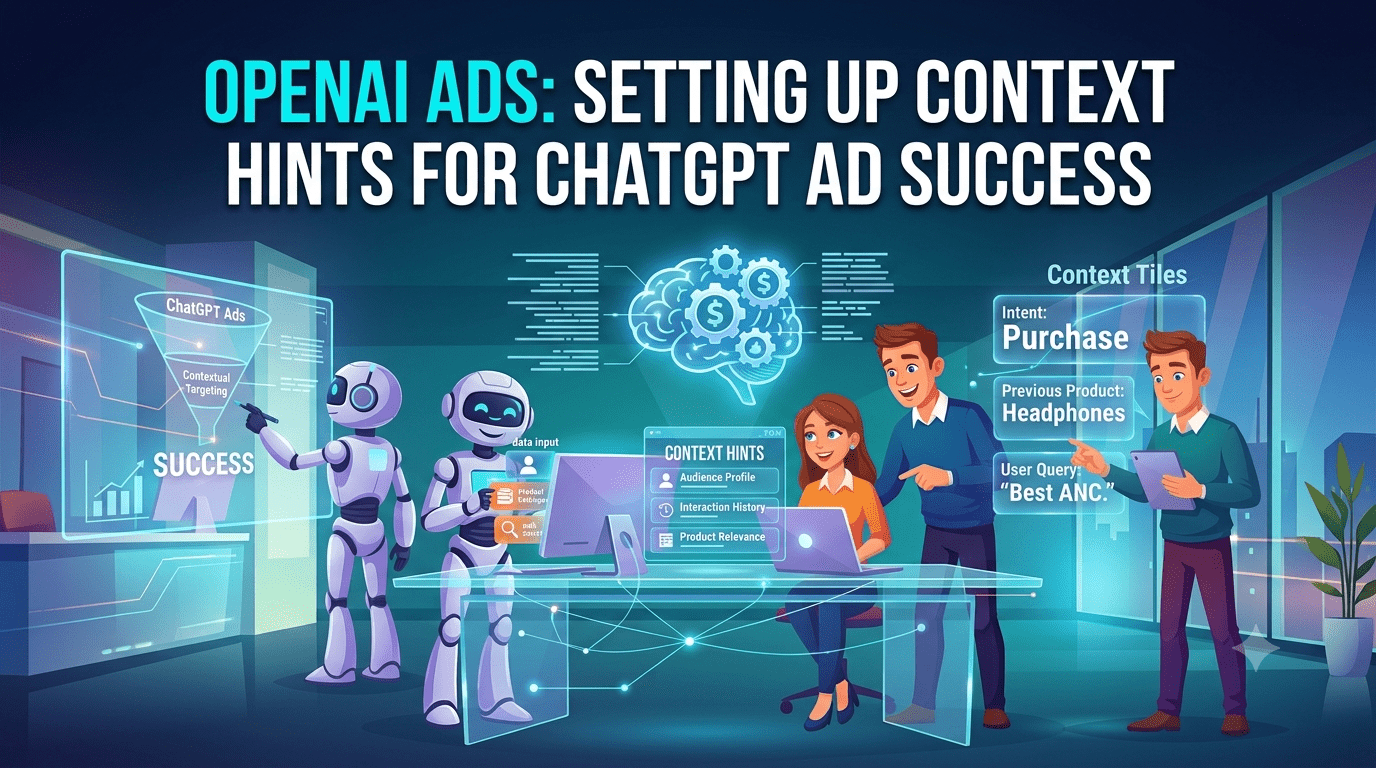
OpenAI Ads: Setting Up Context Hints for ChatGPT Ad Success
Are you a business owner grappling with underperforming marketing campaigns and struggling to connect with your target audience effectively? The rapidly evolving digital landscape demands innovative solutions, and understanding how to leverage new channels like ChatGPT for advertising can be a game-changer. This article will guide you through the intricacies of OpenAI Ads, focusing specifically on setting up context hints to drive unparalleled success in your ChatGPT advertising efforts. By mastering this new frontier, you can unlock significant growth and achieve your marketing objectives with greater precision.
Key Takeaways:
- Context hints are crucial for guiding the AI in ChatGPT ads, ensuring your message aligns perfectly with the user’s conversational context and intent.
- Effective implementation of context hints within the OpenAI Ads Manager allows advertisers to target audiences with unprecedented precision, leading to higher engagement and conversion rates.
- Utilizing context hints can significantly improve the performance of your ChatGPT ad campaigns by reducing irrelevant impressions and increasing the likelihood of meaningful user interactions.
- Partnering with an expert like The AD Leaf Marketing Firm can help businesses navigate the complexities of OpenAI Ads and implement sophisticated context hint strategies for optimal results and scalable growth.
What are Context Hints in ChatGPT Ads?
Context hints are a pivotal element within the OpenAI Ads system, designed to provide the AI with crucial information about an advertiser’s product or service. These hints help guide the conversational AI to surface relevant advertisements during user interactions within ChatGPT. Essentially, they function as explicit directives, ensuring that:
- The ad copy aligns seamlessly with the ongoing chat.
- Targeting aligns seamlessly with the ongoing chat.
Thereby enhancing the user experience and the efficacy of the ad.
Understanding Context Hints and Their Importance
Understanding context hints is fundamental for any marketer looking to advertise on ChatGPT. These hints allow the AI to grasp the nuanced conversational context of a user’s chat, enabling it to present the most appropriate and timely ad. Their importance cannot be overstated, as they directly impact the relevance of the ad impression, influencing click-through rates and overall conversion. Without well-crafted context hints, advertisers risk showing irrelevant ads, leading to wasted spend and a diminished user experience inside ChatGPT.
How Context Hints Work in OpenAI Ads
Context hints work by providing the OpenAI Ads system with descriptive phrases and keywords that characterize your product or service and the types of conversations where your ad should appear. When a user engages in a chat that aligns with these provided hints, the AI is more likely to trigger your ad. This mechanism moves beyond traditional keyword matching, leveraging the AI’s understanding of natural language to identify relevant opportunities for your ChatGPT ad to be shown, making the ads system highly intelligent.
Benefits of Utilizing Context Hints
The benefits of utilizing context hints for ChatGPT ad success are manifold. They significantly enhance ad relevance, leading to higher engagement and better performance metrics. By precisely guiding the AI, context hints minimize irrelevant impressions, ensuring your ad spend is directed towards users genuinely interested in your offering. This targeted approach offers several key advantages:
- Higher engagement and better performance metrics like average CPC and average CPM.
- Minimized irrelevant impressions, ensuring ad spend is directed towards genuinely interested users.
- Boosted conversions.
- Improved brand safety and overall brand perception within this new digital advertising channel.
How to Set Up Context Hints for Success in OpenAI Ads Manager
Setting up context hints effectively in the OpenAI Ads Manager is a strategic process that demands attention to detail. This involves navigating the Ads Manager Beta, creating specific ad groups, and meticulously crafting your context hints to describe the conversations where your ad should appear. A well-structured setup ensures that your ChatGPT advertising campaigns leverage the full potential of AI-driven targeting, maximizing your return on investment and achieving your marketing goals.
Step-by-Step Guide to Accessing Ads Manager Beta
To begin setting up context hints, you first need to access the OpenAI Ads Manager Beta. As this is a new channel, access may be granted through an invitation or specific registration process. Once you have access, familiarize yourself with the interface, as this is where you will manage all your OpenAI Ads campaigns. The platform is designed to be intuitive, guiding advertisers through the process of creating and optimizing their ad groups for ChatGPT advertising.
Creating Effective Ad Groups with Context Hints
Creating effective ad groups is paramount, and context hints are assigned at the ad group level. Within each ad group, you will specify the product or service you are promoting and then write context hints that precisely describe the conversations your target audience might have. Think about user intent and the types of queries that would lead to a natural integration of your ad inside ChatGPT. This granular approach allows for highly targeted campaigns.
Best Practices for Implementing Context Hints
When implementing context hints, several best practices can significantly boost your ChatGPT ad performance. These include:
- Focusing on specificity and providing detailed, yet concise, descriptions.
- Utilizing a mix of broad and exact-match keywords within your hints to capture a wider range of relevant conversational contexts.
- Regularly reviewing your ad group analytics and adjusting your context hints based on performance data to continuously optimize your campaigns for better conversion and lower average CPC.
How to Optimize Your ChatGPT Ads with Keywords
Optimizing your ChatGPT ads with keywords is a critical step in ensuring your campaigns reach the right audience at the right time. While context hints provide a broader understanding of the conversational context, specific keywords within your ad copy and landing page help the AI further refine targeting and improve relevance. This dual approach maximizes the chances of your ad appearing in highly pertinent conversations, driving better engagement and conversion rates for your product or service.
Selecting the Right Keywords for Your Ads
Selecting the right keywords for your ChatGPT ads involves a comprehensive understanding of your target audience’s search intent and conversational patterns. Research relevant terms that people might use when discussing topics related to your product or service within a chat. Consider both broad and exact-match keywords to capture a wide range of relevant impressions. The goal is to identify keywords that not only describe your offering but also align with the natural language used in conversations inside ChatGPT.
Incorporating Keywords into Context Hints
Incorporating keywords directly into your context hints strengthens their effectiveness in guiding the AI. While context hints describe the conversations, integrating specific keywords ensures that the AI understands precisely what your ad is about. For example, if you’re advertising a “digital marketing course,” your context hints might include phrases like “learning digital marketing,” “online marketing education,” or “improving SEO skills,” all containing relevant keywords. This granular approach helps the OpenAI Ads system deliver more accurate and relevant ads.
Measuring the Success of Your Keyword Strategy
Measuring the success of your keyword strategy is essential for continuous optimization. Monitor key performance indicators (KPIs) such as average CPC, average CPM, click-through rates, and conversion rates within the OpenAI Ads Manager. Analyze which keywords are driving the most relevant traffic from ChatGPT ads and contributing to conversions. Use these insights to refine your keyword lists, remove underperforming terms, and allocate budget more effectively to achieve your advertising goals.
What to Consider for Brand Safety in ChatGPT Advertising?
Brand safety in ChatGPT advertising is a paramount concern for any advertiser looking to protect their brand’s reputation and ensure their ads appear in appropriate conversational contexts. Given the AI-driven nature of ChatGPT, understanding and implementing robust safety measures is crucial to prevent your ads from being associated with undesirable or irrelevant content. Proactive strategies are necessary to maintain a positive brand image and ensure your ad campaigns align with your brand values inside ChatGPT.
Understanding Brand Safety in the Context of OpenAI Ads
Understanding brand safety in the context of OpenAI Ads means recognizing the unique challenges and opportunities presented by AI-powered conversational platforms. Unlike traditional display ads or search ads, where content placement can be more rigidly controlled, ads in ChatGPT are dynamically generated based on the conversational context. This requires a nuanced approach to ensure your product or service is not associated with sensitive, inappropriate, or off-topic discussions, which could harm your brand’s reputation and dilute your message.
Implementing Safety Measures in Your Advertising Strategy
Implementing effective safety measures in your advertising strategy for ChatGPT ads involves careful keyword exclusion lists and finely tuned context hints. Work closely with the OpenAI Ads Manager to define what constitutes an “unsafe” conversation for your brand. Utilize negative keywords to prevent your ads from appearing in chats discussing specific topics. Additionally, ensure your context hints are precise enough to guide the AI towards brand-safe conversations, aligning with your desired brand image and avoiding unintended impressions.
Monitoring Brand Safety: Tools and Techniques
Monitoring brand safety in your ChatGPT advertising campaigns requires a combination of vigilance and the right tools. Regularly review ad placements and performance data within the OpenAI Ads Manager to identify any instances where your ads appeared in undesirable conversational contexts. While specific tools for OpenAI Ads are still evolving, leveraging existing analytics tools and potentially third-party brand safety platforms can help track and flag problematic impressions. This continuous monitoring allows for prompt adjustments to your ad groups and context hints, safeguarding your brand’s integrity.
How to Set Up Tracking for Your OpenAI Ads
Setting up robust tracking for your OpenAI Ads is fundamental to understanding the performance of your ChatGPT advertising campaigns and making data-driven decisions. Without proper tracking, it’s impossible to accurately measure return on investment, optimize your ad spend, or understand how users interact with your ads after an impression or click. Effective tracking provides the insights necessary to refine your strategies, improve conversion rates, and ultimately achieve greater success with your product or service promotion.
Why Tracking is Essential for Ad Success
Tracking is essential for ad success because it provides tangible data on how your ChatGPT ads are performing. It allows marketers to see which context hints are most effective, which ad copy resonates best, and critically, how many users are converting on your landing page. Understanding traffic from ChatGPT ads, from the initial impression to the final conversion, helps you identify successful strategies and areas for improvement, ensuring your budget is spent efficiently on this new channel.
Setting Up Tracking Mechanisms in Ads Manager
Setting up tracking mechanisms in the OpenAI Ads Manager typically involves implementing conversion measurement and utilizing UTM parameters. For conversion tracking, you’ll need to configure events that signify valuable actions on your landing page, such as a purchase or lead form submission. Additionally, attach UTM parameters to your landing page URLs for each ad group. These parameters allow you to track the source of traffic more accurately within your existing analytics tools, distinguishing traffic from ChatGPT ads from other digital advertising channels.
Interpreting Tracking Data for Better Performance
Interpreting tracking data effectively is key to improving your ChatGPT ad performance. Analyze metrics like average CPC, CPM, click-through rate, and conversion rate for each ad group and context hint. Look for patterns: which types of conversations lead to the highest conversions? Are there specific ad copies that drive more clicks? Use this data to refine your context hints, adjust your ad copy, and optimize your budget allocation. This iterative process of analysis and adjustment will continuously enhance the effectiveness of your ads in ChatGPT.
Key Takeaways
Summary of Effective Context Hint Strategies
Effective context hints are the cornerstone of successful ChatGPT advertising, acting as critical signals that guide the AI in presenting your product or service to the most relevant users. By meticulously crafting these hints within the OpenAI Ads Manager, advertisers can ensure their ads in ChatGPT align perfectly with the user’s conversational context, significantly boosting engagement and conversion rates. It’s about leveraging AI’s understanding of natural language to create a seamless and pertinent ad experience.
Importance of Keywords in ChatGPT Ads
Keywords play a pivotal role in refining the precision of your ChatGPT ad campaigns. While context hints define the broader conversational landscape, strategic keyword integration within your ad copy and context hints themselves further hones targeting. This synergy ensures that your ad reaches users with explicit intent, improving metrics like average CPC and driving higher quality traffic from ChatGPT ads to your landing page, ultimately leading to better conversions.
Brand Safety Best Practices
Brand safety is non-negotiable in the dynamic environment of ChatGPT advertising. Implementing best practices involves careful selection of negative keywords and precise context hints to prevent your ads from appearing in inappropriate or sensitive conversational contexts. Proactive monitoring within the OpenAI Ads Manager, coupled with a vigilant approach to ad group performance, helps safeguard your brand’s reputation and ensures your ads consistently reflect your desired brand image inside ChatGPT.
Tracking for Continuous Improvement
Robust tracking mechanisms are essential for the ongoing optimization of your OpenAI Ads. By utilizing conversion measurement and UTM parameters, marketers can gain invaluable insights into the performance of their ChatGPT ads, from initial impression to final conversion. Analyzing data such as average CPM, click-through rates, and conversions allows for continuous refinement of ad groups, context hints, and ad copy, driving sustained improvement and maximizing ROI on this new channel of digital advertising.
Frequently Asked Questions | The AD Leaf Marketing Firm
How do I start advertising on ChatGPT?
To start advertising on ChatGPT, you typically begin by gaining access to the OpenAI Ads Manager Beta. Once access is secured, you’ll create ad groups, define your target audience, and most importantly, set up precise context hints that describe the conversations where your product or service should appear. This process guides the AI, ensuring your ChatGPT ad campaigns are relevant and effective, ultimately driving valuable traffic to your landing page.
What are the benefits of using OpenAI Ads Manager Beta?
The OpenAI Ads Manager Beta offers numerous benefits for advertisers, primarily its ability to leverage advanced AI for highly contextual and relevant ad placement within ChatGPT. It allows for granular control over ad groups and context hints, leading to improved ad performance, higher click-through rates, and better conversion potential. This new channel provides a unique opportunity to engage users directly within their conversational context, making your advertising efforts more impactful.
Can I use context hints for different ad formats?
Yes, context hints are a foundational element designed to guide the AI across various potential ad formats that may be introduced within ChatGPT. Regardless of the specific ad format, the core principle remains the same: providing the AI with clear information to describe the conversations where your ad is most relevant. This ensures consistent brand safety and ad effectiveness, no matter how the ad is presented inside ChatGPT to the user.
What should I do if my ads are not performing well?
If your ads are not performing well, the first step is to review your context hints and ad copy within the OpenAI Ads Manager. Analyze your analytics to identify underperforming ad groups or hints. Consider refining your keywords, adjusting your target audience settings, or enhancing your landing page experience. Continuously testing and iterating based on data, focusing on average CPC and conversion rates, is crucial for optimizing your ChatGPT advertising efforts.
How do I ensure my ads are compliant with brand safety guidelines?
Ensuring brand safety for your ChatGPT ads involves implementing negative keywords and carefully crafting your context hints to avoid inappropriate conversational contexts. Regularly monitor your ad placements and performance data in the OpenAI Ads Manager to proactively identify and address any issues. Adhering to the platform’s guidelines and continuously refining your targeting helps prevent your product or service from being associated with undesirable content, maintaining your brand’s integrity.
What support does The AD Leaf Marketing Firm provide for OpenAI Ads?
The AD Leaf Marketing Firm specializes in assisting businesses with navigating and optimizing complex digital advertising platforms, including OpenAI Ads. We provide expert guidance on setting up effective context hints, crafting compelling ad copy, selecting precise keywords, and implementing robust tracking mechanisms. Our team ensures your ChatGPT ad campaigns maximize ROI, achieve superior conversion rates, and maintain brand safety, positioning your product or service for unparalleled success in this innovative new channel.