losing traffic to ai search

Why Your Business Is Losing Traffic to AI Search

Why Your Business Is Losing Traffic to AI Search?

Are you a business owner noticing a significant decline in your website traffic and struggling to understand why? Understanding online search and how it functions, particularly the rise of AI search, is likely playing a crucial role. Many businesses are experiencing a traffic drop, seeing their organic traffic drop, and are facing several challenges, including losing traffic to AI search and searching for solutions to this modern marketing challenge. This article will help you understand the dynamics of AI search and how to adapt to ensure your business maintains its online visibility and continues to attract valuable customers.

Key Takeaways: Why Businesses Are Losing Traffic to AI Search

  1. AI search changes user intent and query behavior. AI-driven search interfaces synthesize answers and reduce clicks to traditional web pages, meaning businesses that rely solely on organic link clicks see fewer visits. To adapt, focus on content designed to satisfy intent at the answer level—concise, authoritative snippets, structured data, and clear on-page signals that AI models can surface as source references.
  2. Content format and structure matter more than raw SEO volume. AI systems prefer clear, well-structured answers: FAQs, step-by-step instructions, tables, schema markup, and summarized takeaways. Long-form content still has value but must include easily extractable sections and authoritative citations to be chosen as a source for AI-generated responses.
  3. Authority, relevance, and freshness are stronger ranking signals. AI rankers prioritize trusted sources and recent information for factual queries. Businesses must invest in demonstrating expertise (author bios, citations, original research), maintaining up-to-date content, and building topical authority through internal linking and external endorsements to remain selectable by AI search engines.
  4. Technical SEO and data strategies become differentiators. Sites that expose machine-readable data, structured data, APIs, open knowledge graph contributions, are more likely to be referenced by AI. Improving site performance, crawlability, and content discoverability (sitemaps, canonicalization, consistent metadata) increases chances of being cited rather than bypassed.

If your business is losing traffic to AI search, you don’t have to navigate the shift alone. The AD Leaf specializes in modern SEO, content strategy optimized for AI-driven discovery, and technical data implementation to regain visibility and convert the traffic that remains. Contact The AD Leaf to audit your content strategy, implement structured data and answer-focused content, and build a roadmap to reclaim traffic in the era of AI search.

Understanding AI Search and Its Impact on Website Traffic

The advent of AI-powered search has fundamentally reshaped how users interact with search engines, leading to significant changes in website traffic patterns. Businesses are witnessing a direct impact on their organic traffic as AI systems become more sophisticated in providing immediate answers. Understanding this shift is paramount for maintaining digital visibility.

What Is AI Search and How Does It Differ from Traditional Search?

AI search represents a significant evolution from traditional search engines by leveraging advanced AI models to interpret user queries and generate comprehensive AI responses directly within the search results. Unlike traditional search, which primarily provides a list of links for users to click, AI search aims to answer questions directly. This often happens through:

  • AI overviews
  • AI summaries

This reduces the need to click through to your website, meaning users are getting their answers at the top of search results without ever visiting a website, leading to a traffic decline for many businesses.

Why Is Your Website Traffic Dropping Due to AI Search?

Your website traffic dropping can often be attributed to the way AI search results are presented. When AI provides direct answers, particularly through Google AI Overviews, users may not feel the need to click to any website, thereby reducing your organic search traffic. This means that even if your content is ranking well, users are getting their information from the AI answers, causing a significant traffic drop and impacting your overall search visibility. The shift in search behavior means that impressions no longer guarantee clicks.

How Can You Adapt to Changes in Search Behavior?

To adapt to these profound changes in search behavior and combat losing traffic, businesses must evolve their digital marketing strategies. The focus should shift from merely achieving high rankings to optimizing for AI visibility and aiming to trigger AI overviews. Understanding what kind of content AI systems favor and how to structure your information for AI-generated responses is crucial for maintaining and even increasing your organic traffic in this new search landscape. This new era demands a proactive approach to SEO.

How to Navigate Google Algorithm Updates

Navigating Google algorithm updates in the era of AI-driven search requires a nuanced understanding of their evolving priorities. With Google continually refining its AI models, businesses must stay abreast of changes to maintain search visibility and mitigate organic traffic declines. Adapting your SEO strategy is no longer optional but essential.

Google Prioritizing Zero-Click Searches

Google’s increasing prioritization of zero-click searches, particularly through AI Overviews, means users are often getting complete answers without ever leaving the search engine results page. This paradigm shift directly impacts your website traffic, as users no longer need to click through to your website for information. Businesses must understand that while their content might still be relevant, the impression doesn’t always translate into a click, leading to a noticeable traffic drop and a reduction in referral traffic.

How to Rank in Google AI Overviews

To rank in Google AI Overviews and secure AI visibility, content must be structured to directly answer user queries comprehensively and concisely. This involves optimizing for answer engine optimization, focusing on clear, authoritative, and well-organized information that AI systems can easily parse and present as AI summaries. Providing definitive answers and demonstrating expertise on a subject makes it harder for AI to bypass your content, increasing the likelihood that your site will be cited or featured within the AI overview itself.

Brand Recognition Over Keyword Optimization

Brand recognition is becoming increasingly vital, sometimes even outweighing traditional keyword optimization. As AI search provides more direct answers, users may be more inclined to seek out trusted brands for further information or services, even if they don’t click on the initial AI response. Building a strong brand identity and cultivating a reputation as an authority in your niche can significantly enhance your search visibility and drive remaining traffic, regardless of how AI changes search.

SEO Strategies for Maintaining Visibility in an AI-Driven World

How to Optimize Your Website for AI Search?

To optimize your website for AI search and enhance your online visibility, it’s crucial to focus on providing clear, comprehensive, and authoritative content that AI systems can easily understand and process. This involves structuring your information with direct answers to common queries, using semantic SEO techniques, and ensuring your content addresses the user’s intent thoroughly. By making your website a definitive source of information, you increase the likelihood of your content being featured in AI overviews and AI summaries, thus maintaining your search visibility even when users do not click through to your website.

What Role Do Keywords Play in AI Search Optimization?

While the role of keywords in traditional search optimization is shifting, they still play a significant role in AI search optimization, albeit with a new emphasis on natural language and semantic relevance. Instead of merely stuffing keywords, businesses should focus on incorporating long-tail keywords and conversational phrases that mirror how users pose questions to AI-powered search engines. This approach helps AI systems better understand the context and intent behind a user’s query, improving your chances of ranking for relevant AI responses and securing your position in the evolving search landscape.

How Can You Enhance Your Organic Traffic Amidst AI Competition?

Enhancing your organic traffic amidst intense AI competition requires a multi-faceted approach that prioritizes user experience and content depth. Focus on creating unique, valuable content that goes beyond what AI overviews can provide, encouraging users to click through to your website for more detailed insights. Building authority and trust in your niche can make it harder for AI to completely bypass your content, as users may actively seek out your brand. Additionally, monitoring your organic search performance through tools like Google Search Console can help you identify opportunities and adapt your strategy.

Addressing the Traffic Decline: Actionable Steps

How to Analyze Your Traffic Drops Effectively?

When experiencing a traffic drop, effectively analyzing the decline is the first crucial step to adapting your digital marketing strategy. Utilize analytics platforms to pinpoint specific pages or content areas that have seen a reduction in website traffic, and compare these drops with major Google algorithm updates or the increased prevalence of AI overviews in search results. Understanding the nature of the traffic declines—whether it’s an overall search reduction or a shift in organic search traffic—will help you diagnose the problem accurately and formulate targeted solutions to improve your visibility.

Steps to Improve Your Website’s AI Visibility

To improve your website’s AI visibility and combat losing traffic, implement several key steps. These include:

  1. Re-evaluating your content to ensure it provides comprehensive, answer-first information that can easily be picked up by AI systems for AI summaries and AI responses.
  2. Optimizing for answer engine optimization by structuring your content with clear headings and concise answers to common queries, making it easier for AI to trigger AI overviews from your site.
  3. Focusing on building domain authority, as AI often prioritizes credible and authoritative sources for its AI-generated content.

How to Leverage LinkedIn for Increased Website Traffic?

Leveraging LinkedIn for increased website traffic involves strategic content sharing and engagement within the professional network. Share snippets of your website content, especially those designed to trigger AI overviews, and link back to the full articles on your site. Participate in relevant industry discussions and groups, positioning your brand as an expert. This not only drives referral traffic directly from LinkedIn but also enhances your brand recognition, which can indirectly improve your overall search visibility as AI is changing search, making it harder for AI to completely overshadow trusted brand content.

The Future of Search: Preparing for Ongoing Changes

What Trends Should You Watch in AI Search Technology?

To prepare for the future of search, businesses must closely watch key trends in AI search technology, particularly the continued evolution of AI models and their impact on search behavior. Anticipate further integration of AI overviews and AI summaries directly into search results, reducing the need for users to click through to your website. Pay attention to advancements in multimodal search, where AI-powered search engines process not just text but also images, audio, and video, broadening the scope of optimization. Staying informed about these changes is vital for maintaining organic search traffic and overall search rankings.

How to Future-Proof Your SEO Strategy Against Traffic Declines?

Future-proofing your SEO strategy against potential traffic declines requires a proactive and adaptable approach. Focus on creating evergreen content that consistently provides value, making it harder for AI to completely supplant your information. Diversify your digital marketing efforts beyond just organic search, exploring channels like email marketing, social media, and paid search to build a more resilient online presence. Continuously monitor your website traffic and search rankings, using insights from Google Search Console to adapt your strategy as AI is changing search and the AI search market continues to evolve. The AD Leaf Marketing Firm can help you adapt and thrive in this evolving landscape.

How The AD Leaf Marketing Firm Can Help?

The AD Leaf Marketing Firm is your expert partner in navigating the complexities of AI-driven search and ensuring your business maintains strong online visibility. We specialize in developing scalable, results-driven marketing strategies that help businesses adapt to Google algorithm updates and the rise of AI overviews. From optimizing your content to trigger AI responses and improving your AI visibility, to diversifying your traffic sources and understanding the nuances of the AI search market, our team provides comprehensive solutions. Partner with The AD Leaf to safeguard your organic traffic, enhance your search rankings, and thrive in the future of search, ensuring you don’t keep losing traffic to AI search.

Key Takeaways

Summarizing the Impact of AI Search on Website Traffic

The rise of AI search, particularly AI overviews, has fundamentally altered how users interact with search results, leading to a significant shift in website traffic patterns. Businesses are experiencing a noticeable traffic drop as AI systems provide direct answers, reducing the need for users to click through to websites. This means that while content might still be ranking, the conversion from impression to click has diminished, demanding a re-evaluation of traditional SEO strategies to maintain online visibility and adapt to this new digital marketing landscape.

Highlighting Actionable Steps for Businesses

To combat losing traffic to AI search, businesses must implement actionable steps focused on AI visibility and answer engine optimization. This involves structuring content to directly answer user queries, making it easier for AI to generate AI summaries and AI responses from your site. Diversifying traffic sources beyond organic search, leveraging platforms like LinkedIn, and proactively adapting to Google algorithm updates are crucial for maintaining website traffic and ensuring your business remains competitive in an AI-driven search market.

Reinforcing the Importance of SEO Adaptation

SEO adaptation is no longer an option but a necessity in the era of AI-powered search. Businesses must move beyond traditional keyword optimization and embrace strategies that optimize for AI systems, focusing on comprehensive, authoritative content that can trigger AI overviews. Continuously monitoring website traffic and search rankings through tools like Google Search Console allows for ongoing refinement of digital marketing efforts, ensuring your business stays ahead of the curve as AI is changing search, safeguarding your organic traffic and overall search visibility.

For businesses seeking expert guidance in navigating the complexities of AI search and optimizing their digital strategy, The AD Leaf Marketing Firm offers comprehensive solutions. Our expertise helps you understand Google AI Overviews, improve your AI visibility, and develop resilient SEO strategies that drive results and ensure your business thrives amidst these ongoing changes.

Frequently Asked Questions | The AD Leaf Marketing Firm

What Are Common Reasons for Traffic Drops Due to AI Search?

Common reasons for a traffic drop due to AI search primarily stem from AI overviews and AI summaries providing direct answers within the search results, reducing the need for users to click through to your website. When AI systems provide immediate AI responses, users receive the information at the top of search results, leading to a decrease in organic traffic. This shift in search behavior means that your content may still be ranking, but the lack of clicks results in website traffic dropping significantly, impacting your overall search visibility.

How Can I Check if AI Search Is Affecting My Website?

You can check if AI search is affecting your website by closely monitoring your organic traffic in Google Search Console and other analytics platforms. Look for sudden traffic declines that coincide with major Google algorithm updates or the increased prevalence of AI overviews for your target keywords. Analyze whether your top-ranking pages are still receiving clicks or if users are getting their answers directly from AI summaries, indicating that AI search is leading to a traffic drop and impacting your search rankings.

What Tools Can Help Me Analyze My Website Traffic?

Several AI tools can help you analyze your website traffic and understand the impact of AI search. Google Analytics provides comprehensive data on user behavior and traffic sources, while Google Search Console offers insights into your search visibility, keyword performance, and AI-driven search trends. Other third-party SEO tools can also help you identify which of your content is being featured in AI overviews or AI summaries, allowing you to adapt your digital marketing strategy and optimize for AI responses effectively.

Can I Still Rely on Traditional SEO Techniques?

While traditional SEO techniques still hold some value, relying solely on them in the era of AI-driven search is increasingly insufficient for maintaining robust website traffic. Keyword optimization remains important, but the focus has shifted towards semantic SEO, answer engine optimization, and creating authoritative content that AI systems can easily interpret for AI summaries. To truly adapt and prevent losing traffic, businesses must evolve their strategies to prioritize AI visibility and understand how AI is changing search, rather than exclusively depending on older methods.

How Often Should I Update My SEO Strategy for AI Search?

Given the rapid evolution of AI search and frequent Google algorithm updates, you should aim to review and update your SEO strategy for AI search at least quarterly, if not more frequently. The AI search market is constantly developing, with new AI models and AI-powered search features emerging regularly, impacting search behavior. Regularly monitoring your organic traffic, search rankings, and how AI overviews are affecting your niche allows you to adapt proactively, ensuring your digital marketing efforts remain effective and your website maintains strong visibility in 2025 and beyond.

What Makes The AD Leaf Marketing Firm a Good Partner for SEO?

The AD Leaf Marketing Firm is an excellent partner for SEO because we specialize in developing scalable, results-driven marketing strategies tailored to the modern search landscape, including the complexities of AI-driven search. We help businesses understand the nuances of Google AI Overviews, optimize for AI visibility, and adapt to ongoing Google algorithm updates to prevent losing traffic. Our expertise in answer engine optimization, leveraging AI tools, and diversifying digital marketing efforts ensures your business maintains robust organic traffic and strong search rankings, making it harder for AI to completely bypass your content.

ChatGPT Ads, openai advertising, OpenClaw AI, ai advertising agency, llms.txt

What is an LLMs.txt File and Should Your Website Have One?

What is an LLMs.txt File and Should Your Website Have One?

Businesses are constantly seeking new ways to maintain and enhance their online presence. If you’re a business owner aware of a potential marketing or visibility issue, you’ve likely encountered the buzz around AI and large language models (LLMs). The emergence of AI tools has introduced new considerations for how your website interacts with these powerful systems. Understanding novel approaches, such as implementing an LLMs.txt file, can be crucial for optimizing your content for the next generation of search and information retrieval. This article will delve into what an LLMs.txt file is, why it might be essential for your website, and how to create one effectively.

Key Takeaways

  1. Purpose and definition: An llms.txt file is a simple, machine-readable text file that communicates site-specific guidelines to language models and AI crawlers (similar to robots.txt but aimed at large language model systems). It can specify what content should be indexed, ignored, or treated with special handling, helping control AI training data usage and automated summarization of your pages.
  2. Benefits for site owners: Implementing an llms.txt file gives you clearer control over how generative AI treats your content—protecting sensitive material, preserving brand voice, and reducing undesired automated reuse. It also helps manage crawl budgets and privacy concerns without altering on-page content or server behavior.
  3. When and how to use it: Consider adding an llms.txt if your site contains proprietary, copyrighted, or privacy-sensitive content, or if you want to influence AI-derived snippets and answers. Place a plain-text llms.txt at your site root with straightforward directives (allow/deny, scope, timestamps, contact info) and keep it maintained alongside robots.txt and sitemap updates.
  4. Limitations and best practices: llms.txt relies on voluntary compliance by AI providers; it’s not legally enforceable on its own. Use it as part of a layered strategy—combine clear licensing, technical controls (meta tags, API restrictions), and legal terms. Monitor AI usage, update directives as models and policies evolve, and document your intent for transparency.

If you want help evaluating whether your site needs an llms.txt file, drafting effective directives, or integrating it into a broader AI governance and SEO strategy, The AD Leaf is a marketing partner experienced in content protection, AI Search Engine Optimization, and technical implementation. Reach out to The AD Leaf to assess risks, create compliant llms.txt rules, and align your site’s AI visibility with your business goals.

Understanding the LLMs.txt File

The rise of artificial intelligence has brought about new challenges and opportunities for website owners. As large language models become more sophisticated, they are increasingly used to process and synthesize information from the web. This necessitates new protocols to guide how these AI systems interact with your content, ensuring proper attribution and control over how your data is used. The LLMs.txt file is a direct response to this evolving digital environment, providing a mechanism for website owners to communicate directly with AI crawlers.

What is an LLMs.txt file?

An LLMs.txt file is a plain text file that website owners can place at the root of their website to provide specific instructions to AI crawlers and large language models (LLMs). Similar in concept to the long-standing robots.txt file, an LLMs.txt file aims to help AI systems understand your content better by specifying how they should interact with or cite it. It gives AI a clear signal regarding preferred ways to use your content, ensuring that your intellectual property is respected and your site’s information is accurately represented in AI-generated responses.

How does an LLMs.txt file differ from robots.txt or sitemap?

While an LLMs.txt file shares a superficial resemblance to robots.txt and sitemap files, its purpose is distinct. The following table highlights the differences between these files:

File Type Primary Purpose
robots.txt Instructs traditional search engine crawlers (like Googlebot) which parts of your site they should not crawl, influencing traditional SEO and visibility.
sitemap.xml Provides a structured list of all the URLs on your website that you want search engines to crawl, helping them discover your content more comprehensively.
LLMs.txt Specifically designed to give AI systems and large language models guidance on how to interpret, use, and potentially cite your content, going beyond mere crawl instructions to influence content usage.

Why do you need an LLMs.txt file for your site?

You need an LLMs.txt file for your site because large language models like ChatGPT, Claude, and Gemini are increasingly used by AI search engines and AI assistants to generate answers and insights. Without explicit instructions, these AI models might crawl and use your content in ways that don’t align with your preferences, potentially leading to misattribution or improper context. By adding an LLMs.txt file, you help AI understand your website’s content, ensuring that when these LLMs use your content, they do so appropriately, giving AI a clear signal to cite your content correctly and respect your content usage policies.

Creating an LLMs.txt File

Creating an LLMs.txt file is a proactive step for any business looking to navigate the evolving landscape of AI-driven content consumption. It’s not just about protection; it’s about optimizing how your valuable content contributes to the broader digital knowledge base through AI. The process involves more than just putting a file on your server; it requires careful consideration of what information you want to convey to AI systems and how you wish your content to be utilized.

How to create an LLMs.txt file step-by-step

Creating an LLMs.txt file is a straightforward process that involves several key steps. This file will house your directives for AI crawlers and ensures that any AI crawler or AI system visiting your domain can easily discover and parse the file. To set it up, you need to:

  1. Create a plain text file named “llms.txt” using a simple text editor.
  2. Add specific instructions within this text file, detailing how you want large language models to interact with your site’s content.
  3. Upload this llms.txt file to the root directory of your website.

Key components to include in your LLMs.txt file

When creating an LLMs.txt file, several key components are essential to effectively communicate with AI systems. You should include directives that specify which AI bots or large language models are allowed or disallowed from accessing certain parts of your site. Additionally, you can add instructions on how these AI models should attribute or cite your content when they use it to generate responses. Including a brief description of your content’s purpose or specific use cases can also help LLMs understand your content better, ensuring more accurate and relevant AI-generated outputs.

Best practices for creating an LLMs.txt file

To ensure your LLMs.txt file is effective, follow several best practices. Always place the file at the root of your website so it is easily discoverable by any AI crawler. Use clear, concise language in your directives to avoid misinterpretation by AI models. Regularly review and update your llms.txt file as your website content evolves or as new AI systems emerge, ensuring that your instructions remain relevant. Furthermore, consider specifying preferred citation formats or linking back to original sources, which helps large language models properly attribute your content and enhance your site’s visibility within AI search results.

How to Create an llms.txt File for Your Business Website

Creating an llms.txt file for your business website is a forward-thinking strategy that aligns with the future of digital marketing and content visibility. It’s not just about preventing misuse; it’s about optimizing the way AI systems understand and leverage your unique content, ultimately enhancing your brand’s presence in AI-driven search environments. By proactively establishing these guidelines, your business can ensure its content is utilized responsibly and effectively by the burgeoning ecosystem of large language models.

Step 1: Decide Which Pages Actually Matter

The initial step in creating an effective llms.txt file is to thoughtfully decide which pages on your website are most crucial for AI systems to interact with, and conversely, which ones you might want to restrict. This involves a strategic review of your content to identify high-value pages, such as core service offerings, authoritative blog posts, or product descriptions, that you want large language models to understand and potentially cite. Focusing on these key pages ensures that your directives within the llms.txt file provide meaningful guidance to the AI crawler.

Step 2: Write a One-Sentence Description for Each Page

Once you’ve identified the pivotal pages, the next step is to write a concise, one-sentence description for each. This brief description serves as an important piece of structured content that can help AI models, including ChatGPT and Gemini, to quickly grasp the essence and purpose of each URL. By providing this simplified overview in your llms.txt file, you give AI a clear signal about the topic and value of the content, which can improve how large language models contextualize and use your content in their responses.

Step 3: Organize Pages Into Logical Groups

After crafting individual descriptions, organize your pages into logical groups within your llms.txt file. This step helps AI systems better understand your website’s hierarchy and the relationships between different sections of content. For instance, you might group all service pages together, or all blog posts related to a specific category. This structured approach facilitates more accurate parsing by an AI crawler and ensures that large language models can efficiently process and interpret your content based on its thematic coherence, enhancing its overall visibility.

Step 4: Write a Short Business Summary at the Top

To provide immediate context, write a short business summary and place it at the very top of your llms.txt file. This brief description should concisely explain what your business does and its primary goals, giving AI models a foundational understanding of your brand’s identity and mission. This initial context can significantly help LLMs in interpreting your content, ensuring that any AI-generated summaries or responses align with your overall brand messaging and purpose, thereby enhancing how AI systems understand your website.

Step 5: Upload the File to Your Website Root

The practical final step is to upload the llms.txt file to the root directory of your website. This is a critical action because AI crawlers, much like traditional search engine bots, are programmed to look for this specific file in the main directory. Ensuring the llms.txt file is correctly placed makes it easily discoverable and parseable by any AI system or large language model attempting to crawl your site, allowing your directives to be effectively applied to your content usage.

Step 6: Plan to Keep It Updated

An llms.txt file is not a set-it-and-forget-it solution; you must plan to keep it updated regularly. As your website evolves with new content, services, or changes in AI technology and best practices, your directives within the llms.txt file should reflect these changes. Regularly reviewing and revising your file ensures that large language models always have the most current instructions on how to understand your content and use your content, maintaining optimal interaction with AI systems.

Why This Matters for Local and Small Business Websites

For local and small businesses, effectively managing how AI interacts with your website can be a game-changer for visibility and brand reputation. In an increasingly AI-driven search landscape, an llms.txt file offers a crucial layer of control over your digital presence, ensuring that your valuable content is understood and attributed correctly by large language models. This proactive approach helps your business stand out in local AI search results and protects your intellectual property in an era where AI models frequently curate information.

A Real Example: What This Site’s llms.txt Looks Like

Imagine an example where a local bakery wants to ensure its unique recipes and local history are accurately reflected by AI. Their llms.txt file might include specific instructions for large language models to prioritize their “About Us” page for historical context and their “Menu” page for product details, while also stipulating proper citation of their original recipes. This practical application demonstrates how creating an llms.txt file can help AI systems understand your content and specific nuances of your business, improving how AI search presents your brand.

Using the LLMs.txt File Effectively

Effectively using your llms.txt file means going beyond mere creation; it involves strategic implementation to maximize its benefits for your website’s visibility and content control within the AI ecosystem. This approach helps ensure that large language models not only access your content but also interpret and utilize it in a manner that aligns with your business objectives. By thoughtfully curating your directives, you give AI clear signals about how to interact with your digital assets.

How to use LLMs.txt in conjunction with robots.txt and sitemap.xml

For optimal results, the llms.txt file should be used strategically in conjunction with your robots.txt and sitemap.xml files. While robots.txt tells traditional search engine crawlers which parts of your site not to crawl for SEO purposes, and sitemap.xml helps search engines discover all your URLs, the llms.txt file specifically guides AI systems on how to interpret and use your content. By harmonizing these three files, you create a comprehensive strategy that helps large language models and search engines alike to understand your website thoroughly, enhancing both traditional SEO and AI-driven visibility.

Use cases for implementing an LLMs.txt file

There are numerous practical use cases for implementing an llms.txt file. A business might use it to specify that large language models should only cite content from their blog with a direct link back to the original article, thereby enhancing attribution and driving traffic. Another use case involves instructing AI models to avoid summarizing certain proprietary information or sensitive data pages. This file helps AI avoid misinterpreting your content, ensuring that when LLMs use your content, they do so appropriately and according to your preferences, providing a clear signal to AI crawlers.

Comparing LLMs.txt to sitemap.xml and robots.txt

Understanding the distinctions between llms.txt, sitemap.xml, and robots.txt is crucial for effective website management. Each file serves a unique purpose:

File Primary Purpose
robots.txt Restricts traditional search engine access to certain parts of your site, influencing crawl budget and traditional SEO.
sitemap.xml Lists all the URLs you want search engines to crawl, improving content discoverability.
llms.txt Specifically designed to give AI a clear signal regarding how large language models should interpret, attribute, and use your content, going beyond simple crawl instructions to manage content usage and context for AI systems.

Integrating AI Systems with LLMs.txt

How AI systems can leverage LLMs.txt files

AI systems can significantly leverage llms.txt files by receiving explicit instructions on how to interact with website content. This plain text file gives AI a clear signal regarding preferred content usage, attribution, and areas to prioritize or avoid. By using an llms.txt file, AI models like Claude and Gemini can more accurately understand your website’s purpose and specific content, ensuring that when LLMs use your content, they do so in a manner consistent with your brand’s guidelines and intellectual property rights, thereby improving overall content visibility and responsible AI interaction.

Examples of AI applications that benefit from LLMs.txt files

Various AI applications stand to benefit immensely from a well-structured llms.txt file. For instance, AI search engines can use it to provide more precise and relevant answers, directly citing the original source URL as instructed. AI assistants like ChatGPT and Perplexity can draw upon permitted content, delivering accurate summaries and insights without misrepresenting the source. Content curation platforms can leverage the file to understand your content, ensuring proper categorization and display, and helping large language models accurately reflect your website’s information and intent.

Claude vs. traditional systems: The role of LLMs.txt

The role of the llms.txt file becomes particularly evident when comparing advanced AI systems like Claude with traditional search engine crawlers. While traditional systems rely heavily on robots.txt and sitemap.xml for crawl instructions, Claude, and other large language models, benefit from the llms.txt file’s specific guidance on content interpretation and usage. This distinction allows the llms.txt file to help AI understand your content in a nuanced way, going beyond mere accessibility to influence how AI models contextualize, summarize, and cite your information, giving AI a more refined interaction experience.

Frequently Asked Questions (FAQs) about LLMs.txt Files

What happens if I don’t create an LLMs.txt file?

If you choose not to create an llms.txt file, large language models and AI crawlers will likely interact with your website content based on their default protocols and algorithms. This means you lose the opportunity to give AI a clear signal regarding how your content should be used, attributed, or even restricted. Without an llms.txt file, there’s a higher risk of misinterpretation, incorrect citation, or AI models using your content in ways that don’t align with your business objectives, potentially impacting your brand’s visibility and intellectual property.

How do I know if I need an LLMs.txt file?

You need an llms.txt file if your business relies on digital content, values proper attribution, or wants to influence how AI models understand and use your content. If you have unique articles, proprietary data, or specific branding you wish to protect or promote through AI search, creating an llms.txt file is crucial. Any website owner looking to navigate the evolving landscape of AI-driven content consumption and ensure their content is accurately represented by large language models should consider adding an llms.txt file.

Can I generate LLMs.txt files automatically?

While some basic elements of an llms.txt file could potentially be generated automatically, a truly effective file requires thoughtful, manual curation. Automated tools might create a basic plain text file structure or list URLs, but they typically cannot provide the nuanced instructions needed for proper attribution or content usage policies that help AI understand your content deeply. The best practices for creating an llms.txt file involve human oversight to ensure that the directives precisely reflect your desired interactions with large language models, giving AI accurate guidance.

How does the LLMs.txt file impact SEO?

The llms.txt file impacts SEO by influencing how AI search engines and AI assistants use your content to generate responses, which in turn affects your website’s visibility in AI-driven search results. While it doesn’t directly influence traditional SEO rankings in the same way robots.txt or sitemap.xml do, it ensures that when LLMs use your content, they cite it correctly and provide accurate context. This proper attribution can lead to increased recognition and organic traffic from AI search queries, enhancing your overall digital presence and helping large language models promote your brand.

What tools can help me create an LLMs.txt file?

Creating an llms.txt file primarily involves using a simple text editor, as it is a plain text file. Tools like Notepad (Windows), TextEdit (Mac), or any code editor (e.g., VS Code, Sublime Text) are perfectly suitable for writing the directives. There aren’t specialized “llms.txt generators” because the content requires specific, human-written instructions to effectively help AI understand your content. The most important “tool” is a clear understanding of your content and how you want large language models to interact with it.

Are there any common mistakes to avoid with LLMs.txt files?

Yes, several common mistakes should be avoided when creating an llms.txt file. A significant error is placing the file incorrectly, as it must reside at the root of your website to be discovered by an AI crawler. Another mistake is using ambiguous or overly complex language in your directives, which can confuse large language models. Failing to update the file as your website changes or neglecting to specify clear citation guidelines are also common pitfalls. Following best practices ensures your llms.txt file effectively helps AI understand your content and your instructions for content usage.

AI SEO Agency, Florida AI SEO Expert, AI search Optimization, Generative Engine Optimization, AI sEO vs SEO

AI SEO Guide: Use Artificial Intelligence for Search Results & Search Optimization

AI SEO Guide: Use Artificial Intelligence for Search Results & Search Optimization

Are you a business owner grappling with declining organic traffic or struggling to maintain visibility in an increasingly competitive digital landscape? Many businesses find themselves in this predicament, aware that their current marketing and sales strategies are underperforming but unsure of the precise solution. This comprehensive guide will illuminate the path forward, demonstrating how leveraging AI SEO can be the transformative solution you need to revitalize your online presence, improve your search results, and ultimately drive business growth. The AD Leaf Marketing Firm specializes in guiding businesses through these complex transitions, providing scalable, results-driven AI marketing and advertising services tailored to your specific needs.

Key Takeaways

  • AI SEO represents a fundamental shift from traditional SEO by integrating artificial intelligence to predict user intent and optimize for a more nuanced search experience, moving beyond keyword density to focus on comprehensive answer-first content.
  • Optimizing content for AI search involves creating high-quality, relevant, and authoritative content that directly addresses user queries and provides complete answers, utilizing AI tools to identify gaps and refine existing material.
  • AI crawlers significantly enhance SEO performance by understanding content context and relevance with greater sophistication, allowing for more accurate indexing and improved visibility in AI-driven search results.
  • Selecting the right AI SEO tools and integrating them strategically into your existing SEO framework is crucial for staying competitive and achieving sustained growth in an evolving search landscape, with expert guidance from partners like The AD Leaf Marketing Firm proving invaluable.

What is AI SEO and How is it Different from Traditional SEO?

Understanding AI in SEO

AI in SEO refers to the application of artificial intelligence technologies to enhance various aspects of search engine optimization. This includes leveraging machine learning algorithms to analyze vast amounts of data, predict user behavior, and optimize content for better visibility in search results.

Aspect AI for SEO
Approach Dynamic, data-driven insights
Adaptability Continuously learns and adapts to changing search trends and user preferences

This allows for more adaptive and effective strategies in search optimization, providing a significant edge in improving SEO performance.

Key Differences Between AI SEO and Traditional SEO

The primary difference between AI SEO and traditional SEO lies in their approach to understanding and ranking content. Traditional SEO often focuses on keyword density, backlinks, and technical SEO factors, following a set of established best practices. In contrast, AI SEO goes deeper, using artificial intelligence to decipher search intent, understand context, and evaluate content quality from a holistic perspective, much like Google’s AI Overviews. While traditional search results are still relevant, AI-driven search results prioritize comprehensive answers and a richer search experience, making it imperative for SEO professionals to adapt their SEO strategies to align with these changes in search. This shift also includes optimizing for voice search and generative AI.

The Role of Artificial Intelligence in Search Optimization

Artificial intelligence plays a pivotal role in modern search optimization by fundamentally transforming how search engines process and rank information. AI crawlers, for instance, are more sophisticated than traditional crawlers, capable of understanding the nuances of language and content relevance, which directly impacts visibility in AI search results. This means that to rank in AI search, businesses must optimize their content for AI search, ensuring it is comprehensive, authoritative, and directly answers user queries. The integration of AI in SEO is not just about using AI tools; it’s about understanding how AI search engines, like those utilizing Google’s AI, are evolving to provide more intelligent and personalized search results.

How to Optimize Your Content for AI Search

Steps to Optimize Content Using AI Tools

Optimizing your content for AI search involves a strategic shift from traditional content creation. To do this effectively, there are several key steps to consider:

  1. Utilize AI tools to conduct in-depth search intent analysis, identifying the specific questions and needs of your target audience that AI-powered search engines are designed to answer.
  2. Focus on creating comprehensive, answer-first content that directly addresses these queries, providing detailed and authoritative information.
  3. Continuously monitor performance using AI-driven analytics to refine your approach and adapt to new search trends and Google search updates.

AI platforms can also assist in identifying content gaps, suggesting relevant topics, and even generating initial drafts that can then be refined by human writers, ensuring the content is both AI-friendly and engaging for users.

Best Practices for Content Optimization for AI Search

To ensure your content performs well in AI-driven search results, several best practices are essential. Prioritizing the creation of high-quality, original content that offers genuine value and solves user problems comprehensively is key. This moves beyond simply stuffing keywords and focuses on semantic relevance and thematic authority, which AI systems are highly adept at recognizing. Furthermore, to enhance readability and make it easier for AI crawlers to understand and index, you should:

  • Structure your content logically with clear headings, subheadings, and bullet points.
  • Integrate schema markup and ensure strong on-page SEO elements.

These actions provide structured data that AI search engines can easily interpret, significantly boosting your content’s visibility and search performance in AI results.

Utilizing AI Crawlers for Enhanced SEO Performance

AI crawlers are the next generation of web indexing tools, employing artificial intelligence to process and understand web content with unparalleled sophistication. Unlike traditional crawlers that primarily follow links and analyze keywords, AI crawlers can interpret the context, sentiment, and overall relevance of your content, leading to enhanced SEO performance. To leverage these powerful tools, ensure your website has robust technical SEO, including fast loading times, mobile responsiveness, and a clean site architecture, as these foundational elements enable AI crawlers to efficiently access and evaluate your content. By understanding how these intelligent crawlers operate, you can proactively optimize your content and site structure to improve your chances of ranking higher in AI-driven search results, ultimately increasing your visibility and organic traffic in the evolving search landscape. This proactive approach ensures your SEO strategies are aligned with the future of search.

What are the Best AI SEO Tools Available?

Top AI-Powered Tools for Search Optimization

The market for AI SEO tools is rapidly expanding, offering a range of solutions designed to enhance various aspects of search optimization. Some of the top AI-powered tools include platforms that specialize in AI content generation and optimization, helping you create highly relevant and engaging content that aligns with AI search intent. Others focus on advanced keyword research, predicting emerging search trends and identifying lucrative long-tail keywords that traditional methods might miss. There are also AI tools dedicated to technical SEO audits, identifying complex site issues that could hinder AI crawlers, and providing actionable recommendations for improvement. These AI SEO tools leverage machine learning to automate tedious tasks and provide deeper insights, making them indispensable for any serious SEO professional looking to maintain visibility in AI search.

How to Choose the Right AI Tool for Your Business

Selecting the appropriate AI tool for your business requires careful consideration of your specific needs, budget, and existing SEO strategies. Start by identifying your biggest SEO challenges, whether it’s content creation, competitor analysis, or technical optimization. Look for AI platforms that offer robust features directly addressing these pain points, such as advanced analytics for search engine optimization or capabilities for optimizing content for AI search. Consider the scalability of the tool and its integration capabilities with your current marketing stack, including Google Search Console. It’s also beneficial to read reviews and explore case studies to understand the real-world impact of different AI tools. Ultimately, the right AI tool should provide actionable insights, automate repetitive tasks, and help you achieve tangible improvements in your search results and overall SEO performance, guiding you effectively through the AI SEO guide.

Integrating AI Tools into Your SEO Strategy

Integrating AI tools into your existing SEO strategy is crucial for staying competitive and maximizing your search optimization efforts. Begin by piloting one or two AI tools that address immediate needs, such as a content optimization platform to enhance your existing articles or an AI-powered keyword research tool to uncover new opportunities. Gradually expand your integration as you become more familiar with the capabilities of AI and its impact on your search results. Train your team on how to effectively use these AI systems, emphasizing that AI for SEO is meant to augment, not replace, human expertise. Regular monitoring of your SEO performance with AI tools will allow you to continuously refine your approach, ensuring your SEO strategies are dynamic and responsive to the evolving landscape of AI-driven search and Google’s AI Overviews. The AD Leaf Marketing Firm specializes in helping businesses strategically integrate these advanced AI solutions.

How is AI Changing SEO Strategies?

The Impact of AI on SEO Performance Metrics

Artificial intelligence is profoundly changing how we measure and interpret SEO performance metrics, moving beyond surface-level data to provide deeper, more actionable insights. Traditional SEO metrics like keyword rankings and backlink counts are still relevant, but AI-driven search introduces new layers of evaluation, such as content relevance score, user engagement with AI Overviews, and the effectiveness of content in answering complex queries. AI systems can analyze vast datasets to identify patterns that impact visibility in AI search results, allowing SEO professionals to optimize content not just for keywords, but for a comprehensive search experience. This shift helps businesses understand their actual impact on user intent and provides a clearer path to improving overall SEO performance.

AI is Reshaping Content Creation and Delivery

AI is fundamentally reshaping content creation and delivery, transforming how businesses develop and distribute material to attract their target audience and improve search results. AI tools are now capable of assisting with everything from generating initial content outlines and suggesting relevant topics to optimizing existing content for AI search engines. This includes tailoring content for voice search and generative AI responses, ensuring it meets the sophisticated demands of AI-driven search. The focus is shifting from simply producing content to creating highly personalized, contextually relevant, and authoritative content that directly addresses user queries, making it easier for AI crawlers to understand and rank effectively, thereby enhancing visibility in AI search results.

Future Trends in AI-Driven Search Optimization

The future of AI-driven search optimization promises even more sophisticated and personalized search experiences, driven by continuous advancements in artificial intelligence. We can expect search engines to further refine their understanding of natural language, making search intent even more critical for SEO strategies. AI search results will likely become more interactive, potentially integrating more multimedia and dynamic content directly into AI Overviews. This means SEO professionals will need to adapt their strategies to focus on comprehensive content that can serve as definitive answers, anticipating user needs even before they are explicitly stated. The AD Leaf Marketing Firm is at the forefront of these changes, guiding businesses to optimize for these evolving search trends and use AI for SEO effectively.

How AI Revolutionizes Keyword Research

Finding Low-Competition Keywords

AI revolutionizes keyword research by enabling businesses to uncover low-competition keywords with unprecedented precision, a critical factor for improving search results. Unlike traditional SEO methods that might overlook nuanced or emerging long-tail queries, AI tools can analyze vast amounts of search data to identify highly specific phrases with strong search intent but limited competition. These AI SEO tools leverage machine learning algorithms to predict future search trends and pinpoint untapped opportunities, allowing businesses to optimize their content for niches that yield higher conversion rates and better visibility in AI search results. This strategic approach helps smaller businesses compete more effectively against larger enterprises by focusing on targeted, high-value keywords.

Understanding Search Intent

Understanding search intent is paramount in modern search engine optimization, and artificial intelligence significantly enhances our ability to decipher it. AI for SEO goes beyond merely recognizing keywords; it analyzes the context, phrasing, and user behavior surrounding a query to determine the underlying goal a user has when performing a search. This deep understanding of search intent allows businesses to optimize content that truly satisfies user needs, whether they are looking for information, navigation, or a transaction. By aligning content more precisely with user intent, businesses can achieve higher rankings in AI-driven search, as AI search engines prioritize content that offers the most relevant and comprehensive answers, leading to an improved search experience.

Analyzing Competitors

AI tools provide a distinct advantage in analyzing competitors, offering insights that traditional SEO methods simply cannot match. By leveraging AI systems, businesses can gain a deeper understanding of their rivals’ SEO strategies, including the types of content that perform well in AI search, their backlink profiles, and even their keyword targeting approaches for AI-powered search. These AI SEO tools can identify content gaps on competitor sites and pinpoint opportunities where your business can create more authoritative and comprehensive content for AI search. This competitive intelligence allows for more informed decision-making, helping you refine your own content optimization efforts and ultimately improve your SEO performance and visibility in AI search results.

Creating and Optimizing Content with an AI Co-Pilot

Generating SEO-Optimized Outlines

Generating SEO-optimized outlines becomes significantly more efficient and effective with an AI co-pilot, revolutionizing how SEO professionals approach content creation. AI tools can rapidly analyze vast amounts of data, including competitor content and search intent, to suggest comprehensive outlines that are perfectly aligned with what AI search engines, such as those powering Google’s AI Overviews, are looking for. This allows businesses to optimize their content for AI search from the very beginning, ensuring that every piece of content is structured to provide definitive answers and achieve high visibility in AI search results, thereby enhancing overall SEO performance. An AI co-pilot acts as an invaluable assistant in formulating robust content strategies that leverage the power of artificial intelligence.

Drafting Content at Speed

Drafting content at speed is one of the most compelling advantages of using an AI co-pilot, fundamentally changing the pace of content creation for search engine optimization. AI platforms can generate initial content drafts, expand on ideas, and even rephrase sentences to improve clarity and relevance, allowing SEO professionals to produce high-quality content much faster than with traditional methods. This rapid drafting capability means businesses can quickly iterate and optimize their content for AI search, keeping up with dynamic search trends and ensuring their SEO strategies remain agile. While the human touch remains crucial for accuracy and nuance, AI for SEO provides a powerful accelerator, enabling more frequent content updates and improved visibility in AI-driven search results.

The Crucial Human Touch

Despite the remarkable capabilities of AI systems in content generation, the crucial human touch remains indispensable for creating truly effective and authoritative content for AI search. While AI tools can draft content at speed and optimize for various SEO factors, human writers bring creativity, critical thinking, empathy, and unique perspectives that artificial intelligence cannot replicate. The human touch ensures that content is not only factually accurate and semantically relevant but also engaging, authentic, and resonates deeply with the target audience. SEO professionals must collaborate with AI, using it as a powerful assistant to enhance their SEO strategies rather than replacing their expertise, especially for ensuring content aligns with complex search intent and performs well in AI-driven search results.

On-Page Optimization

On-page optimization takes on a new level of sophistication with the integration of AI, going far beyond traditional keyword stuffing to truly optimize content for AI search engines. AI tools can analyze content in real-time, suggesting improvements for readability, semantic relevance, and comprehensive topic coverage that align with what AI crawlers prioritize. This includes recommendations for internal linking, meta descriptions, headings, and image alt text, ensuring every on-page element contributes to improved SEO performance and higher visibility in AI search results. By leveraging AI for on-page SEO, businesses can ensure their content is not only discoverable by traditional search but also perfectly tailored for the nuanced understanding of AI-driven search algorithms, making it easier to rank in AI search.

Technical SEO: How AI Identifies Hidden Issues

Technical SEO is significantly enhanced by AI, which can identify hidden issues that often elude traditional audit methods. AI systems can rapidly crawl and analyze entire websites, pinpointing complex problems such as broken links, crawl errors, site speed bottlenecks, and mobile usability issues with unparalleled precision. These AI tools go beyond basic checks, understanding how these technical factors impact a site’s overall SEO performance and its ability to be effectively indexed by AI crawlers. By leveraging AI for technical SEO, businesses can proactively resolve critical issues that hinder their visibility in AI search results, ensuring a flawless user experience and a robust foundation for all their SEO strategies, ultimately helping them optimize their content for AI search.

Why Should You Use AI for SEO?

Benefits of Implementing AI in Your SEO Strategy

Implementing AI in your SEO strategy offers a multitude of benefits, fundamentally transforming how businesses achieve search optimization and improve their search results. AI for SEO provides unparalleled data analysis capabilities, allowing SEO professionals to identify intricate patterns and predict search trends with greater accuracy than ever before. This leads to more targeted and effective content optimization, better understanding of search intent, and the ability to find low-competition keywords. Furthermore, AI systems automate repetitive tasks, freeing up valuable time for strategic planning and creative execution. Ultimately, integrating AI into your SEO strategies enhances SEO performance, increases visibility in AI search results, and provides a significant competitive edge in the evolving landscape of AI-driven search.

Case Studies: Successful AI SEO Implementations

Successful AI SEO implementations are becoming increasingly common, demonstrating the tangible benefits of integrating artificial intelligence into search optimization efforts. Numerous case studies highlight how businesses have leveraged AI tools to achieve remarkable improvements in their search results and overall SEO performance. For instance, companies have reported significant increases in organic traffic by using AI to generate SEO-optimized content outlines and draft initial content. Others have seen dramatic improvements in their Google Search rankings by using AI for in-depth competitor analysis and identifying hidden technical SEO issues. These examples underscore how AI for SEO empowers businesses to optimize their content for AI search, resulting in higher visibility in AI search results and a stronger online presence across all search engines.

Partnering with The AD Leaf for AI SEO Solutions

Partnering with The AD Leaf Marketing Firm for AI SEO solutions provides businesses with expert guidance and cutting-edge technology to navigate the complexities of AI-driven search. As a leading digital and AI marketing agency, The AD Leaf specializes in developing scalable, results-driven SEO strategies that leverage the full power of artificial intelligence. We help businesses integrate the best AI SEO tools, optimize their content for AI search, and understand how to achieve high visibility in AI search results, including Google’s AI Overviews. Our partnership ensures that your SEO performance is not just reactive but proactively aligned with future search trends, guaranteeing superior search optimization and sustained growth in an increasingly competitive digital landscape.

Four Essential Points on AI SEO

AI SEO is revolutionizing search engine optimization by shifting focus from traditional keyword density to understanding and predicting user search intent through artificial intelligence. It leverages AI systems and advanced algorithms to analyze vast datasets, optimize content for comprehensive answers, and enhance visibility in AI-driven search results. This approach ensures that content is not just found but truly satisfies the user’s query, aligning perfectly with the evolving demands of AI search engines and Google’s AI Overviews, thereby delivering superior SEO performance.

Why AI is the Future of Search Optimization

Artificial intelligence is undeniably the future of search optimization because it enables search engines to deliver a more intelligent, personalized, and accurate search experience. AI for SEO moves beyond the limitations of traditional SEO by allowing for real-time adaptation to changing search trends, deeper analysis of search intent, and the ability to process complex queries, including voice search. This means that businesses that effectively use AI to optimize their content for AI search will gain a significant competitive advantage, ensuring their content is highly visible and ranks effectively in AI search results as search engines and AI continue to evolve.

How to Get Started with AI SEO Today

To get started with AI SEO today, begin by understanding the fundamental differences from traditional SEO and recognizing the potential of AI in SEO to transform your search optimization efforts. First, invest in learning about AI tools and how they can be integrated into your existing SEO strategies, focusing on content optimization and identifying low-competition keywords. Next, conduct a comprehensive audit of your current content to identify gaps and opportunities for optimizing content for AI search. Finally, consider partnering with an expert like The AD Leaf Marketing Firm to guide you through the process, ensuring your SEO performance is maximized for AI-driven search results and Google search.

Frequently Asked Questions about AI SEO

What is AI SEO and how does it work?

AI SEO is the application of artificial intelligence and machine learning to enhance search engine optimization strategies, making them more adaptive, predictive, and efficient than traditional SEO. It works by using AI systems to analyze massive amounts of data, understand search intent, optimize content for AI search engines, and personalize the search experience for users. This approach helps businesses achieve higher visibility in AI search results by ensuring their content is not only keyword-rich but also contextually relevant and provides comprehensive answers, ultimately boosting SEO performance across all search engines and particularly within Google’s AI Overviews.

Can AI tools replace traditional SEO strategies?

No, AI tools cannot entirely replace traditional SEO strategies; rather, they augment and significantly enhance them, making them more powerful and effective. Traditional SEO provides the foundational best practices, such as technical SEO, on-page SEO, and link building, that remain crucial for any website’s visibility. AI for SEO then layers on advanced capabilities like predicting search trends, understanding complex search intent, and automating content optimization. The most successful SEO strategies integrate both traditional SEO principles and cutting-edge AI tools, allowing SEO professionals to achieve superior SEO performance and ensure their content ranks effectively in AI search results and traditional search results.

How can I measure the effectiveness of AI in my SEO efforts?

Measuring the effectiveness of AI in your SEO efforts involves tracking a range of performance metrics that go beyond traditional SEO indicators. You can measure the impact by observing improvements in organic traffic, higher rankings in AI-driven search results, increased user engagement with your content, and better conversion rates stemming from AI-optimized content. AI tools often come with built-in analytics that provide deeper insights into content relevance, search intent satisfaction, and the efficiency of your content optimization processes. Furthermore, monitoring your presence in AI Overviews and analyzing how often your content is chosen for generative AI responses can provide direct evidence of your AI SEO strategies’ success in enhancing your search experience.

Are there any risks associated with using AI for SEO?

While the benefits of using AI for SEO are substantial, there are indeed some risks associated with its implementation that SEO professionals must consider. Over-reliance on AI content generation without human oversight can lead to generic, inaccurate, or low-quality content that fails to resonate with users or meet the standards of AI search engines. There’s also the risk of algorithmic bias if the AI systems are trained on biased data, which could inadvertently impact visibility in AI search results. Additionally, some AI tools may struggle with highly nuanced or sensitive topics, requiring significant human intervention to ensure accuracy and ethical considerations. Proper implementation involves a balanced approach, using AI assistants to enhance, not replace, human expertise in your SEO strategies.

How do I choose the best AI SEO tool for my needs?

Choosing the best AI SEO tool for your needs requires a careful assessment of your specific business goals, existing SEO strategies, and budget. Start by identifying your primary challenges in search optimization, whether it’s content creation, keyword research, technical SEO, or competitor analysis. Look for AI platforms that offer strong features in these areas, such as advanced search intent analysis, AI content generation capabilities, or robust technical SEO audits. Consider the tool’s integration with other platforms like Google Search Console and its scalability as your business grows. Reading reviews, requesting demos, and evaluating the level of customer support can also guide your decision to ensure the selected AI tool truly enhances your SEO performance and helps you effectively use AI for SEO.

What role does content play in AI-driven search optimization?

Content plays an absolutely critical and elevated role in AI-driven search optimization, even more so than in traditional SEO. In an AI search environment, search engines use artificial intelligence to understand the context, relevance, and overall quality of content with unprecedented sophistication, aiming to deliver the most comprehensive and authoritative answers. Therefore, to rank in AI search, businesses must focus on creating high-quality, in-depth, and answer-first content that directly addresses user search intent and provides genuine value. This means optimizing content for AI search by ensuring it is well-structured, semantically rich, and capable of satisfying complex queries, as AI crawlers prioritize content that offers a superior search experience and is likely to appear in AI Overviews.

The Role of AI in Creating Intelligent Marketing Funnels: A Guide for Business Owners

The Role of AI in Creating Intelligent Marketing Funnels: A Guide for Business Owners

As customer expectations rise, the need for more sophisticated and personalized approaches becomes critical.

By utilizing AI marketing funnels, business owners can automate workflows, personalize interactions, and make data-driven decisions. For example, studies show that embracing AI can significantly elevate marketing efforts, improve customer engagement, and streamline lead generation through smarter automation. 

To explore how AI can transform your marketing efforts, reach out today to discover personalized strategies designed to meet your business goals.

Traditional Marketing Funnels vs AI Marketing Funnels

Traditional sales funnels often rely on manual processes, delayed responses, and generalized messaging. AI marketing funnels use marketing automation, predictive analytics, and personalized content to create more responsive customer experiences.

Businesses using AI-driven funnels can adapt more quickly to customer behavior, improving customer engagement and conversion optimization across multiple digital marketing channels.

Traditional Marketing Funnels

  • Manual lead tracking
  • Generic customer messaging
  • Slower response times
  • Limited personalization

AI Marketing Funnels

  • Automated workflows
  • Real-time customer insights
  • Personalized content delivery
  • Smarter lead generation strategies

Understanding AI Marketing Funnels

What are AI Marketing Funnels?

AI marketing funnels harness algorithms and machine learning to analyze customer behavior and optimize marketing strategies. These funnels guide potential customers through the buying process, from awareness to conversion, using automated tools.

Key Components of AI Marketing Funnels

  • Customer Segmentation – AI tools analyze data to identify distinct customer segments, enabling targeted marketing efforts.
  • Personalized Content – Automation facilitates the delivery of tailored messages that resonate with individual preferences.
  • Predictive Analytics – AI forecasts customer behavior, helping businesses anticipate needs and adjust strategies accordingly.

Benefits of AI in Marketing

Enhanced Efficiency

Automating repetitive tasks significantly reduces manual effort, allowing teams to focus on strategic initiatives. AI optimizes ad spending and resource allocation using real-time data, ensuring every marketing effort achieves maximum impact.

Improved Customer Experience

Personalized interactions create a more engaging environment for customers, leading to increased satisfaction and loyalty. AI tools offer instant responses to customer inquiries, enhancing overall service quality.

Data-Driven Insights

AI processes vast amounts of data to uncover valuable trends and insights that inform marketing strategies. Businesses can make informed decisions grounded in accurate data rather than assumptions, which leads to better outcomes.

Stronger Lead Generation and Conversion Optimization

AI marketing funnels improve lead generation by identifying high-intent users and delivering more relevant messaging throughout the customer journey. Businesses can use intelligent marketing strategies to improve conversion optimization while reducing wasted marketing efforts.

Marketing automation also allows businesses to nurture leads more efficiently through automated emails, audience targeting, and customer follow-up sequences.

Creating an Effective AI Marketing Funnel

Step 1: Define Goals and Objectives

Establish what success looks like for your marketing funnel. Setting measurable targets such as lead generation, conversion rates, or customer retention sets the stage for effective strategy development.

Step 2: Choose the Right AI Tools

Research various AI tools that align with your business needs. Look for solutions that provide features such as lead scoring, automated responses, and comprehensive analytics.

Step 3: Build Customer Segments

Utilize AI to segment customers based on demographics, behaviors, and preferences. Tailoring marketing messages for each segment increases relevance and effectiveness.

Step 4: Design the Funnel Stages

Map out the stages of the funnel, including awareness, consideration, and conversion. Each stage should have clear objectives and strategies to effectively engage customers.

Step 5: Implement and Monitor

Launch your AI marketing funnel and closely monitor its performance. Analyze metrics and adjust strategies as necessary to ensure optimal results.

Best Practices for AI Marketing Funnels

  • Test and Optimize – Continuously test various strategies and optimize based on performance data.
  • Integrate with Other Marketing Efforts – Ensure the AI funnel complements other marketing initiatives for a cohesive approach.
  • Stay Updated – Keep informed about the latest AI trends and tools to continuously enhance your marketing funnel.

Ready to Build Smarter AI Marketing Funnels?

AI marketing funnels help businesses improve customer engagement, automate repetitive tasks, and create more intelligent marketing strategies designed for long-term growth.

Whether your business wants to improve lead generation, strengthen conversion optimization, or streamline digital marketing efforts, The AD Leaf can help create a customized strategy aligned with your goals.

Ready to enhance your marketing strategy with AI? Reach out to us today to learn how AI marketing funnels can reshape your customer engagement strategy and drive success.

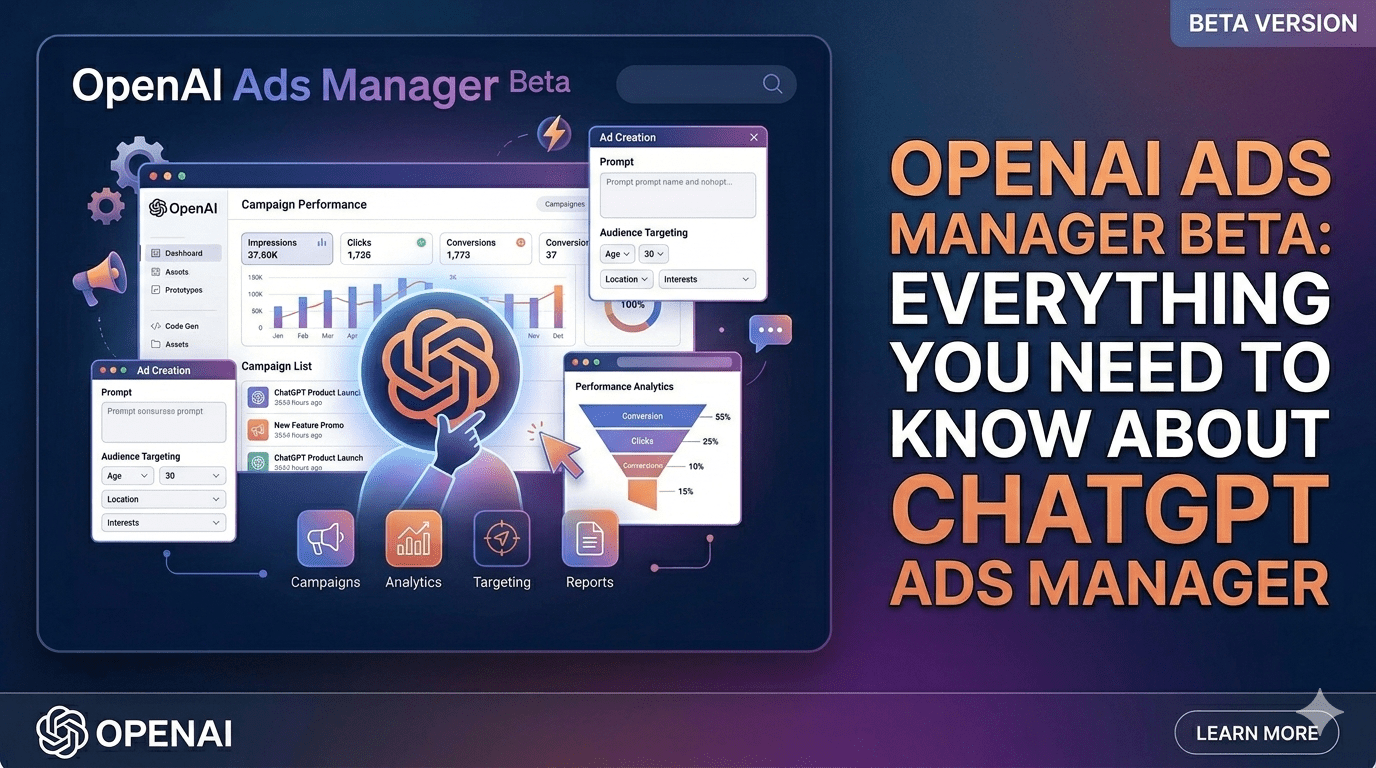
OpenAI Ads Manager Beta: Everything You Need To Know About ChatGPT Ads Manager

OpenAI Ads Manager Beta: Everything You Need To Know About ChatGPT Ads Manager

Are you a business owner struggling with reaching your target audience effectively and driving conversions? Many businesses face the challenge of navigating the ever-evolving digital marketing landscape to find the most impactful advertising channels. This article will guide you through the intricacies of the OpenAI Ads Manager Beta, offering a comprehensive look at how this innovative platform can revolutionize your advertising strategies and help you achieve scalable, results-driven marketing outcomes.

Key Takeaways:

  • The OpenAI Ads Manager Beta offers a new, powerful way for advertisers to reach users within ChatGPT, leveraging AI for targeted campaigns.
  • The platform provides a self-serve interface, giving marketers greater control over their ad campaigns, from budget setting to performance optimization.
  • Key features include advanced targeting options, various ad formats, and detailed analytics to measure campaign effectiveness and return on investment.
  • The AD Leaf Marketing Firm is an expert partner, ready to help businesses harness the full potential of the OpenAI Ads Manager Beta, ensuring campaigns are strategically developed and optimally managed for maximum results.

What is the OpenAI Ads Manager Beta?

ChatGPT Ads, openai advertising, OoenClaw AI

Overview of the Ads Manager Beta

The OpenAI Ads Manager Beta represents a significant leap forward in digital advertising, offering a self-serve platform that allows advertisers to create and manage campaigns directly within OpenAI’s ecosystem, particularly within ChatGPT. This beta phase is designed to provide marketers with an early opportunity to leverage OpenAI’s powerful AI capabilities for delivering highly relevant ads, ultimately aiming to enhance user experience while providing valuable advertising real estate for businesses. The ads manager beta platform is transforming how businesses approach contextual advertising.

Key Features of OpenAI Ads Manager

The OpenAI Ads Manager offers robust features designed to give advertisers more control over campaign performance and targeting. Its intuitive interface makes managing campaigns straightforward, even for those new to the ad platform.

Here’s a look at some of its key capabilities:

Feature Description
Targeting Detailed location targeting to reach specific audiences.
Budget Management Set specific campaign budgets for better financial control.
Ad Groups Create various ad groups to segment your audience effectively.
Conversion Tracking Monitor key metrics like CPC and CPM, and optimize for better conversion rates.

How OpenAI Expands Ads Manager Beta

OpenAI is continuously expanding its ads manager beta, integrating feedback from initial advertisers and iterating on its features. This expansion includes several key improvements:

  • Enhancing the API for broader integration possibilities
  • Introducing new ad formats
  • Improving the targeting algorithms to ensure ads inside ChatGPT are even more relevant

The goal of OpenAI is to provide a comprehensive ad platform that rivals the capabilities of established players like Google and Meta, giving marketers a powerful new channel to advertise in ChatGPT effectively and efficiently.

How to Create Your First Campaign in OpenAI Ads Manager

Step-by-Step Guide to Access Ads Manager

To access Ads Manager, you typically begin by navigating to the designated section within your OpenAI account or through a direct link provided during the beta program. Once you log in, you will find the self-serve ads manager dashboard where you can begin to create campaigns. The OpenAI Help Center offers detailed instructions and support to guide you through the initial setup, ensuring a smooth onboarding process for every new advertiser looking to leverage this innovative ad platform.

Setting Up Your Campaign Budget and Ad Groups

Setting up your campaign budget is a critical step in the OpenAI Ads Manager Beta, allowing you to define your total spend and manage expenses effectively. You can choose between daily or lifetime budgets, and then allocate funds to specific ad groups, which are collections of ads sharing common targeting parameters. This granular control over your ad groups ensures that your new ad campaigns are precisely targeted, maximizing the potential for impressions and conversions while staying within your financial limits.

Optimizing Your Campaign for Better Engagement

Optimizing your campaign in the OpenAI Ads Manager is crucial for achieving better engagement and higher conversion rates. This involves continuously monitoring key metrics such as CPC, CPM, and conversion data to identify areas for improvement. Utilizing OpenAI’s context hints and adjusting your ad creatives or landing page content based on performance insights can significantly enhance your campaign’s effectiveness. Regular optimization helps marketers refine their strategies, ensuring that every ad in ChatGPT delivers maximum impact and return on investment.

What Makes Advertising in ChatGPT Unique?

Understanding Context Hints for Ads in ChatGPT

Advertising in ChatGPT offers a unique advantage through its use of advanced context hints, which are sophisticated AI-driven signals that help determine the most relevant ad to display to a user. Unlike traditional platforms, the OpenAI Ads Manager Beta leverages the conversational context within ChatGPT to infer user intent and deliver highly targeted ads directly within the user’s interaction. This means that an ad is not just shown based on demographic data, but on what the user is actively discussing or asking, leading to a much higher likelihood of engagement and conversion for the advertiser.

Benefits of AI-Generated Ads in ChatGPT

The benefits of AI-generated ads in ChatGPT are substantial for any marketer looking to optimize their campaigns. These ads can dynamically adapt to the user’s conversation, offering unparalleled relevance and personalization. This capability leads to higher click-through rates and improved conversion metrics compared to static advertising formats. Furthermore, the OpenAI Ads Manager Beta streamlines the creation of ad content, as AI can assist in generating compelling copy that resonates with the user’s immediate context, enhancing the overall effectiveness of each impression and driving better campaign performance.

Location Targeting and CPC Considerations

Location targeting within the OpenAI Ads Manager Beta provides advertisers with precise control over where their ads are displayed, allowing businesses to reach specific geographic audiences. This feature is crucial for local businesses or campaigns with regional relevance, ensuring that the budget is spent on impressions that matter most. When considering CPC (cost per click), advertisers can optimize their bids based on the location’s market competitiveness and the desired conversion rate. This strategic approach to location targeting and CPC helps in maximizing the return on investment for new ad campaigns launched inside ChatGPT.

How to Enhance Control Over Your Campaign Pacing

Managing Your Budget Effectively

Effectively managing your budget within the OpenAI Ads Manager Beta is paramount for ensuring your campaign’s long-term success and sustainability. The self-serve platform allows advertisers to set daily or lifetime budget caps, preventing overspending and providing financial predictability. Regular monitoring of your ad spend against key performance metrics like CPM and CPC enables you to make informed adjustments. This proactive budget management ensures that your campaigns remain cost-efficient while still generating valuable impressions and conversions, ultimately helping you to optimize your overall advertising strategy.

Strategies for Optimizing Ad Engagement

Optimizing ad engagement in the OpenAI Ads Manager Beta involves a multi-faceted approach, starting with crafting highly relevant ad copy and selecting appropriate ad formats that resonate with the ChatGPT user base. A/B testing different creative variations and calls to action can provide valuable insights into what drives the best performance. Furthermore, continuously refining your ad group targeting based on conversion data helps ensure that your ads are reaching the most receptive audience. By consistently analyzing engagement metrics and adapting your strategies, marketers can significantly boost interaction and achieve higher conversion rates.

Utilizing OpenAI’s Features for Campaign Control

OpenAI’s Ads Manager Beta offers a suite of features designed to give advertisers more control over campaign performance and pacing. Beyond budget management and ad group customization, the platform’s detailed analytics provide deep insights into every metric, allowing for precise adjustments. Leverage the OpenAI Help Center for advanced tips on using the API for automated campaign management, or explore how OpenAI expands ads manager beta capabilities through new updates. These tools empower marketers to fine-tune every aspect of their ad campaign, ensuring optimal performance and strategic deployment of their ad budget.

Onboarding and Verification Process for Advertisers

How to Create Your Account and Get Started with OpenAI Ads?

To begin your journey as an advertiser on the OpenAI Ads Manager Beta, the first step involves creating your account, which is a straightforward process designed for a self-serve experience. You’ll typically start by visiting the OpenAI platform and locating the sign-up section for the ads manager. This initial setup requires basic business information and agreement to the terms of service, paving the way for you to create campaigns and access the powerful tools for advertising in ChatGPT. The OpenAI Help Center is a valuable resource if you encounter any difficulties during this crucial first step.

What to Expect During the Onboarding Process for OpenAI Ads?

During the onboarding process for the OpenAI Ads Manager Beta, advertisers can expect a guided experience aimed at familiarizing them with the self-serve platform’s functionalities. This includes tutorials on setting up your first campaign, understanding budget management, and how to define ad groups effectively. The process is designed to ensure that even marketers new to AI-driven advertising can quickly grasp how to create campaigns that drive conversion. Expect comprehensive support to help you navigate the features and start generating valuable impressions right away.

What are the Verification Requirements for Advertisers on OpenAI Ads?

Verification requirements for advertisers on the OpenAI Ads Manager Beta are in place to ensure a trusted and secure advertising environment for all users of ChatGPT. These requirements typically involve submitting documentation to confirm your business identity and legitimacy, which helps prevent fraudulent activities and maintains the integrity of the ad platform. Adhering to these verification steps is essential before you can fully launch your new ad campaigns, ensuring that all ads directly inside ChatGPT are legitimate and trustworthy, fostering a safe ecosystem for both advertisers and users.

Frequently Asked Questions About OpenAI Ads Manager Beta

What is the difference between OpenAI Ads Manager and traditional ad platforms?

The primary difference between OpenAI Ads Manager Beta and traditional ad platforms like Google and Meta lies in its unique integration with ChatGPT and its reliance on AI-driven context hints.

Platform Ad Targeting Method
OpenAI Ads Manager Beta Leverages real-time conversational context within ChatGPT to deliver highly relevant ads.
Traditional Platforms (e.g., Google, Meta) Often target based on demographics and browsing history.

This allows marketers to create campaigns that are hyper-contextual, potentially leading to higher engagement and conversion rates because ads are shown when they are most pertinent to the user’s current interaction.

How can I optimize my ads for better performance?

To optimize your ads for better performance within the OpenAI Ads Manager Beta, focus on refining your targeting, ad creatives, and campaign budget allocation. Regularly review your metrics such as CPC and CPM to identify underperforming areas. Utilize OpenAI’s context hints to craft more relevant ads, and continuously A/B test different ad formats and landing page experiences. Adjusting your ad group settings based on conversion tracking data will also significantly enhance your campaign’s effectiveness, ensuring that every impression contributes positively to your overall conversion goals. The AD Leaf Marketing Firm specializes in these optimization strategies.

What types of businesses can benefit from OpenAI Ads Manager?

A wide range of businesses can benefit immensely from the OpenAI Ads Manager Beta, particularly those seeking to engage users in a conversational, highly contextual environment. This includes e-commerce businesses looking to showcase products directly related to user queries, service-based companies aiming to offer solutions to discussed problems, and content creators promoting relevant articles or tools. Any marketer focused on precise location targeting and eager to leverage AI for enhanced ad relevance will find this ad platform invaluable for driving conversion and expanding their reach inside ChatGPT.

Is there a cost associated with using the OpenAI Ads Manager Beta?

Yes, there is a cost associated with using the OpenAI Ads Manager Beta, as it operates on a standard advertising model where advertisers pay for impressions or clicks, typically measured by CPC or CPM. While the platform itself is a self-serve ads manager, your campaign budget dictates the financial commitment. OpenAI allows marketers to set daily or lifetime budgets for their ad group, providing control over spending. The beta phase allows advertisers to explore the platform’s capabilities and understand the cost-effectiveness of advertising in ChatGPT before full-scale deployment.

How does location targeting work in ChatGPT ads?

Location targeting in ChatGPT ads within the OpenAI Ads Manager Beta functions with advanced precision, allowing advertisers to specify geographic areas where their ads will be displayed. This feature is crucial for businesses aiming to reach local customers or those with region-specific services. The ad platform utilizes user-provided location data and other contextual cues to ensure that relevant ads are shown to users within the designated areas. This enhances the effectiveness of local campaigns, ensuring that your campaign budget is spent on impressions that are most likely to convert in specific geographical markets.

What support does The AD Leaf Marketing Firm offer for OpenAI Ads?

The AD Leaf Marketing Firm offers comprehensive support for businesses looking to leverage the OpenAI Ads Manager Beta, acting as your expert partner from strategy to execution. We assist with everything from initial account setup and understanding the onboarding process to crafting compelling ad formats and optimizing your campaign budget for maximum conversion. Our team specializes in utilizing context hints, managing ad groups, and interpreting key metrics like CPC and CPM to ensure your ads in ChatGPT perform optimally. With our expertise, you can confidently navigate this new ad platform and achieve significant results.

What is Search Engine Optimization?

Every business wants more customers, stronger brand awareness, and better results online. Search engine optimization helps make that happen. When potential customers search for products or services online, businesses with strong SEO strategies appear higher in search results and attract more traffic. 

Companies that invest in SEO basics improve their search engine ranking, strengthen online visibility, and create more opportunities for long-term growth. At The AD Leaf Marketing Firm, we help businesses develop marketing strategies that drive traffic, improve website performance, and generate qualified leads. 

Organic search drives 53% of all website traffic, making SEO one of the most important digital marketing investments for businesses today. If your business wants to improve online visibility and generate more leads, contact us today to learn how our strategies can support your goals.

Understanding the SEO Basics

Many business owners hear the term SEO often, but they may not fully understand how it works. SEO basics focus on improving the quality and structure of your website so search engines can evaluate your content effectively.

Search engines analyze hundreds of factors when determining search engine ranking positions, including:

  • Quality website content and mobile-friendly website design
  • Fast loading speeds and strategic keyword research
  • Clear website navigation and website optimization
  • Optimized title tags and meta descriptions
  • Backlinks from trusted websites

When working on web pages, backlinking is used to build your webpage’s domain authority. Backlinks are important for SEO because they signal to Google that other resources find your content valuable enough to link to it on their own pages.

Mastering SEO basics involves creating content that answers common customer questions. Businesses that publish informative content improve their online visibility because search engines reward helpful websites. For example, businesses developing a larger digital strategy should focus on content marketing to boost online visibility and search engine ranking.

The Role of Keyword Research in SEO

Strategic keyword research plays a major role in every successful SEO campaign and forms the core of SEO basics. Without proper keyword research, businesses risk creating content that customers never search for online.

Effective keyword research identifies the exact phrases potential customers use. Businesses can then build website content around those terms to improve online visibility and search engine ranking. It also helps businesses understand customer intent—whether a user is gathering information or ready to buy.

At The AD Leaf Marketing Firm, we use keyword research to develop comprehensive website optimization strategies that align with your business goals. We analyze competition, search volume, and customer behavior to maximize impact.

Strong keyword research supports:

  • Better search engine ranking and online visibility
  • More targeted website traffic and website optimization
  • Higher conversion opportunities driven by targeted keyword research

Because search trends evolve, maintaining SEO basics requires ongoing adjustments to keyword research to protect your online visibility.

Businesses combining SEO basics with broader marketing campaigns see stronger results during seasonal promotions.

The Role of Keyword Research in SEO

Strategic keyword research plays a major role in every successful SEO campaign and forms the core of SEO basics. Without proper keyword research, businesses risk creating content that customers never search for online.

Effective keyword research identifies the exact phrases potential customers use. Businesses can then build website content around those terms to improve online visibility and search engine ranking. It also helps businesses understand customer intent, whether a user is gathering information or ready to buy.

At The AD Leaf Marketing Firm, we use keyword research to develop comprehensive website optimization strategies that align with your business goals. We analyze competition, search volume, and customer behavior to maximize impact.

Strong keyword research supports:

  • Better search engine ranking and online visibility
  • More targeted website traffic and website optimization
  • Higher conversion opportunities driven by targeted keyword research

Because search trends evolve, maintaining SEO basics requires ongoing adjustments to keyword research to protect your online visibility.

Website Optimization Improves User Experience

Comprehensive website optimization affects more than just search engines; it directly impacts how customers interact with your website. A slow site hurts conversions and reduces trust, which is why optimizing a website improves site speed, mobile responsiveness, and navigation.

Google heavily considers user experience when determining search engine ranking positions. Effective website optimization strategies include compressing images, improving mobile design, and organizing content with headings.

Businesses that prioritize website optimization consistently improve online visibility and increase engagement. SEO basics and website optimization must work together; understanding SEO basics allows you to resolve technical issues that make it difficult to maintain a strong search engine ranking. Building a successful strategy also requires strong collaboration with your marketing partner to align keyword research with user needs.

How AEO Supports Modern Search Strategies

Answer Engine Optimization (AEO) is a crucial part of modern digital marketing. While SEO basics focus on improving search engine ranking and online visibility in traditional search results, AEO helps businesses appear in direct answers generated by AI-powered tools.

As search behavior becomes more conversational, structuring content around customer questions improves your overall online visibility. Successful AEO strategies include:

  • Creating FAQ content based on detailed keyword research
  • Improving website optimization for mobile devices
  • Targeting conversational phrases to boost your search engine ranking

SEO basics and AEO work together to strengthen your digital presence. Focusing on both ensures you appear in traditional search engine ranking results while earning visibility in AI-generated responses. At The AD Leaf Marketing Firm, we adapt your website optimization and content strategies to improve online visibility and position you for future trends using targeted keyword research. Contact us today to learn how our SEO strategies can help your business stay competitive online.

Why Consistency Matters in SEO

Many businesses expect instant results, but search engine optimization is a long-term strategy. Consistency plays a major role in improving search engine ranking and maintaining online visibility.

Businesses that regularly publish high-quality content, conduct ongoing keyword research, and continually optimize their websites typically see the strongest long-term growth. SEO basics should be treated as an ongoing marketing strategy rather than a one-time project to sustain online visibility.

At The AD Leaf Marketing Firm, we help businesses adapt to algorithm changes. Our team continuously optimizes your website, conducts detailed keyword research, and monitors search engine rankings to keep your business competitive.

Why The AD Leaf?

At The AD Leaf, we believe successful SEO strategies require more than technical updates. Businesses need marketing partners who understand branding, customer behavior, and long-term growth. Our team works closely with you to improve online visibility, strengthen search engine rankings, and implement website optimization strategies to support lead generation.

We combine SEO basics, strategic keyword research, content development, and digital marketing expertise to help you compete online. Whether you want to improve online visibility, generate more leads, or strengthen your overall digital presence, contact us today to learn how The AD Leaf can build a customized plan grounded in foundational SEO.

Increasing A Website’s Potential With An SEO Site Audit

Search Engine Optimization continues to evolve every year. Search engines regularly update their algorithms, customer behavior changes, and online competition grows stronger across nearly every industry. Businesses today need more than just a visually appealing website to remain competitive. Without strong SEO services and proper optimization, many websites struggle with poor SEO ranking, weak lead generation, and low conversion rates.

At The AD Leaf Marketing Firm, we help businesses improve online visibility through SEO services, AI-powered marketing, and customized digital strategies. One of the most effective ways to identify growth opportunities is through a professional SEO site audit.

An SEO site audit evaluates the overall health and performance of your website. It examines technical SEO, content quality, mobile responsiveness, backlinks, metadata, keyword targeting, customer targeting, and conversion rate optimization. The audit helps businesses understand what is driving their website’s success and what may be limiting online growth.

Many business owners believe launching a website alone will attract customers. In reality, a website without optimization often becomes little more than an online business card. A properly optimized website should serve as a lead-generation tool that delivers measurable ROI and long-term growth.

According to Google Search Central, page experience, mobile usability, and content quality all influence search visibility. Businesses that ignore these factors often struggle to compete online.

What Does An SEO Site Audit Analyze?

An SEO audit provides businesses with a detailed report on website performance and identifies technical or content-related issues affecting rankings and conversions.

At The AD Leaf Marketing Firm, our SEO services evaluate:

  • Page speed
  • Mobile responsiveness
  • SEO keywords
  • Metadata
  • Backlinks
  • Internal linking
  • Technical SEO errors
  • User experience
  • Conversion rate optimization
  • Customer targeting

The purpose of the audit is to identify gaps between your website’s current performance and where it should be performing. Once those issues are identified, businesses can create smarter digital marketing strategies that improve traffic and lead generation.

For example, slow-loading pages often increase bounce rates and reduce conversions. Weak content marketing services may prevent pages from ranking effectively. Poor customer targeting can attract unqualified traffic that does not convert into leads or sales.

An SEO audit helps uncover these problems before they continue affecting business growth.

Book your strategy session today and discover what your marketing is missing.

Why SEO Audits Matter For Businesses

Businesses that skip SEO audits often experience inconsistent lead generation and limited online visibility. Even companies investing in PPC management services and social media marketing agency campaigns may struggle if their website foundation remains weak.

An SEO audit allows businesses to:

  • Improve customer targeting
  • Increase search visibility
  • Strengthen content marketing services
  • Improve measurable ROI
  • Support conversion rate optimization
  • Improve website usability
  • Strengthen AI-powered marketing strategies

At The AD Leaf Marketing Firm, we use predictive marketing analytics and AI-powered marketing tools to help businesses make smarter data-driven decisions. This allows companies to better understand customer behavior while improving digital campaign performance.

According to HubSpot Marketing Statistics, businesses prioritizing SEO and content marketing are significantly more likely to generate positive long-term ROI than businesses without a clear optimization strategy.

Common Website Problems: SEO Audits Identify

One of the biggest advantages of an SEO audit is the ability to identify hidden website problems that may not be immediately obvious.

Some of the most common issues include:

  • Broken links
  • Duplicate content
  • Missing metadata
  • Weak keyword targeting
  • Poor mobile performance
  • Slow-loading pages
  • Outdated SEO strategies
  • Weak calls-to-action
  • Low-quality backlinks

These issues can hurt rankings, reduce traffic, and negatively impact conversion rate optimization.

Our team creates customized marketing roadmaps designed to solve these problems while improving lead generation and online visibility.

Why The AD Leaf

At The AD Leaf Marketing Firm Corporate, we help businesses turn underperforming websites into high-performing digital assets. Our team combines SEO, content marketing, PPC management, predictive marketing analytics, and AI-powered marketing strategies to support long-term growth.

We focus on measurable ROI, stronger customer targeting, and sustainable digital success. Whether your business needs a complete SEO-optimized website, upgraded digital assets, or a customized marketing roadmap, our team is ready to help.

Take the first step toward better results, and let’s map out your growth together with The AD Leaf Marketing Firm.

Anthropic Launches Claude Design, Claude Opus 4.7, OpenAI

Anthropic Launches Claude Design: Everything You Need to Know

Anthropic Launches Claude Design: Everything You Need to Know

Are you a business owner grappling with inefficient design workflows and struggling to keep pace with rapid product development cycles? The constant need for high-quality visual assets and seamless developer handoffs can be a significant bottleneck, impacting your marketing efforts and overall business growth. This article dicusses Anthropic’s new product, Claude Design, offering a comprehensive guide to understanding its capabilities and how it can revolutionize your design process, providing the solution you’ve been seeking to streamline operations and enhance your creative output.

What Is Anthropic’s Claude Design and Why Is It Important to Design?

Anthropic just launched Claude Design, a groundbreaking artificial intelligence-powered design tool that promises to transform how businesses approach their visual work. Understanding what Claude Design offers and its significance for the design process is crucial for any enterprise looking to gain a competitive edge in today’s fast-paced digital landscape. This new product is set to make design more accessible, efficient, and integrated than ever before, marking a pivotal moment in AI-driven creativity.

Overview of Claude Design

Claude Design, an innovative AI design tool from Anthropic Labs, empowers users of all design backgrounds to create polished visual work with unprecedented ease. This powerful tool acts as a collaborative partner, enabling product managers, marketers, and designers to bring their visions to life through intuitive interactions and intelligent automation, making complex design tasks manageable for everyone on the team.

Feature Detail
Power Source Claude Opus 4.7
Capabilities Understands complex design instructions and generates sophisticated outputs

Key Features of Claude Design

The core of Claude Design’s appeal lies in its robust set of features. It includes a sophisticated web capture tool that can analyze existing websites or PDFs to understand design patterns. Users can provide a text prompt to ask Claude to create various design outputs, which can then be exported in multiple formats:

Design Output Export Formats
Mockups, One-pagers, or Entire Design Systems Standalone HTML files, PPTs, or PDFs

Furthermore, Claude Design is engineered to build integrations with Claude Code, facilitating a seamless handoff from design to implementation, making the entire product development lifecycle more fluid and efficient.

How Claude Design Differentiates From Other Tools

While other AI tools like Canva and OpenAI offer design assistance, Claude Design carves out a unique niche. It focuses on creating comprehensive design systems through its deep integration with Anthropic’s advanced AI models. Unlike tools that primarily offer templates or isolated graphic elements, Claude Design can intelligently build a design system based on a team’s design guidelines, ensuring consistency across all visual assets. Its ability to pass to Claude Code for implementation further distinguishes it, offering an end-to-end solution. Below is a comparison of Claude Design with competitors:

Feature Claude Design Competitors (e.g., Figma, Adobe)
Core Functionality Builds design systems based on guidelines Primarily offers templates or isolated graphic elements
AI Integration Deep integration with Anthropic’s AI models for intelligent design system creation AI-driven features may be present but not for end-to-end design and development workflows
Workflow Integration End-to-end solution, passes to Claude Code for implementation Does not provide the same level of integrated design and development workflows


How to Get Started with Claude Design

Embarking on your journey with Claude Design is straightforward, even if you are new to AI design tools. Anthropic has made Claude Design accessible, ensuring that users can quickly set up their accounts, familiarize themselves with the user interface, and begin creating prototypes without a steep learning curve. The following steps will guide you through the initial process, enabling you to harness the power of this new product for your design needs, from account creation to your first successful project.

Setting Up Your Claude Design Account

To begin using Claude Design, you first need to set up an account, which is currently available as a research preview for Claude Pro and enterprise subscribers. This involves navigating to the Anthropic website and following the registration prompts, which typically require an email address and some basic information to create your user profile. Once your account is active, you will gain access to the Claude Design platform, where you can start exploring its capabilities and integrating it into your existing design workflows with ease and efficiency.

Exploring the User Interface: Figma vs. Claude Design

Upon logging in, you’ll find that the Claude Design user interface is intuitively designed, though it might differ from traditional design tools like Figma or Adobe products. While Figma focuses on collaborative vector graphics editing, Claude Design emphasizes AI-driven generation and system building through text prompts. Users can ask Claude to generate designs, refine existing ones, and manage typography and visual components, moving beyond manual manipulation towards an AI-assisted creative process that redefines interaction with design software. This distinction is vital for understanding its operational philosophy.

Creating Your First Prototype Using Claude Design

Creating your first prototype with Claude Design is an exciting step into AI-powered design. You can start by providing a text prompt describing your desired mockup or one-pager, perhaps specifying a layout, color scheme, and key elements. Claude Design will then leverage its intelligence, powered by Claude Opus 4.7, to generate an initial design, which you can then refine by giving further instructions. This iterative process allows you to collaborate with Claude to create polished visual work, ultimately exporting your prototype as standalone HTML or PDF, ready for review and implementation, bridging the gap between concept and tangible output.

Integrating Claude Code for Enhanced Workflow

What Is Claude Code and What Are the Benefits of Claude Opus 4.7?

Claude Code is Anthropic’s innovative AI coding assistant, designed to seamlessly integrate with Claude Design to transform creative visions into functional code. Powered by the advanced Claude Opus 4.7, Claude Code offers significant benefits by generating clean, efficient code from design mockups, ensuring that the transition from a visual prototype to a live product is smooth and accurate. This integration accelerates development cycles, reduces manual coding efforts, and enhances collaboration between designers and developers, ultimately streamlining the entire product development workflow and allowing teams to build integrations more efficiently.

How to Handoff Your Designs to Claude Code

Handoffs from Claude Design to Claude Code are designed to be effortless, leveraging the deep integration between these Anthropic tools. Once you have created and refined your design in Claude Design, you can simply utilize the “handoff to Claude Code” functionality within the platform. This allows Claude Code to interpret the design system, layouts, and components, generating a corresponding codebase automatically. This streamlined process eliminates much of the traditional manual translation of design specifications into code, ensuring consistency and drastically speeding up development, moving seamlessly from a visual concept to a working prototype.

Best Practices for Using Claude Code with Claude Design

To maximize the efficiency and effectiveness of using Claude Code with Claude Design, several best practices should be followed. Ensure your Claude Design projects are well-structured with clear design systems and consistent typography. When providing a text prompt for Claude Design, be as specific as possible, detailing functional requirements alongside visual elements. Regularly review the generated codebase and design files from Claude Code to ensure they align with your project’s technical specifications and refine as needed. This collaborative approach with Claude will ensure high-quality outputs and a truly integrated design-to-development pipeline, creating polished visual work.

Comparing Claude Design to Other Design Tools

Claude Design vs. Figma: A Feature Comparison

While Figma excels as a collaborative vector graphics editor and prototyping tool, Claude Design distinguishes itself with its AI-first approach. Claude Design, powered by Claude Opus 4.7, can generate entire design systems from a text prompt, whereas Figma requires manual creation of components and styles. Figma’s strength lies in real-time team collaboration on design files, while Claude Design’s unique selling proposition is its ability to directly build integrations with Claude Code, automating the transition from visual design to a functional codebase. Both tools offer powerful features, but Claude Design offers an integrated AI solution.

Claude Design vs. Canva: Which Is Right for You?

Choosing between Claude Design and Canva depends heavily on your specific needs and design background. Canva is an intuitive, template-based graphic design tool ideal for quick, simple visual work, such as social media graphics and presentations, requiring minimal design expertise. Claude Design, as a new product from Anthropic, is built for more complex design challenges, capable of generating comprehensive mockups, one-pagers, and entire design systems through an intelligent text prompt. For businesses seeking advanced AI assistance to streamline product design and development, Claude Design offers a more robust and integrated solution than Canva.

Advantages of Using Claude Design Over Adobe Products

Claude Design presents significant advantages over traditional Adobe products like Photoshop and Illustrator, particularly in terms of automation and AI integration. While Adobe tools offer unparalleled granular control for professional designers, they often involve manual, labor-intensive processes. Claude Design, launched by Anthropic and powered by Claude Opus 4.7, automates many design tasks, allowing users to ask Claude to generate complex designs from simple text prompts and then pass to Claude Code for implementation. This end-to-end AI-driven workflow significantly reduces time-to-market and allows product managers to create polished visual work with unprecedented speed and efficiency.

Key Takeaways

Summary of Claude Design Features

Claude Design, a new product from Anthropic, redefines the design process with its AI-powered capabilities. Key features include a web capture tool for analyzing existing designs, the ability to generate entire design systems, mockups, and one-pagers from a text prompt, and seamless integration with Claude Code for development handoffs. It is powered by Claude Opus 4.7, ensuring intelligent and sophisticated outputs, and allows users to export designs as standalone HTML files, PPTs, or PDFs, making it an incredibly versatile and powerful design tool for various applications.

Benefits of Using Claude Design for Businesses

For businesses, Claude Design offers a multitude of benefits, primarily by streamlining the entire design-to-development pipeline. It significantly accelerates product development cycles, reduces the need for extensive design expertise within a team, and ensures design consistency across all visual assets by building a design system from the ground up. The ability to collaborate with Claude to create and refine designs, coupled with the efficient handoff to Claude Code, enables faster iteration and deployment, ultimately saving time and resources while enhancing the quality of your company’s visual work.

Why Choose The AD Leaf Marketing Firm for Implementation

Implementing a sophisticated AI design tool like Claude Design into your existing workflows requires expert guidance to maximize its potential. The AD Leaf Marketing Firm specializes in integrating cutting-edge AI marketing and advertising solutions for businesses of all sizes. Our team can help you leverage Claude Design to create polished visual work, optimize your design systems, and ensure seamless handoffs to development, guaranteeing that your investment in this powerful new product translates into tangible business growth and increased efficiency. Partner with us to unlock the full power of Anthropic’s Claude Design.

More About Agentic AI and AI Agent Development

Agentic AI Use Cases for Businesses

Agentic AI, exemplified by tools such as Claude Design, offers a transformative approach for businesses across various sectors. These AI agents, powered by advanced models like Claude Opus 4.7, can automate and optimize complex tasks that traditionally require significant human intervention. For instance, in marketing, agentic AI can generate sophisticated ad creatives, personalize customer experiences, and analyze market trends to inform strategy, all through an intelligent prompt system. This allows product managers and marketing teams to focus on higher-level strategic planning rather than repetitive operational tasks.

In product development, Agentic AI can revolutionize the prototyping phase. A business can ask Claude to create mockups or one-pagers based on a text prompt, rapidly iterating through design concepts. Furthermore, with the integration of Claude Code, these designs can be seamlessly converted into a functional codebase, accelerating the development cycle from concept to a tangible prototype. This capability to build integrations with Claude Design and Claude Code dramatically reduces time-to-market and enhances efficiency in creating polished visual work, allowing companies to respond faster to market demands.

Frequently Asked Questions | The AD Leaf Marketing Firm

What Is the Main Purpose of Claude Design?

The main purpose of Claude Design, a new product launched by Anthropic, is to democratize and accelerate the design process using advanced artificial intelligence. It empowers users, regardless of their design background, to create polished visual work, including mockups, one-pagers, and entire design systems, primarily through intuitive text prompts. The tool aims to streamline the workflow from conceptualization to implementation by offering seamless integration with Claude Code for efficient design-to-development handoffs, making it a comprehensive solution for modern businesses.

How Can I Export Designs from Claude Design?

Users of Claude Design can easily export their created designs in several versatile formats to suit various needs. Once you collaborate with Claude to create and refine your visual work, you have the option to export the output as standalone HTML files, PPTs, or PDFs. This flexibility ensures that the designs generated by Claude Design, powered by Claude Opus 4.7, can be readily shared with stakeholders, integrated into presentations, or used directly for web development, providing practical utility beyond just the design phase.

Is Claude Design Suitable for Small Businesses?

Yes, Claude Design is particularly suitable for small businesses, offering significant advantages by enabling them to produce high-quality visual work without the need for extensive in-house design expertise or expensive external agencies. With its user-friendly interface and the ability to generate designs from a simple text prompt, small businesses can create professional mockups, one-pagers, and even develop a consistent design system. This allows them to compete effectively in the market by rapidly developing compelling marketing materials and product prototypes, leveraging advanced AI tools from Anthropic.

How Does Claude Design Enhance Collaboration Among Teams?

Claude Design significantly enhances collaboration among teams by providing a common, AI-driven platform where product managers, marketers, and designers can articulate their visions using natural language prompts. The tool allows team members to ask Claude to generate initial designs and then collectively refine them through iterative text prompts. This fosters a more inclusive design process where feedback can be directly incorporated, and changes can be implemented swiftly. Furthermore, its ability to pass to Claude Code facilitates a smoother handoff between design and development, ensuring alignment across the entire project lifecycle.

Can I Use Claude Design Offline?

Currently, Claude Design, as a cutting-edge AI design tool powered by Claude Opus 4.7, requires an active internet connection to function. Its capabilities, including processing complex text prompts, leveraging its web capture tool, and generating sophisticated design files, rely on access to Anthropic’s cloud-based AI models. Therefore, to collaborate with Claude to create and refine your visual work, you will need to be online. There is no information suggesting an offline mode is available for the research preview or enterprise subscribers at this time.

What Are Common Issues Users Face With Claude Design?

As a relatively new product, users of Claude Design, while benefiting from its innovative AI capabilities, might encounter some common challenges. These could include occasional inconsistencies in design output that require further refinement via prompt adjustments, a learning curve in formulating effective text prompts to achieve desired results, and potential limitations in handling highly specialized or niche design requirements compared to traditional manual tools like Figma and Adobe. Additionally, as it is a research preview for Claude Pro and enterprise subscribers, access and specific feature availability might evolve.

ai virtual receptionist, ai phone answering service

AI Reasoning vs. Human Logic: Why You Shouldn’t Fire Your Marketing Team

AI Reasoning vs. Human Logic: Understanding the Core Differences & Why You Shouldn’t Fire Your Marketing Team

While AI offers immense potential to streamline processes and uncover insights, understanding its true capabilities and limitations in comparison to human reasoning is crucial for making informed decisions and finding a sustainable path to growth. This article will help clarify the distinctions between AI and human intelligence, enabling you to leverage technology wisely and empower your marketing team for unprecedented success.

What are the Key Differences Between AI and Human Reasoning?

Understanding AI Reasoning and Its Mechanisms

AI reasoning primarily operates on algorithms and vast datasets, excelling at pattern recognition and data processing. An AI system, whether it’s a deep learning model or a more traditional AI, learns from its training data to make predictions or classifications. This allows AI to perform tasks like image recognition or language translation with remarkable speed and accuracy, but it fundamentally differs from human intelligence.

Aspect AI Reasoning
Mechanism Algorithms and vast datasets
“Understanding” Statistical, based on identifying correlations
Core Strengths Pattern recognition, data processing, speed, accuracy

Human Intelligence: A Unique Approach to Problem Solving

Human intelligence involves a complex interplay of experience, emotion, intuition, and abstract thought. Our reasoning ability allows us to understand context, adapt to novel situations, and engage in creative problem-solving in ways that current AI cannot replicate. The ability to empathize, strategize based on ambiguous information, and innovate truly sets human capabilities apart, particularly in dynamic fields like marketing where understanding consumer psychology is paramount.

Aspect of Human Intelligence Key Capability
Contextual Understanding Adapting to novel situations
Creative Problem-Solving Empathy and strategizing with ambiguous information

This makes the partnership of AI and human intelligence so powerful.

The Role of Bias in AI and Human Decision Making

Both AI and human decision-making are susceptible to bias, though their origins differ. Recognizing and mitigating these biases is crucial for effective marketing strategies.

Type of Bias Origin
AI Bias Typically stems from the training data itself; if the dataset reflects historical prejudices or skewed information, the AI output will inherit and perpetuate these biases. For example, if an AI system is trained on unrepresentative marketing data, its recommendations might inadvertently exclude certain demographics.
Human Cognitive Biases Arise from our psychological shortcuts, past experiences, and emotional responses, which can also lead to suboptimal decisions.

How Does Generative AI Compare to Traditional AI?

Key Features of Generative Models

Generative AI, exemplified by large language models (LLMs) like ChatGPT, represents a significant leap from traditional AI by creating new content rather than just analyzing existing data. These generative models are trained on massive text datasets and can generate human-like text, images, or even code. The architecture of these LLMs allows them to predict the next word or pixel in a sequence, leading to incredibly coherent and creative output. Generative AI excels in content creation, brainstorming, and drafting initial marketing copy, demonstrating a powerful new facet of artificial intelligence.

Weaknesses of Generative AI in Marketing

Despite their impressive capabilities, generative AI models like ChatGPT have notable weaknesses in marketing applications. They often lack real-world understanding and common sense, which can lead to factual inaccuracies or “hallucinations” in their output. Furthermore, while they can generate creative content, they struggle with truly original strategic thinking, understanding nuanced market sentiment, or adapting to rapidly changing human emotions. Relying solely on generative AI doesn’t account for the critical, context-specific insights that human experts bring to a marketing campaign.

Advantages of Traditional AI in Business

Traditional AI, encompassing algorithms for classification, regression, and optimization, offers distinct advantages in business, particularly in areas requiring precision and structure. These AI models excel at tasks like predictive analytics, customer segmentation, fraud detection, and inventory management, where accuracy based on historical data is paramount. Unlike generative AI, traditional AI is often more interpretable, allowing businesses to understand why certain decisions or predictions are made. In marketing, traditional AI is invaluable for optimizing ad spend, personalizing recommendations based on past behavior, and analyzing campaign performance metrics reliably.

Why Is Human Intelligence Still Essential in the Age of AI?

The Importance of Emotional Intelligence in Marketing

Emotional intelligence remains a critical domain where human intelligence far surpasses current AI capabilities, particularly in marketing. Understanding the nuanced emotions of target audiences, empathizing with their pain points, and crafting messaging that truly resonates requires a level of human cognition that AI systems simply cannot replicate. While AI can analyze sentiment from text, it lacks the real-world understanding and intuitive grasp of human feelings necessary to build deep, meaningful connections with consumers. This human ability is essential for developing impactful brand narratives and fostering customer loyalty.

Creative Thinking: A Domain Where Humans Excel

Creative thinking is another crucial area where human reasoning continues to be indispensable, especially in the dynamic field of marketing. While generative AI models like ChatGPT can produce novel content and even suggest innovative ideas based on its training data, its creativity is ultimately derivative, stemming from patterns it has learned. True human creativity involves breaking existing patterns, conceiving entirely new concepts, and adapting to unforeseen market shifts with original thought. The ability to conceptualize truly groundbreaking campaigns and develop unique strategies still firmly resides within human capabilities.

How AI and Human Teams Can Collaborate Effectively

The most effective marketing strategies emerge from a synergistic collaboration between AI and human teams, leveraging the strengths of both. AI excels at data analysis, pattern recognition, and automating repetitive tasks, providing valuable insights and freeing up human experts for more strategic work. Human intelligence, with its capacity for emotional intelligence, creative thinking, and nuanced understanding of context, then interprets these insights, adds a layer of empathy, and crafts truly impactful campaigns. This “AI and human” partnership ensures that campaigns are data-driven yet deeply human-centric, optimizing both efficiency and effectiveness.

What Are the Implications of AI Models on Marketing Teams?

AI Models’ Impact on Marketing Strategies

The integration of advanced AI models profoundly impacts contemporary marketing strategies by automating numerous processes and uncovering intricate patterns within vast datasets. While AI excels at tasks such as predictive analytics, personalized content delivery, and optimizing ad spend, it redefines the role of human marketers. Instead of replacing human intelligence, AI systems augment our capabilities, allowing marketing teams to focus on higher-value activities like strategic planning, creative direction, and fostering authentic customer relationships. This shift means marketing strategies become more data-driven, efficient, and targeted, yet still require a human touch for true resonance.

How to Integrate AI Without Displacing Your Team

Successfully integrating AI into your marketing operations without displacing your team involves strategic planning and upskilling. Focus on leveraging AI models to automate repetitive tasks, allowing human experts to concentrate on creative and strategic initiatives that require nuanced understanding and emotional intelligence. Provide comprehensive training for your team on how to effectively utilize AI tools, interpret their output, and collaborate with AI systems. Emphasizing the “AI and human” partnership ensures that AI becomes a powerful assistant, enhancing productivity and innovation rather than a replacement for valuable human talent and expertise.

Case Studies: Successful AI-Human Collaborations

Numerous case studies highlight the success of AI and human collaborations in marketing. For instance, a major e-commerce brand used traditional AI for customer segmentation and personalized product recommendations, while human marketers crafted emotionally resonant campaigns based on these insights, resulting in a 20% increase in conversion rates. Another example involves a content agency employing generative AI models like ChatGPT for drafting initial content outlines and social media captions, freeing up human writers to refine, add unique voice, and ensure factual accuracy and creative impact. These examples underscore how AI enhances, rather than diminishes, human capabilities.

Conclusion: Embracing Both AI and Human Intelligence in Marketing

Key Takeaways from AI vs. Human Reasoning

The core differences between AI and human reasoning are fundamental: AI excels in pattern recognition and data processing using algorithms and training data, while human intelligence offers unique advantages in emotional intelligence, creative thinking, and contextual understanding. Generative AI models, while capable of creating new content, lack real-world understanding and common sense, which is where human experts provide invaluable input. Effective marketing strategies therefore emerge from a powerful “AI and human” collaboration, where AI handles data-heavy tasks, and humans provide the strategic, empathetic, and creative direction.

How to Position Your Marketing Team for Success

To position your marketing team for enduring success in the age of AI, prioritize continuous learning and skill development. Encourage your team to become proficient in leveraging various AI models and tools, understanding their strengths and limitations. Foster an environment where collaboration between human intelligence and artificial intelligence is seen as a cornerstone of innovation. By focusing on critical thinking, creative problem-solving, and emotional intelligence, your team can evolve into strategic partners with AI, ensuring they remain indispensable in driving impactful and human-centric marketing campaigns.

Why The AD Leaf Marketing Firm is Your Best Partner

Navigating the complex landscape of AI and human intelligence in marketing requires expert guidance. The AD Leaf Marketing Firm is your ideal partner, specializing in scalable, results-driven digital and AI marketing solutions for businesses of all sizes. We excel at integrating advanced AI systems to optimize your marketing efforts while ensuring your human team’s unique strengths are amplified, not overshadowed. Our comprehensive approach guarantees that your marketing strategies are not only data-driven and efficient but also deeply human-centric, helping you achieve measurable growth and sustained success.

Frequently Asked Questions

How does AI reasoning differ from human reasoning in marketing?

AI reasoning in marketing primarily operates on algorithms and vast training data, excelling at pattern recognition, predictive analytics, and automating tasks. In contrast, human reasoning involves abstract thought, emotional intelligence, intuition, and an understanding of nuanced context, allowing marketers to interpret complex consumer behavior, develop truly creative strategies, and adapt to unforeseen market shifts. While AI excels at data processing, human intelligence grasps the emotional and social underpinnings of marketing.

Can generative AI replace traditional marketing teams?

No, generative AI, including powerful LLMs like ChatGPT, cannot fully replace traditional marketing teams. While generative AI excels at content creation, brainstorming, and drafting initial copy, it lacks real-world understanding, emotional intelligence, and the capacity for truly original strategic thinking. Human experts are indispensable for understanding nuanced market sentiment, adapting to dynamic situations, ensuring factual accuracy, and developing brand voice. The most effective approach involves an “AI and human” collaboration, where AI augments human capabilities rather than replaces them.

What are the strengths of human intelligence in the marketing field?

Human intelligence possesses several unique strengths in the marketing field that current AI cannot replicate. These include emotional intelligence, creative thinking, strategic foresight, and ethical judgment. Human ability to build genuine relationships and understand cultural nuances remains paramount for successful, impactful marketing strategies that resonate on a deeper level.

How can AI improve marketing outcomes without replacing human roles?

AI can significantly improve marketing outcomes without replacing human roles by acting as a powerful assistant and data analysis tool. AI excels at automating repetitive tasks, identifying complex patterns in large datasets, personalizing content at scale, and optimizing campaign performance through predictive analytics. This frees up human marketing teams to focus on higher-level strategic planning, creative development, fostering customer relationships, and interpreting AI-generated insights with their unique emotional intelligence and contextual understanding. The key is to establish an “AI and human” partnership, leveraging the strengths of both.

What are the best practices for integrating AI in marketing strategies?

Best practices for integrating AI in marketing strategies include starting with clear objectives, identifying specific tasks where AI excels, and investing in continuous training for your team to effectively use AI tools. Prioritize an “AI and human” collaborative approach, ensuring human oversight and interpretation of AI output. Focus on ethical AI use, mitigating bias, and regularly evaluating AI model performance. The AD Leaf Marketing Firm can assist in developing a tailored integration plan that maximizes AI’s benefits while empowering your human team.

Why should businesses not fire their marketing teams in the AI era?

Businesses should not fire their marketing teams in the AI era because human intelligence brings indispensable qualities that AI cannot replicate. While AI excels at data processing and automation, human marketers provide emotional intelligence, creative thinking, strategic foresight, and nuanced understanding of brand values and customer relationships. The “AI and human” partnership is far more powerful than either operating in isolation, allowing for data-driven efficiency combined with genuine human connection and innovative strategy. A strong marketing team, empowered by AI, is crucial for sustained growth and authentic brand building.

AI Customer Service Agent for {{lpg_industry}}, custom ai agent development

AI Agents vs Agentic AI: What’s the Difference?

AI Agents vs Agentic AI: What’s the Difference?

Businesses are constantly seeking innovative solutions to enhance efficiency and drive growth. Artificial intelligence (AI) has emerged as a transformative force, but understanding its various forms is crucial for effective implementation. Many business owners are looking for clear definitions of the different types of AI and ways to deploy AI to solve their sales and marketing problems. This article explores the nuances between AI, AI agents, and agentic AI, providing clarity on their distinct characteristics, capabilities, and applications.

Key Takeaways

  • AI Agents are AI systems designed to perform specific tasks autonomously, leveraging AI capabilities to make decisions and take actions without constant human intervention.
  • Agentic AI represents a paradigm shift where AI agents operate within a framework to autonomously manage complex workflows, demonstrating a higher degree of autonomy and adaptability.
  • The key difference between AI Agents and Agentic AI lies in their level of autonomy and complexity, with Agentic AI orchestrating multiple AI agents to achieve broader, more intricate goals.
  • Businesses can leverage AI agents and agentic AI to automate processes, improve decision-making, and enhance customer experiences, driving significant improvements in efficiency and productivity.

What is Agentic AI?

Agentic AI represents a significant advancement in the field of artificial intelligence, pushing beyond traditional AI applications to create systems that can autonomously manage complex workflows and achieve specific goals. This evolution leverages the power of AI models, including large language models (LLMs), to enable machines to make decisions and take actions with minimal human intervention. Agentic AI represents a cutting-edge approach to automation, where AI agents operate within a framework designed for autonomy and adaptability.

Defining Agentic AI

Agentic AI represents a paradigm where AI agents autonomously manage intricate agentic workflows, showcasing a heightened degree of autonomy and adaptability. In contrast to traditional AI, which typically performs predefined tasks based on explicit instructions, agentic AI systems can understand high-level objectives and autonomously devise and execute strategies to achieve them. This involves an AI system that can perceive its environment, set goals, and take actions to achieve those goals without explicit programming for every possible scenario.

Characteristics of Agentic AI Systems

Agentic AI systems possess several key characteristics that distinguish them from other forms of artificial intelligence. These characteristics include:

  1. Autonomy: They make decisions and take actions without constant human oversight.
  2. Goal-oriented behavior: They focus on achieving specific objectives through strategic planning and execution.
  3. Adaptability: They learn from experience and adjust their behavior in response to changing circumstances.

Finally, agentic AI often involves multi-agent systems, where multiple AI agents collaborate to achieve a common goal, each contributing unique AI capabilities and insights.

Examples of Agentic AI in Action

Agentic AI is finding applications across various industries, transforming how businesses operate and deliver value. In supply chain management, agentic AI systems can autonomously optimize logistics, predict disruptions, and coordinate responses in real-time. Customer service benefits from AI agents that could understand customer needs and proactively offer solutions, enhancing satisfaction and loyalty. In finance, these systems can automate trading strategies, assess risk, and detect fraud, improving efficiency and accuracy. These examples demonstrate the transformative potential of agentic AI to automate complex workflows and drive innovation.

Understanding AI Agents

AI agents are a fundamental building block of modern artificial intelligence, designed to perform specific tasks autonomously and efficiently. These AI agents operate within a defined environment, interacting with data sources, and making decisions to achieve predetermined goals. Understanding how AI agents operate and their various use cases is essential for harnessing their potential across diverse industries.

What are AI Agents?

AI agents are autonomous entities that can perceive their environment, make decisions, and take actions to achieve specific tasks. Unlike traditional AI systems that require explicit programming for every possible scenario, AI agents can learn and adapt to changing conditions. The key defining factor in AI agents is autonomy, allowing them to act independently without constant human intervention. AI agents excel at automating repetitive tasks, analyzing data, and providing real-time insights, making them valuable assets for businesses seeking to improve efficiency and productivity.

How AI Agents Operate

AI agents operate through a structured process that involves several key steps. This process can be broken down into the following stages:

  1. Receiving input from their environment through sensors or data feeds.
  2. Processing this information using AI algorithms and models, including large language models (LLMs), to understand the current state of affairs.
  3. Making decisions based on this understanding, using predefined rules or learned strategies.
  4. Executing these decisions by taking actions that interact with its environment, such as sending commands, generating reports, or updating data.

This cycle of perception, decision-making, and action continues iteratively, enabling the AI agent to adapt and optimize its behavior over time. To deploy AI agents successfully, best practices involve clear goal definition, robust training data, and continuous monitoring.

Use Cases for AI Agents

AI agents find practical applications across a wide range of industries, transforming how businesses operate and deliver value. In customer service, AI agents can power chatbots that provide instant support, answer frequently asked questions, and resolve common issues. In manufacturing, they can monitor equipment performance, predict maintenance needs, and optimize production processes. Financial institutions leverage AI agents to detect fraudulent transactions, assess credit risk, and automate trading strategies. Healthcare providers use them to diagnose diseases, personalize treatment plans, and manage patient care. These diverse use cases highlight the versatility of AI agents and their potential to drive innovation and efficiency across various domains.

Types of AI Agents

Within the realm of artificial intelligence, the conceptual taxonomy of AI agents can be categorized based on their architecture, learning capabilities, and decision-making processes. Understanding these different types of AI agents is crucial for selecting the right approach for specific applications. Each type offers unique advantages and is suited to different kinds of problems. These agents and systems offer unique benefits for any business.

AI Agent Types

The AI agent type is influenced by various factors such as the complexity of the environment in which they operate and the degree of autonomy required. Factors to consider when exploring this are the use cases and tasks that the agent is designed to handle. AI agents and agentic AI can be used in a variety of ways depending on what is needed.

Reactive (reflex) agents: These agents respond directly to incoming inputs or events using predefined rules.

Reactive or reflex AI agents are the simplest type of AI agent, responding directly to input without maintaining any internal state or memory. These agents and systems react to the current situation based on predefined rules, such as “if X then Y.” The main AI use case of these AI agents is their quick response time and ease of implementation makes them suitable for tasks where speed is critical and the environment is relatively simple and predictable. This autonomous nature is perfect for simple tasks.

Model-based agents: These agents maintain an internal representation of their environment, allowing them to make more informed decisions.

Model-based AI agents, unlike reactive AI agents, maintain an internal model of the environment that allows them to make more informed decisions. By incorporating a representation of the world and how it changes, model-based AI agents can predict future states and plan actions accordingly. This type of AI system is particularly useful in complex environments where the agent needs to reason about the consequences of its actions. They are autonomous agents that make their own decisions.

Utility-based agents: These agents weigh potential outcomes to choose the action that offers the highest “value” based on predefined criteria.

Utility-based AI agents take decision-making a step further by incorporating a utility function that assigns a value to different outcomes. The AI agent then chooses the action that maximizes its expected utility, based on the agent’s beliefs about the environment and the potential results of its actions. This allows utility-based AI agents to make rational decisions in situations where there are multiple conflicting goals and trade-offs to be considered. The agent might use gen AI to find the best course of action.

Learning agents: These agents improve over time by adjusting their behavior based on outcomes, feedback, or new data.

Learning AI agents are designed to improve their performance over time by learning from experience. These AI agents operate by incorporating a learning element that allows them to adjust their behavior based on outcomes, feedback, or new data. This enables learning AI agents to adapt to changing environments and improve their decision-making capabilities, making them suitable for tasks where the environment is dynamic and uncertain. These learning abilities make them different than an AI agent.

AI vs AI Agents: Key Differences

Artificial intelligence (AI) is a broad field that encompasses the development of intelligent systems that can perform tasks that typically require human intelligence. AI agents, on the other hand, are specific AI systems designed to operate autonomously within an environment to achieve particular goals. Understanding these differences is crucial for determining the appropriate approach for various applications, with AI providing the overarching framework and AI agents offering targeted, autonomous solutions.

Comparing Functionality: AI vs AI Agents

The core functionality of AI lies in its ability to process information, recognize patterns, and make predictions or decisions based on data. AI systems, including gen AI models, can be trained to perform a wide range of tasks, from image recognition to natural language processing. In contrast, AI agents are designed to take actions and interact with their environment autonomously. They use AI capabilities to perceive their surroundings, make decisions, and execute actions to achieve specific tasks, often operating in real-time and without constant human intervention. Using the right AI agents and agentic AI is key to success.

Understanding the Workflow of AI vs AI Agents

The workflow of AI typically involves data collection, preprocessing, model training, and deployment, with humans often overseeing each step to ensure accuracy and effectiveness. AI agents, however, operate within a closed-loop system where they continuously perceive, decide, and act autonomously. They receive input from their environment, process this information using AI algorithms, make decisions based on predefined rules or learned strategies, and execute actions to achieve their goals. To deploy AI, understanding this flow is key.

When to Use AI Agents vs Agentic AI

When deciding whether to use AI, AI agents, or agentic AI, it’s essential to consider the specific requirements of the application. AI is suitable for tasks that require data analysis, pattern recognition, and prediction. AI agents excel at automating repetitive tasks, making real-time decisions, and interacting with dynamic environments. Agentic AI is best suited for managing complex workflows and coordinating multiple AI agents to achieve broader, more intricate goals, providing a higher level of autonomy and adaptability. The right type of agents could dramatically improve your business.

Agentic AI vs AI Agents: A Deeper Dive

Examining the Conceptual Taxonomy

Delving deeper into the conceptual taxonomy of AI agents versus agentic AI reveals fundamental differences in their design and functionality. An AI agent operates as an autonomous entity performing specific tasks, while agentic AI orchestrates a network of AI agents to achieve a broader objective. Grasping this conceptual taxonomy is crucial for businesses aiming to leverage the strengths of each approach to enhance efficiency and innovation.

Risks and Challenges of Agentic AI

Despite the promising benefits of agentic AI, it presents several risks and challenges that organizations must address. These include ensuring data security and privacy, managing the complexity of multi-agent systems, and mitigating the potential for unintended consequences. Additionally, ethical concerns such as bias and fairness must be carefully considered when deploying agentic AI systems to ensure responsible and trustworthy use. A robust framework of understanding is necessary for the success of all agents and systems.

Benefits of Using AI Agents

The benefits of using AI agents are multifaceted, encompassing enhanced efficiency, improved decision-making, and streamlined processes. AI agents and agentic AI can automate repetitive tasks, freeing up human employees to focus on more strategic and creative work. Additionally, they can analyze vast amounts of data in real-time to provide insights and recommendations, enabling businesses to make data-driven decisions and optimize performance. By deploying these agents, businesses can achieve significant cost savings and gain a competitive edge.

Generative AI and Its Relation to Agentic AI

What is Generative AI?

Generative AI is a type of artificial intelligence focused on creating new content, such as text, images, and audio, based on patterns learned from existing data. Unlike traditional AI that primarily analyzes and classifies data, generative AI models use algorithms like large language models (LLMs) to generate novel outputs that resemble the training data. Understanding how gen AI works is crucial for leveraging its capabilities in various applications. Gen AI uses artificial intelligence.

How Generative AI Relates to Agentic AI

Generative AI relates to agentic AI by providing the underlying technology for creating AI agents that can autonomously generate content and interact with their environment. Generative AI models can be integrated into agentic AI systems to enable them to generate realistic responses, create original artwork, or compose compelling narratives. This integration enhances the capabilities of agentic AI, allowing it to perform more complex and creative tasks. These AI agents can also automate repetitive tasks.

Applications of Generative AI in Business

Generative AI has numerous applications in business, ranging from content creation to product development. In marketing, generative AI can create personalized ads, generate product descriptions, and even design entire marketing campaigns. In product development, it can assist in generating new product ideas, creating prototypes, and optimizing designs. Additionally, generative AI can be used to automate customer service, create training materials, and personalize user experiences. By using gen AI, businesses can enhance efficiency and drive innovation.

Five Core Distinctions Between AI Agents and Agentic AI

1. Autonomy and decision-making

AI agents are autonomous entities designed to perform specific tasks with limited decision-making capabilities. Agentic AI, on the other hand, involves systems that orchestrate multiple AI agents, enabling more complex decision-making processes and a higher degree of autonomy. In this context, autonomy refers to the ability of the AI system to operate without constant human intervention, making decisions and taking actions based on predefined goals and constraints. AI agents could use gen AI in their workflow.

2. Complexity and learning

AI agents are typically designed for specific tasks, and their complexity is limited to the requirements of those tasks. Agentic AI systems, however, are more complex, involving multiple AI agents that collaborate to achieve broader objectives. The complexity of agentic AI also extends to its learning capabilities, as these systems can adapt and improve over time by learning from experience and incorporating new data. This makes it an important element to consider when deploying AI.

3. Functional scope

The functional scope of AI agents is typically narrow, focusing on performing specific tasks within a defined environment. In contrast, agentic AI systems have a broader functional scope, encompassing multiple tasks and environments. Agentic AI can manage entire workflows, coordinate multiple AI agents, and adapt to changing conditions, making it suitable for more complex and dynamic applications. Agentic AI represents an important advancement in the use of artificial intelligence.

4. Proactiveness

AI agents generally react to specific inputs or events, performing their assigned tasks in response to predefined triggers. Agentic AI systems, however, exhibit a higher degree of proactiveness, anticipating future needs and taking actions to prevent potential problems. This proactiveness is enabled by the ability to analyze data, identify patterns, and make predictions, allowing agentic AI to optimize performance and minimize disruptions. Having proactive ai agents and agentic AI helps improve any business.

5. Planning and process execution

AI agents typically follow predefined plans and processes to execute their assigned tasks, with limited ability to deviate from the established procedures. Agentic AI systems, on the other hand, can dynamically plan and execute processes based on real-time conditions and changing objectives. This flexibility allows agentic AI to adapt to unexpected events, optimize resource allocation, and improve overall efficiency. The framework is designed for autonomy and adaptability of ai agents and agentic AI.

Choosing the Right Solution for Your Business

Identifying Your Needs: AI, AI Agents, or Agentic AI?

To effectively deploy AI and automate processes, identifying specific business needs is essential. This involves assessing pain points, bottlenecks, and areas where efficiency can be improved. Different AI solutions offer unique AI capabilities, so aligning these capabilities with business requirements is crucial for success.

Steps to Implementing an AI Solution

Implementing an AI solution involves several key steps, beginning with defining project scope and objectives. Select appropriate AI models and frameworks, ensuring seamless integration with existing systems. Train and validate AI models using relevant data sources, while continuously monitoring performance and refining strategies.

Why Partner with The AD Leaf Marketing Firm?

Partnering with The AD Leaf Marketing Firm ensures seamless integration and optimal performance of AI solutions. As a national digital and AI marketing agency, they offer scalable, results-driven services for businesses of all sizes. Their expertise in AI allows them to craft tailor-made AI strategies. They understand your specific marketing goals.

Key Takeaways

Summary of AI vs AI Agents vs Agentic AI

AI is a broad field, AI Agents perform specific tasks autonomously, and Agentic AI orchestrates complex workflows. Understanding the distinctions between AI, AI Agents, and Agentic AI is crucial for leveraging their potential. AI capabilities enable informed decisions about which approach best suits your needs.

Essential Considerations for Businesses

Businesses should consider their specific needs, available resources, and risk tolerance when adopting AI technologies. Deploying AI and automating processes require careful planning and execution. A clear understanding of potential challenges, like bias and data security, is vital for responsible AI implementation.

The Future of AI Technologies

The future of AI technologies involves increased autonomy, improved decision-making, and enhanced AI capabilities. Advancements in large language models (LLMs) and multi-agent systems will drive further innovation in Agentic AI. Businesses that embrace these advancements will gain a competitive edge.

More About Our AI Agent Development Services

The AD Leaf Marketing Firm excels in AI agent development, creating tailored solutions that streamline your business operations. Our AI agents are designed to understand and respond to customer needs with natural language, similar to a human receptionist. We focus on developing virtual receptionists that seamlessly integrate with your existing phone systems and CRM, ensuring that every call is handled efficiently. By automating routine tasks and providing 24/7 availability, our AI agents help businesses capture leads and improve customer support. These innovative solutions help businesses handle call volumes effectively, reduce missed calls, and enhance overall front office productivity.

More About The AD Leaf’ AI Customer Service Agents & Workflow Automation Services

The AD Leaf Marketing Firm provides comprehensive AI customer service and workflow automation services. We develop AI-powered solutions that automate routine tasks, such as appointment scheduling and answering frequently asked questions, freeing up your staff to focus on more strategic activities. Our AI agents are designed to streamline processes, enhance customer interactions, and improve efficiency. We ensure seamless integration with your existing business tools and phone systems, allowing businesses to leverage AI to enhance workflow management and enhance customer support. By automating these front office tasks, we ensure businesses handling call volumes see significant improvements.

Frequently Asked Questions | The AD Leaf Marketing Firm

What is the difference between AI and AI Agents?

Artificial intelligence (AI) is the broad concept of creating machines that can perform tasks that typically require human intelligence. AI agents, on the other hand, are specific AI systems designed to autonomously perform tasks, make decisions, and take actions to achieve specific goals within an environment. Essentially, AI agents are a subset of AI, focusing on autonomous operation and goal achievement.

How does Agentic AI differ from traditional AI?

Traditional AI typically involves predefined tasks and explicit instructions, whereas Agentic AI systems can autonomously manage complex workflows and adapt to changing conditions. Agentic AI leverages AI agents to make decisions and take actions with minimal human intervention, operating within a framework designed for autonomy and adaptability, making it more versatile and capable of handling intricate scenarios.

Can AI Agents work without human supervision?

Yes, AI agents are designed to operate autonomously, making decisions and taking actions without constant human oversight. However, initial setup, training, and occasional monitoring are essential to ensure they function correctly and achieve their intended goals. Over time, well-designed AI agents can significantly reduce the need for human intervention in routine tasks.

What are the key components of an Agentic AI system?

Agentic AI systems typically include AI agents, a framework for managing workflows, and data sources for input and feedback. The AI agents leverage AI algorithms and models, including large language models (LLMs), to process information and make decisions. The framework provides the structure and rules for AI agents to operate within, while data sources provide the necessary context and learning opportunities.

How can businesses deploy AI Agents effectively?

To deploy AI agents effectively, businesses should focus on several key areas. These include:

  1. Clear goal definitions and identification of specific tasks suitable for automation.
  2. Investment in robust training data and continuous performance monitoring.

Additionally, selecting the right AI technologies and frameworks that align with specific needs and requirements is crucial.

What are the challenges associated with implementing Agentic AI?

Implementing Agentic AI can present several challenges, including the complexity of designing and managing autonomous systems, the need for high-quality data and AI models, and the potential for unintended consequences. Ethical considerations, such as bias and fairness, also need to be addressed. Overcoming these challenges requires careful planning, skilled expertise, and a commitment to responsible AI development.

For expert assistance in deploying AI solutions, consider partnering with The AD Leaf Marketing Firm, a national digital and AI marketing agency specializing in scalable, results-driven services for businesses of all sizes. Contact us today to learn how we can help you transform your marketing with AI!

What is the difference between AI and AI Agents?

While artificial intelligence (AI) refers to the broad concept of machines mimicking human intelligence, AI agents are specific, autonomous entities designed to perform specific tasks within an environment. In essence, AI is the umbrella term, and AI agents are a practical application.

How does Agentic AI improve workflows?

Agentic AI improves workflows by autonomously managing complex tasks, coordinating multiple AI agents to achieve broader objectives. These agentic systems adapt to changing conditions, optimizing processes in real-time. This heightened autonomy streamlines operations and enhances efficiency. This creates a beneficial workflow.

What are the risks associated with Agentic AI?

The risks associated with Agentic AI include data security concerns, the complexity of managing multi-agent systems, and the potential for unintended consequences. Ethical considerations such as bias and fairness are also critical. To overcome these considerations, there must be a robust framework to deploy AI effectively.

Can AI Agents be customized for specific tasks?

Yes, AI agents can be customized for specific tasks by tailoring their algorithms, training data, and decision-making processes. Customization ensures that the AI agent operates effectively. Businesses must deploy AI with an agent that meets their business needs. This will give them the most effective ai use.

What industries benefit most from using AI Agents?

Industries like customer service, manufacturing, finance, and healthcare benefit most from using AI agents. In these sectors, AI agents automate repetitive tasks, improve decision-making, and enhance efficiency. These ai agents provide autonomy to the business and allow employees to focus on other business needs.

How can I implement Agentic AI in my business?

Implementing Agentic AI involves assessing business needs, selecting suitable AI models, and establishing a robust framework for managing autonomous agents. Start with smaller projects, continuously monitor performance, and seek expert assistance to ensure successful integration and optimal results, and consider working with an AI agent.